
I will not be preaching this Sunday because Deacon Carol, our new curate, will do so. Nonetheless, I will say a few words to introduce her; and in what follows, I reflect on what it means to be a deacon.
An “assistant curate” is a job – a role in the parish. It is similar to medical residency, in which a somewhat trained and qualified physician acquires knowledge specific to his or her field, as well as receives mentorship, and begins to provide services in a supervised context. A deacon, on the other hand, is a religious order, which is more than a job or parish role. As some would believe, each ordination creates an ontological change – the change of some aspect of our very essence BOTH as a person and member of the Body of Christ – that never goes away. Once ordained, we never cease to be so, even when we retire from parish and other duties.
Furthermore, neither of the two “lower” orders is necessarily a rung in the ladder of ecclesiastical importance. Some deacons are permanent, meaning they will never become priests; never wish to do so, do not have the training, and are totally fine with the fact that their vocation is different. All deacons do get upset if they hear someone refer to them as “just a deacon”! Likewise, not all priests are called to be bishops; though of course, of many who might be, only a few are elected. However, to acquire a higher religious order, one does need to be ordained to the lower orders, first – and, here’s the most important notion: each order subsumes the significance of the lower one. So as a priest, Carol and I will always remain deacons by virtue of our first ordination. We get to keep, and build on, that ontological change.
So what’s the difference? The word deacon literally means “a servant”. In our context, a deacon is someone who is supposed to connect the service we offer to each other within the church, to the service we offer outside its walls. To this end, she has prescribed liturgical roles that belong to her alone, whenever she is present at the liturgy, and are supposed to reflect this outward-oriented vocation of servanthood: 1) read the gospel, 2) prepare the altar for the consecration of elements; 3) lift up the chalice at the time of consecration; and 4) give the dismissal. In the absence of a deacon, a priest will do these jobs (remember, a priest is a deacon as well!).
Now, there also are some liturgical functions a deacon is not allowed to perform. She may do everything that a lay person does, plus give out the consecrated bread, preach, and say a modified blessing, which remains more of a prayer, “May God bless you”. But she is not able to fully bless any person or thing, and therefore, cannot consecrate bread and wine, or baptismal water, or married couple; for this reason, she will not officiate at such services until her ordination to priesthood. For a transitional deacon, this will usually happen after a year or so; effectively, half-way through a typically two-year-long curacy.
How do you tell “who is who” at a church service? You will recognize a deacon by a stole that’s tied across her body, while a priest would wear her stole untied and hanging symmetrically. A presiding priest at a Eucharistic service will also wear a poncho-like garment called a chasuble, in liturgical colours appropriate to church seasons. There would only be one presiding priest on most occasions, so you may see one priest in a chasuble, and another — with an untied stole. In more elaborate liturgical traditions, a liturgical deacon, confusingly, could also be an ordained priest in case there is no ordained deacon present; and he or she would also wear an outer garment with two stripes, called a dalmatic.
By way of questions for further thought, here are some, as follows:
- Did you already know all this information and understand it the same way, or have you been taught something different – or perhaps, this is all new?
- Do you believe in ontological change of any kind, whether brought on by ordination, parenthood, life transitions, vocational awareness, etc.?
- If a deacon, and consequently, a priest embodies and represents the servanthood of the Church, what does it mean – what should she do, how should she be and live, outside the liturgies? What do you expect from her?
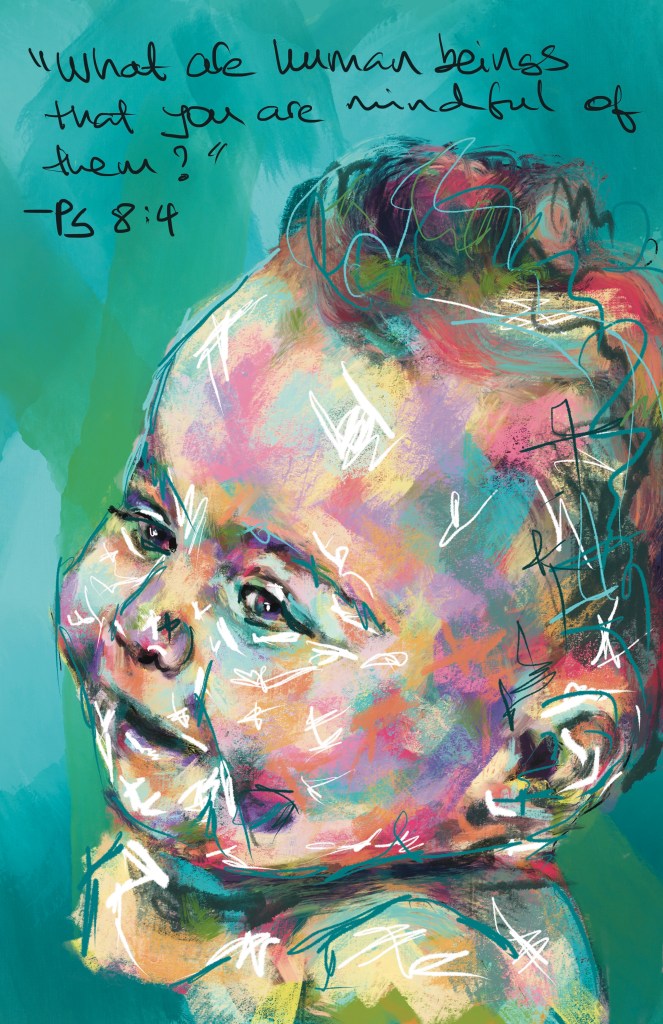
- In the readings for this week, I was really moved by the phrase I quote in my drawing: “What are humans that God should be mindful of us?”. Really, what/who are we? And if God thinks us worthy of creating us and being mindful of us, what does that say about our calling to become mindful of, and serve as deacons to, each other?


 Irina's Art
Leave a Reply