
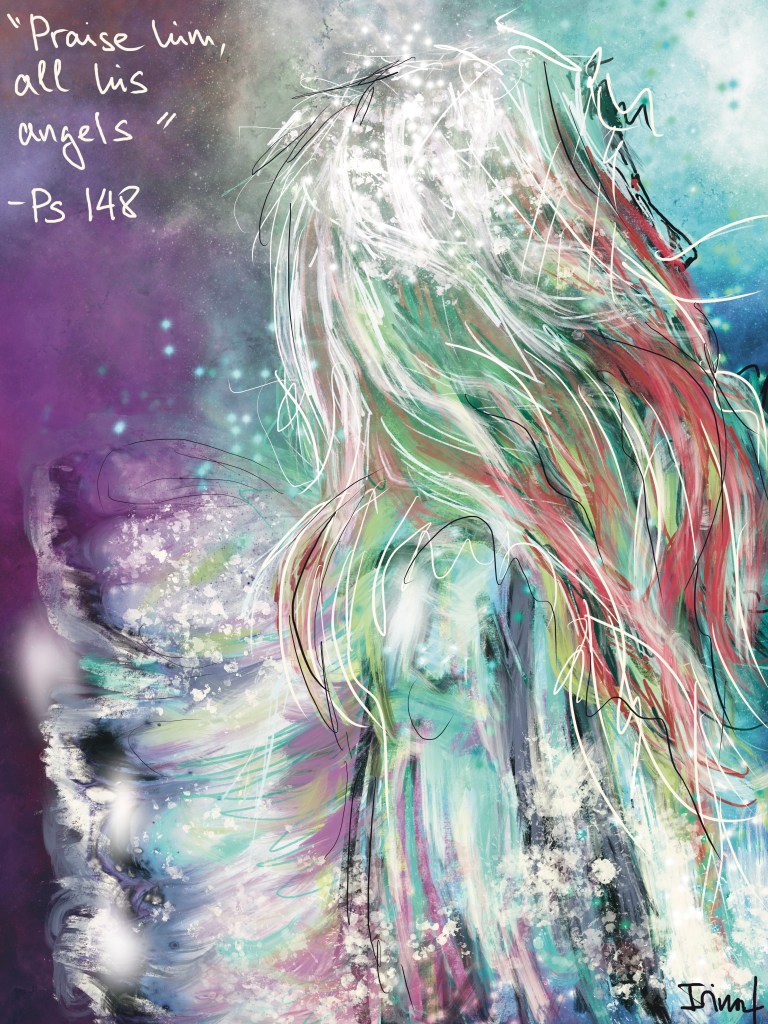
Today we celebrate St Michael and All Angels. With the figurines from our homes, we created a visual representation of this invisible order of creation. Our scriptures and traditions hint at who angels are, but leave most of it to our imaginations, which visual artists over centuries applied to reflect their diverse beliefs. So eventually, male warriors of the early days dropped their swords, acquired wings and musical instruments, became more feminine, and changed out of hunter-warrior tunics into robes and vestments, and got chubbier and younger. But, all of these images are, effectively, human. Indeed, according to the scriptures, humans and angels share many traits.
As beings who are created and limited in knowledge, power, and presence, yet find their “citizenship in heaven”, we and angels possess intellects and wills that we all apply towards worshiping God and resisting evil on earth, as allegorically, the angels once did in heaven. According to some theological schools, we will fight once more alongside each other in the final battle at the end of all time. Until all becomes forever well, however, the image of a dragon falling from heaven right onto our earth – not into some abstract, distant hell! – seems to capture the reality of the presence of evil in our world accurately.
For however we conceptualize evil metaphysically, we certainly feel its effects very tangibly. And our jobs related to resisting it are quite similar to the tasks angels perform in the stories about them. The scriptures are silent on what angels look like, but not on what they do. This, to me, is the most useful aspect of paying attention to who angels are, even for those of us whose belief systems place them into the category of fairies and unicorns.
First, like Gabriel, we are all “angeliafóros” (messengers) of important, life-changing Good News. Second, we are each other’s companions and guides, as the angels came to Daniel amidst the furnace flames, drove Elija up to heaven in the fiery chariot, etc. Third, we are helpers and ministers, like the angels who saved Lot and Hagar, got Peter out of prison, and ministered to Jesus in the desert. And fourth, as Jacob earned a blessing from an angel in an overnight wrestling match, our job is to struggle with the dynamics and patterns within our hearts and mind in order to understand our God-given purpose more fully.
Since these jobs are ours now and for all eternity, perhaps, we do have some invisible partners working with us even now, here on earth. May this feast of all angels remind us that the mystery and diversity of life might, in fact, exceed the limits of our knowledge and science: for example, some strangers we entertain could be angels, and some human acts of kindness could seem miraculous. Might there also be some interconnectedness, even inseparability, of heaven and earth? That’s what today’s OT passage illustrates using the image of the stairway to heaven, which Jesus quotes later on. But as the aptly titled song suggests, no amount of material wealth – or I would add, any other earthly achievements – could buy us the upward passage along the heavenly ladder, which the angels in Jacob’s dream seem to have trod so freely. How do we get up there then?
Perhaps, such a ladder doesn’t even exist anywhere outside ourselves. Perhaps instead, our very life and being is that conduit. Might the intersection of this world and the next one reside within our own hearts, minds, souls, bodies? (St Paul did write, “Christ lives in me”.) So there’s nowhere to climb, nothing to earn or buy, apart from what’s already been given to us. We might envision it as Jacob’s ladder, mustard seed, grain of yeast, valuable pearl, buried treasure, lush vineyard… consider finding an image that speaks to you, and your own ways to notice and sustain this heaven-earth connection within you. In this work, we are not alone, but partner with the rest of creation, visible and invisible, as worshippers and messengers, warriors and ministers, even as we wrestle with our sense of calling from time to time, and provide companionship and support each other “us up, “lest we dash our feet against the stone” (Ps. 91). Thanks be to God.
Questions
- Have your beliefs regarding angels changed over your lifetime? What’s your own default mental image/representation of angels? Where does it come from? Have you ever portrayed angels in art?
- Do you know the names of all the seven Princes of Heaven who are recognized by scripture and tradition? Consider looking up and reviewing the references to Michael and Gabriel in the canonical texts; as well as to Raphael, Uriel, Sealtiel, Jehudiel, and Barachiel in the apocrypha.
- Why is Michael called St Michael even though he is an angel and not a human? (Hint: in Latin, “sanctus” means “holy”. All heavenly dwellers are holy: the Cherubim and Seraphim, the Living Creatures and Heavenly Hosts, and all Saints).
- Consider also reviewing the biblical stories in which people were privileged to receive the special messages delivered by angels. Have you had similar mystical encounters and/or insights?
 Irina's Art
Leave a Reply