
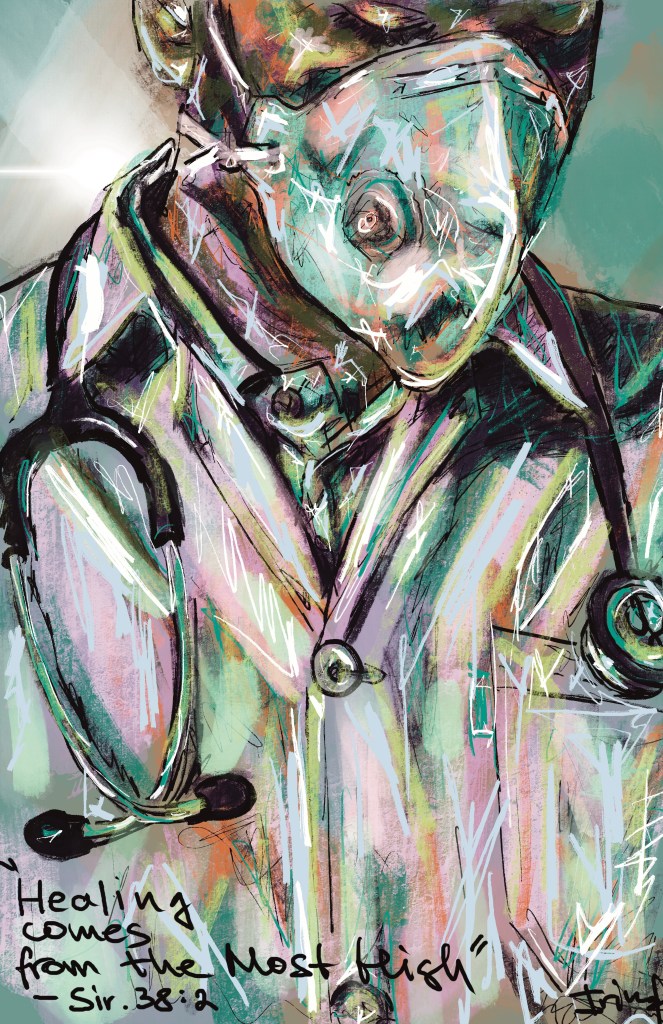
The feast of St Luke the Evangelist (aka “of Antioch”) is on Oct 18. In the Christian tradition, St Luke was a Hellenistic Jewish near contemporary of Jesus, who lived to the age of 84, worked as a physician, wrote Luke-Acts, accompanied Paul in prison when the latter awaited martyrdom in Rome – and, also painted the first icon resembling the famous Virgin of Vladimir. The historical-critical scholars, however, deny the possibility that Paul had such a specific friend who was a doctor, artist, and writer all in one. The physician reference is from Colossians, and the imprisonment one – from 2 Timothy, both of which are likely pseudepigraphical. The portion of Acts written from the first-person point of view is the 1st century source, but again, it is likely that this history of the “Way of Jesus” called Luke-Acts dates to the 2nd century.
But, St Luke is still my favourite saint because he combines all three of my personal aspirations! He seemed to have wielded, with equal competence, a scalpel and stethoscope, paintbrush and reed pen. Deep listening, excising what no longer serves, creating a harmony of colour and composition in our world, choosing words and actions with wisdom… How might we use these skills to tell the story of ultimate healing, available to all and resulting from the birth of God in us?
Now, with regards to the temporal, material, physical kind of healing, of course, it has limitations. I am struck by how matter of factly a certain Alexandrian called Joshua ben Sirach wrote c. 180 BC: “The Lord created medicines out of the earth, and the sensible will not despise them… give the physician his place… there may come a time when recovery lies in his hands.” Yet, the writer continually asserted that it is God who creates the physician and pharmacist, gives them their skills and tools, and inspires them to pray so that they can do their job. As such, they are not to be unduly glorified for their ability to heal, since all healing at their hands ultimately comes from the Most High; but, at the same time, we respect them and call on them to do their job, even as we pray to God while they do it. You’d think that it would be in the BC world that people attributed more of a miraculous origin to healing, but this exhortation to me sounds much more balanced than what I see today in our tendency to ascribe limitless powers to the medical profession, and to grieve and be angry when it fails.
But that’s physical healing. It might or might not happen; and when it does, it still only lasts for as long as the person lives. When I think of healing in a broader sense – emotional, spiritual, metaphysical – to me, the main “medicinal ingredient” is a relationship. From this perspective, above all, healing comes from Presence. For example, consider the difference between CBT and attachment therapy in approaching “problems” in relationships within our families. The behaviourists say, “when your kid does X, you do Y to reinforce, or ignore to extinguish”. Consequences rarely seem to work, however, because they do not address the cause of misbehaviour; and ignoring may lead to the belief that a person doesn’t matter to his loved ones. So the attachment theorists tell you, instead, neither to ignore or punish, and not to appear perturbed, but acknowledge the deeper need, and “simply” let them know, in words or actions, that you are there. Easier said than done, but I believe it works.
You heard the words from 2 Timothy: “only Luke is with me”. This passage really moves me with its notes of sadness, despite the tone of acceptance. “I have fought the good fight, I have finished the race.” Yes; but all have left me, and I do need my cloak in the chill of the Roman prison (where, unlike in the modern facilities, everything needed to be supplied from the outside). “Only Luke is with me”. Maybe, this “Luke” couldn’t fetch the cloak, or parchments, or free “Paul”. But he was there. May we also do our best to be present with the lonely, as this friend was to the prisoner. Because what any need does first, is that it isolates us as the “have nots”, in contrast to “haves”. But miraculously, the genuine presence of another tells us that the cause of our suffering does not diminish our dignity and worth.
This character from Acts and 2 Timothy who healed with his presence and medical tools, according to our tradition, is also the writer whose words of inclusion and belonging continue to heal the world today. Of the four gospels, it is Luke that has the greatest number of healing miracles and forgiven sinners, writes of Nativity and Ascension, and has Jesus teach the Beatitudes to all gathered down “on the plains”, rather than to a few chosen ones up “on the mount”. So to Luke, healing is a simultaneous movement of a self towards heaven, and of Christ down into our hearts – God unfailing, healing presence with us, that inspires us to be genuinely present with each other. Healing is a process. Healing takes and lasts an eternity. “Healing is becoming”. Amen.
Discussion Questions
- In anticipation of the feast of All Saints, coming up in a few weeks, let’s begin to ponder the meaning of the word “saint”. Do the saints who lived in the past, such as St Luke, “need” our commemoration? What does the tradition of observing feast days accomplish for us?
- Do you have a favourite saint? A person from the Bible, perhaps, or Christian history, or maybe even a contemporary who is/was particularly instrumental and inspirational to you in your faith development?
- Looking at the poem “Healing Takes Time”, how do you understand “healing” in light of “becoming”? Does the pairing of the two cause you to think any differently about what it means to “be well” or “get better”? Healing, changing, becoming, gardening… which word stands out to you, today, as descriptive of your relationship with your own Self?

 Irina's Art
Leave a Reply