
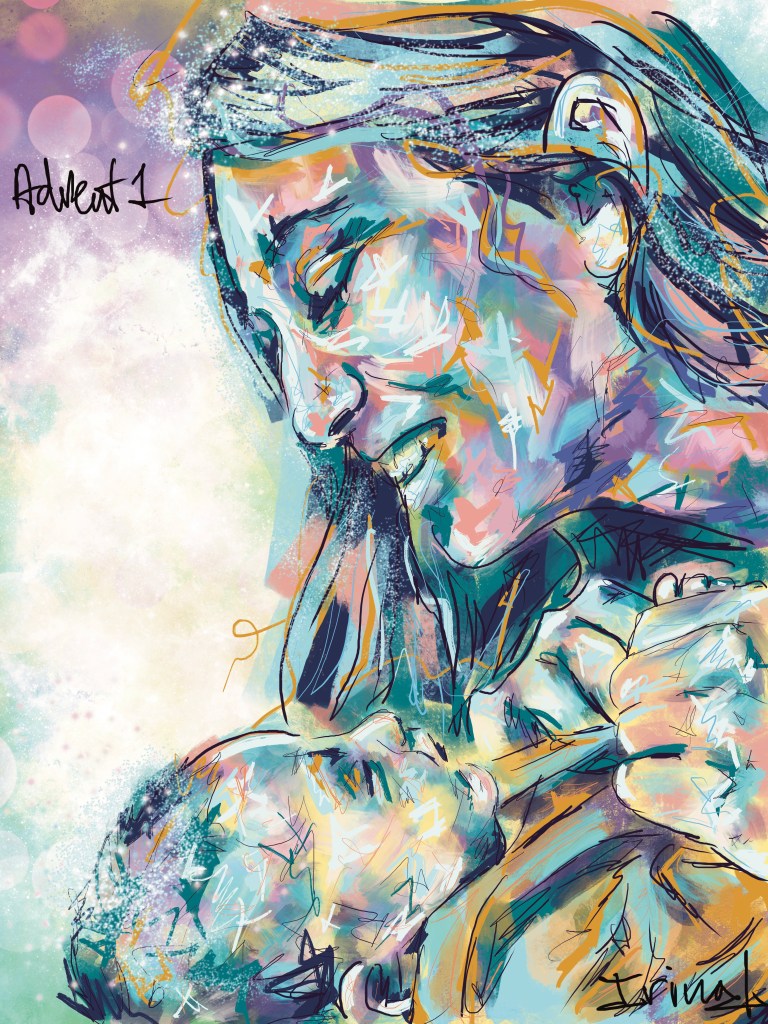
This drawing is Part I in the series called, “Embracing Grace: Honouring the Rich Tapestry of Motherhood during Advent, 2023”
We’re in the count-down time of the year! The jingles on the radio and in the stores extol the White Christmases, roasted chestnuts, presents, winter fun, and above all, happy families, which await us in the not too distant future. The church, however, tells us to wake up and find joy that’s already here and now, and less materially-based. Most years, I find the ideals of both church and culture hard to achieve. Inevitably, there is a situation on the news or in life, not to mention the seasonal demands of work and home, that seem to eclipse the glow of happy golden days, like the “darkening of the sun and moon” that Jesus references in today’s gospel.
Indeed, the first gospel of Advent always carries over the doom and gloom of our late November readings, and the brusqueness of John the Baptist that’s coming next offers no reprieve. The 1st century followers of apocalyptic Judaism – including Jesus, John, and Paul – didn’t strive to make this world better, nor did they expect that it ever would; instead, they hoped that another world was coming very soon to replace it. To this, they were counting down the days. As for ourselves, we very much hope for some improvement in the world of today, and as such, we, too, are pretty much always counting down to something; so much so, that we occasionally forget to notice what is here and now. But there’s always something coming “next” or “soon”! If not the presents under the tree, a break from homework and a few days off work, then retirement, promotion, higher level of gymnastics to compete in, or a newer phone model to buy…
Are we, by nature, the creatures of hope or discontent? Regardless, the seasons of the church make use of our affinity for counting-down. Advent used to be parallel to Lent, and still is in some traditions – the time of preparation for a high feast with a long fast. We might not be giving up meat and dairy, but we also recognize this time to be special. But while to some of us, refraining from singing the carols and putting up the lights may be very meaningful, my guess is that very few of us embrace the idea fully. End of year parties roll around, we are all shopping and baking, attending concerts, and etc. So personally, I am not dogmatic about what day the baby would be allowed in the crèche. However, I do attempt to arrive at Christmas spiritually refreshed, rather than physically exhausted and disillusioned with my inability to manufacture the glow of a “white” Christmas. To me, Advent, like life itself, it’s a transition – not a switch.
And there is more to any transition than simply waiting. That’s what often makes it hard: there’s work to do, and feelings to deal with. Over a decade or so of learning to stay sane as I get my kids through our school mornings, I’ve distilled my understanding of transitions to the “3 Ws in Waiting”: 1) waking, 2) willing, and 3) warming up. The first two are the challenges: waking is difficult (period) and the will to do what’s needed (make breakfast, locate items of uniforms, finish homework, etc.) or to face what’s coming (e.g., writing a test or confronting the mean girls) is also hard to find. The constructive part is the third W, the “warm up”. It helps to alleviate the tension of transition in two ways: warm up TO what’s coming by finding something good about it (e.g., “it’s Friday-yay”), and also warm up FOR it by rehearsing some aspects (e.g., review test material, or practice what to say in a given situation). To sum up, the key is to figure out what’s coming, be willing to do what’s needed or get help, find something that might make it seem worth the effort, and practice what you know will be hard.
So rather than putting on myself the pressure of creating a perfect holiday, I prefer to see Advent as the proverbial “5 more minutes” that my youngest is so fond of requesting every time I try to get her to switch activities or get out of bed. Indeed, “5 more minutes” are always needed, in any kind of transition, in order to wake up fully to what we might want or need to learn, gain, and change through whatever comes next. In a sense, what we are “expecting” has already happened: God is being born in our heart now, and every moment prior and next. To this end, our rituals, prayers, and charity, inherent to both Advent and Lent, give us the opportunity both to practice and find worth in the reality of living in this kind of “now and not yet”. May our hearts truly warm up “to” and “for” God’s transforming work. Traditions aren’t there for us to argue about, but rather to help us open our eyes and find the will and courage to keep making the world just a little “more right”. Let’s begin by “enriching and strengthening” each other, as God’s grace is doing so for us, and may the beauty of Advent be with us again this year. Amen.
Discussion Questions
- Do you find waiting difficult? What aspects of waiting are particularly hard – just the sheer boredom and not knowing how to fill the time, or dealing with the uncertainty, or perhaps dreading what’s coming if it’s unpleasant, or lacking patience when anticipating a pleasant event? What strategies help you to overcome these difficulties?
- What image of waiting do you find constructive? Waiting is rarely easy, but could it be seen as the opportunity for creativity to blossom, hard work to be accomplished, self-discovery to produce important insights, etc. Creating a painting is one such image for me. I use a lot of layering, so at times I have to step away and let it dry, or sometimes simply to move on to another activity of greater priority; so, I leave my work unfinished for long periods of time, and be ok with it being “not perfect (yet)”. That’s hard for me to do. On the other hand, waiting to come back each time gives me the chance to consider a wider variety of directions I could then take with it upon returning than if I’d pressed on or rushed it earlier.
- Speaking of paintings, Jesus’ reference to the Son of Man reminds me of the famous surrealist painting by the same title. In his self-portrait, Rene Magritte shows a man in a business suit, face obscured by a giant green apple, standing against the cloudy sky, one arm painted backwards. To me, it seems to say that Jesus — “the” Son of Man — is also continually born and working in each person’s mundane, anonymous, conformist, material and business-like existence. Our first temptation (hence the apple) is to hide or suppress his presence within ourselves, and the second is to turn our backs to the clouds on which he is said to arrive/depart. But why did the communist agnostic artist reference the Bible in naming his self-portrait? That’s another question!
 Irina's Art
Leave a Reply