
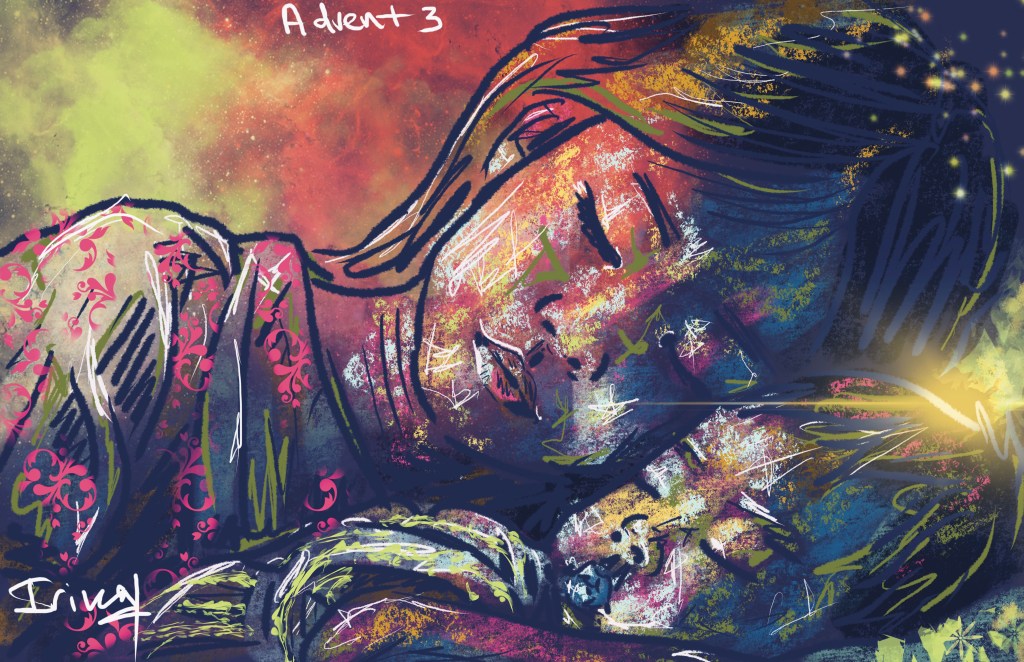
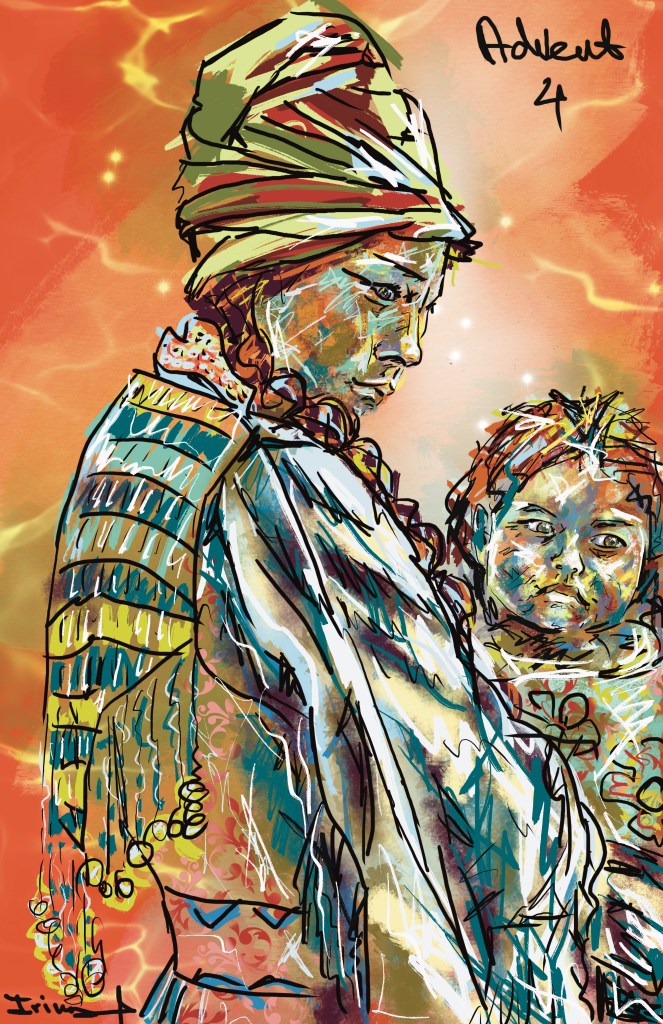

The last Sunday of Advent focuses on Mary’s “let it be” in response to the archangel. We have all said “let it be”, many times. Some of the forks on my road are likely different from yours, such as the decision to pursue my vocation, as expressed in the rite of ordination; but others I share with some of you. For example, a couple of days ago I celebrated my wedding anniversary. Both ceremonies involved literally saying “I do”. Then, three times, I pondered and said “yes, I do” to my commitment to caring for the new life entering this world. Most big decisions seem to involve changes to how we live with others, and each of our relationships is a sacrament of life with God – of a continual saying “I do” and “let it be”; adapting to commitments and learning from them, and sometimes having to say goodbye. I wonder if this is why our faith understands God’s self-revelation as conception and birth.
In any case, commitment does involve considerable pondering within our hearts. It’s not because we necessarily resist the change, but rather because we realize that life would never be quite the same afterwards. In Luke, we notice not one but two families confronted with the news that demanded an answer. Each of the characters processed this in their own ways, but considered the same question: “how can this be?”
The news found the families in diametrically opposite situations. First there was Elizabeth, an older woman born to a priestly line and married to a priest in the still functioning Jerusalem Temple. 70 years later it would be gone, but in Jesus’ time, each week, one of 8,000 priests was chosen randomly to burn incense inside its sanctuary. Given these odds, each would do this once or twice in a lifetime, so it was a special day and place for Zechariah when this happened: he heard the angel announce to him that despite their age, his wife would become pregnant for the first time. Several OT stories come to mind: previously barren women, suddenly able to conceive, each time ushering in a new turn in the history of Israel. So Elizabeth is said to have viewed this as a favor, though I wonder if in his response to the angel, Zechariah voiced a mutually held concern. Carrying a baby to term, nursing it through the sleepless nights, chasing a toddler, and dealing with a teen would be less than ideal in the last decades of one’s life! And the poignancy of never seeing the baby grow into adulthood on top of that. It was probably contemplating all this that left Zechariah literally speechless until the birth of his baby John (the Baptist!).
Six months later, Mary, a relative of Elizabeth, received similar news, which found her in exactly the opposite social context: there was nothing special about that day; she was possibly still child herself; much lower economic status; the bride price already paid, but marriage had not yet taken place. So she fled, temporarily, to Elizabeth’s door, some 70 miles from home. Both children were a miracle – unplanned, one might say. Though I believe that all our planning and “trying” only takes us so far, while the actual timing of conception and resulting combination of genes is still always up to God (barring IVF). As such, any baby is a miracle. And any parent has asked, upon finding out – in awe or despair – “how can this be?”
Eventually, we do move on from “how can this be” to “let it be”, in becoming parents, or in any other life-changing decision. But just saying “let it be” does not make it “be”: there’s a long, twisty, uneven, undulating road that leads from the realization to fulfillment. It lies through the pain of delivery, nights spent tending to a newborn or waiting up for a teen, toddler tantrums and teenage sulking, passing down tradition and scripture, faith and values. And finally, it involved saying “yes” to the hardest part: letting them stay behind at the temple, go off on a mission, to the cross and the sky. That’s why in Orthodox theology, Mary is called “the joy of all who sorrow”. What we learn from her is how our own sorrows enable our hearts to offer compassion to others. We are not all parents, but most of us know that the true meaning of loyalty is in holding on to the person – not to a specific way of life with the person. Only this way we may fully grow into our purpose, and let them do the same. Let’s try to remember that we are all active participants in the mystery of the Incarnation, and our “yes” may change the world, one day at a time. Amen.
For Further Reflection
- To what or to whom you are holding on right now – do you need to say yes to a new commitment, revisit your promises, or let go?
- From what did the birth of God in you — as manifested in new insights, truth, clarity, peace, light, love, etc. — “save” you this past year, and what are your hopes for 2024?
 Irina's Art
Leave a Reply