

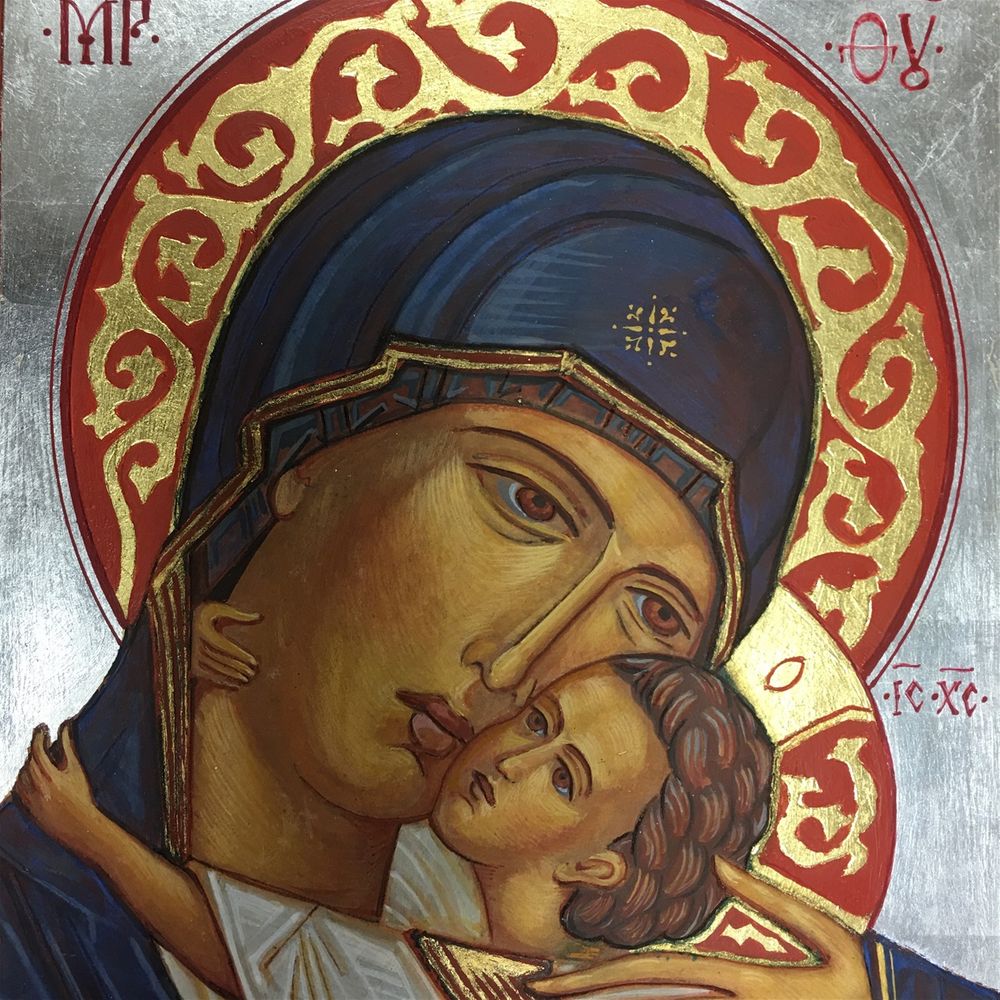
Every year, the mystery we call Incarnation eludes my words, but its visual counterpart, the image of the holy Mother and Child, draws me in. In art, it predates Christianity, and most world spiritualities honour the sacredness of birth. Our tradition keeps it at its very heart: in the new life in the manger at Christmas, and also in the movement out of the womb-like grave into the resurrection at Easter. Why is capturing our connection with the divine through the imagery of birth is so universal, while the majority of people – men, children, and many women – may not personally relate to giving birth?
Here are two images (above): one is contemporary, and another is made after an ancient pattern. Many more might now come to mind, including the memories of family and friends holding their babies. Does the image speak any differently to you this year? Does it tell of peace and harmony, or of poignancy and uncertainty? For some of us, it might highlight the gap between what is and what was, or was supposed to be: partners never found, children never conceived or lost, promises failed, lives cut short. There is room for all these thoughts and feelings in the story of God’s birth. There is room for joy and loss, and for people of all walks of life. Room for those who never had a chance to birth or raise a baby.
For God is born in all our connections: with parents, partners, friends, communities, and workplaces. Paradoxically, God is even born through our attempts to connect with Him/Her: in prayer, meditation, art, music, nature. The birth of God is the birth of human purpose, which may come to us unbidden like the news that Mary received, and unstoppable as labor once it starts; but most of the time, we search for it persistently, reach out, approach – like the shepherds and wisemen who came to the baby.
But, there’s risk involved in finding purpose, giving love, committing to a cause. Births are risky. Until the past few decades, it was the most common way for a woman to die. After her delivery, Mary then risked both of their lives taking Jesus to Egypt – where thousands of babies had already died in the clash of Moses and Pharaoh – as today mothers all over the world flee homes to save their babies. The poem on the first page of our leaflet, called “The Risk of Birth”, uses the image of taking a risk in bringing a baby into our imperfect world, to point to us, still choosing love; despite its arrival at the wrong time, inconveniences, unhappy endings, and having to let go.
Love’s timing is rarely “right”: our scriptures are filled with miraculous births that came way too late in life to be fully enjoyed, Jesus’ conception came too early in Mary’s life, and giving birth away from home made it more trying. And even though this is the story of a birth, it implies a loss. Having tried to save him, Mary kept losing him: to the temple, itinerant years, cross, and heaven. That’s why I say, in any situation you find yourself tonight – there is room for you, too, in this sacred story. Our children will grow distant physically or emotionally to find their purpose; friends move away; loved ones die; jobs end or retirement comes; and none will be spared increased dependence on others that comes with illness and aging.
Purpose, vocation, relationship, and commitment are risky. Sharing the risks might be what makes it worthwhile. I like to imagine that Mary did not endure labor alone – that from the nearby inn, a few women quietly walked over to help her. Likewise, in our lives, God’s birth doesn’t happen in isolation, but in the community of people joined by the common purpose of each serving as a “midwife” to another. Jesus’ birth did happen in a very ordinary place, and we may not be that special as individuals. But all the usual, ordinary, daily things done together become extraordinary: praying, singing, learning, fixing our old building, cooking, knitting, accompanying suffering, coming together for funerals and weddings, raising kids as a village, giving refugees a second chance, welcoming a diverse group of language students, telling jokes… This is how God gets born! And year after year, we come here to celebrate this on Christmas Eve – not seeking a magical experience, but to offer the only gift we can to the Christ child. The gift of being here as a community.
So let’s keep pondering all our meaningful connections, tucking away in our hearts the memories of joy and poignancy. Consider painting, drawing, making photographs, sculptures and music, journaling and writing poetry – let’s take risks to create, to love, and to learn from our ancient texts, full of allegory and truth. May the birth of God in you tonight bring peace that surpasses all understanding. Amen.
Reflection Questions
In most Orthodox icons, Mary is shown to hold the baby tenderly, but rather awkwardly – with inexperienced and rather stiff hands – to show that while she doesn’t really know how to fully grasp her sacred gift, she is aware that it is not hers to keep. She had to say “let it be” countless times, at every stage of her journey as the Mother of God.
- How do you balance a sense of trusting in God’s timing and providence, and yet doing your best to handle your responsibilities
- What helps you notice the evidence of God’s love in our lives, and tell it apart from simply “good” or “pleasant” things — or might it be the point that nothing good in the world is “simple”, and everything gives us “the sign” of the Divine care and presence (cf. Christina Rossetti’s “Love Came Down on Christmas“)?
- Conversely, when you notice that somebody is not doing well, how do you decide when and whether to rescue them, or only support/accompany their learning and “let it be” according to their own agency? Do you recall any such situations, and do you think you’d made the right choice (how do you know)?
For Reflection with Children
Over the past week or so, my kids and I have been watching “The Santa Clauses” (a Disney series). The show does raise a few philosophical questions via its sequence of scenes that range from fully cringe-worthy to fairly endearing. In case you wish to have some reflection time with your kids over the holidays, I share two thoughts that it prompted for me:
1. Why would making Christmas available every day take away its magic? In other words, why do we tend to view things as “less special” if we have them readily available? And what simple truths and moments of joy are we missing simply because they are “ordinary” and ubiquitous?
2. Mrs Claus said at one point something like “everything here [on the North Pole] has been ever so slightly off — which made it so exquisite!”. Can you think of some moments when imperfection brought you more joy than a smooth and professional experience or presentation would have created (hint: how about our children’s pageant, or any church activity involving the kids)? How open are you to trying something new, knowing that you don’t have the set of skills to be “good” at it right away? How might we model this openness to our children, or might we, in fact, learn it from them?
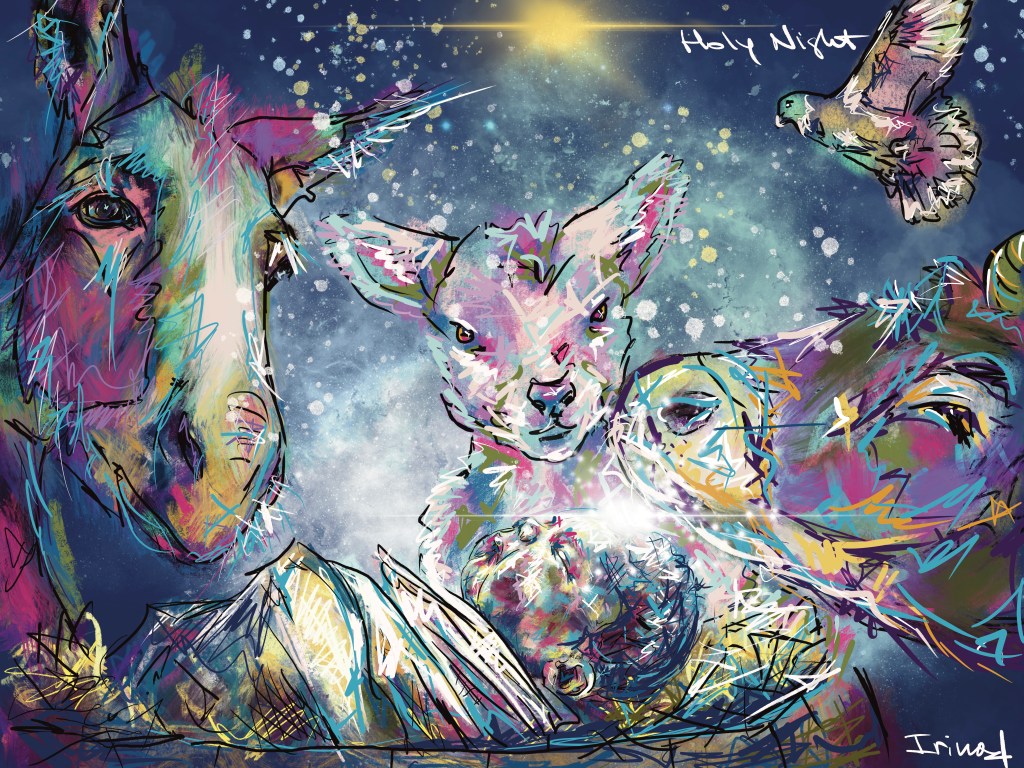
 Irina's Art
Leave a Reply