
Every Christmas morning at 8 am, my son says, “I am sad that Christmas is over”, and I reply, “Oh, but it lasts 12 days!” It is, indeed, tough to go from the month of growing excitement to the “Now what?” of the day itself. So, traditions developed to separate out what was originally one feast into Christmas, Epiphany, and Baptism of Jesus, and add Jesus’ Temple dedication at the age of 40 days to create a mirror of Lent that spans the time from Christmas to Candlemas.
At present, we are just past the “12th Night”, which is Jan 5 or Jan 6, dependng on who is counting. In the West, the Magi arrived, and for the Orthodox who share our Gregorian calendar — Jesus was baptized. The Greeks pour wine into the sea (as pagans placated its waves long before Christianity), and Latin Americans give out candy and look for baby figurines baked into cakes. Some of the Orthodox wait till Jan 19 to mark the Baptism of Jesus, since today is the Julian Christmas; so it will be in a couple of weeks that the Russians will go polar-dipping. As for us Anglicans, we try to do it all! Usually, we anticipate Epiphany on the 2nd Sunday after Christmas, and observe the Baptism of Jesus the following week. But this time with Christmas Eve falling on Sunday, we lost a week of both Advent and Christmastide, and the 2nd Sunday after Christmas is already after Epiphany.
So, for today, I mixed the readings and prayers of the two feasts, and will bless the waters as well as chalk the door. This feels like going back to the ancient way of celebrating everything at once, which makes perfect sense. The three narratives, plus the Presentation at the Temple, all illustrate the same concept: God’s ongoing self-revelation. Call it epi-phanea (“manifestation from above”) or theo-phanea (“manifestation of God”, the name for Jesus’ baptism); portray it as the shepherds seeing the baby in a manger, wisemen noticing the star, elderly priest holding an infant, or dove and voice soaring above the waters – all these represent the glimpses of God’s eternal nature within the limits of the material world and human understanding.
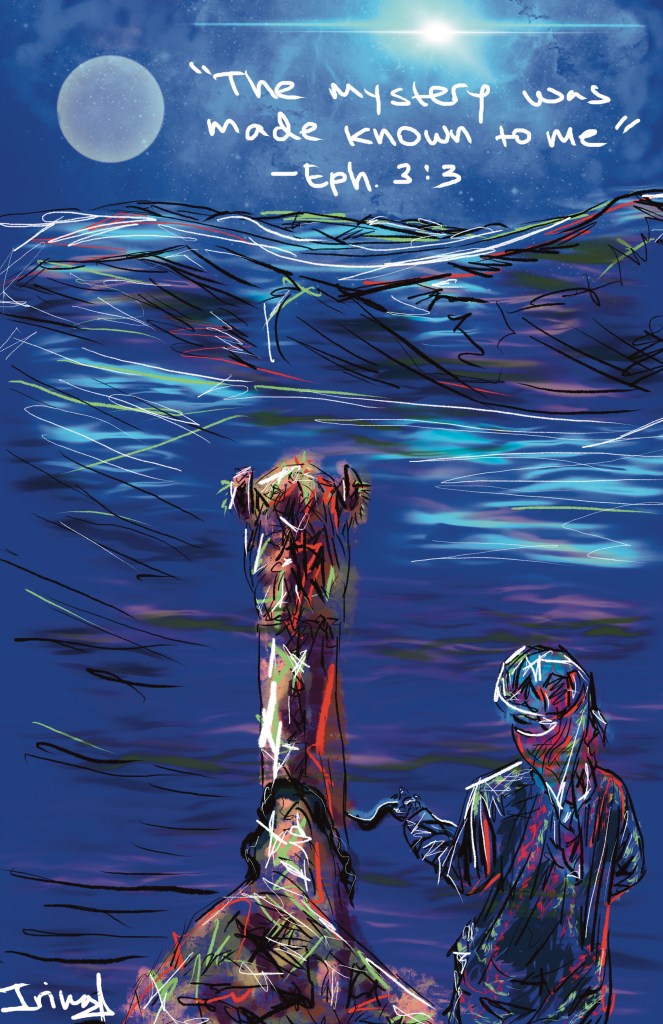
As for the 12th night, if it wasn’t for Shakespeare, it would be unknown in North America apart from the areas of French influence. But in Latin America, Spain, and Italy, this is the Big Day, when either a hag called Befana (from Italian “epifania”) brings all the gifts, or Caspar, Melchior, and Baltazar get to deliver them. Maybe, they were kings, nomadic chieftains, or Zoroastrian astrologers. Maybe, it was the beautiful confluence of Saturn and Jupiter that guided them then, as we saw it a few years ago. Possibly, the author of Matthew wished to present Jesus as the ultimate Moses, and introduced the massacre of the Egyptian children as an echo of the one provoked by the stubbornness of the Pharaoh. But to me, the essence of Epiphany is in both the gifts — pointing to Jesus’ burial! — and the journey.
How would the Magi describe their trip? TS Eliot imagined a very colourful retelling, though his 1927 poem is less of a biblical exegesis and more of a reflection of this young man’s search for normalcy, belonging, and identity in the post-war England of the “roaring 20s,” that we still share in the 20s of our own century. This quest characterizes both the coming of age and aging in general. The journey is inward rather than Westward, and the sacred child to be found at the destination is a renewed sense of self, reborn within one’s heart. TS Eliot calls it the first death – a deep paradigm shift wrought with discomfort, regret for the olden days and loss of the known. At first glance, the result is “you might say, satisfactory”: ordinary jobs, families, hobbies. Christmas can’t last beyond 12 days, and Blue Monday comes soon enough. Yet, I suspect, we wouldn’t really want Christmas if it lasted forever, and the hope of Epiphany is that it happens amidst the daily grind. It’s always “the worst time of the year for the journey”, as the poem puts it.
Our gold, frankincense, and myrrh are the subtle glimpses of the divine that arrive at ordinary moments, when and where they are least expected, just like the biblical images woven into Eliot’s poem: the water streams, three trees, white horse, vines, dicing for silver, wineskins that are “just” part of the landscape, yet have sacramental significance. God’s self-revelation is easily missed as a mere whisper, or movement in the shadows.
My kids ask me, “Is it God’s voice I hear in my head, or only my imagination?” Likely, it’s both; but what’s important is that many of us do yearn to hear it, and the beauty of belonging to a faith community is that here we talk freely about having such longings. Over the past year, I have noticed a growing sense of trust in pastoral care and education, and heard significant memories that had apparently never been shared for fear of being dismissed, laughed at, or considered a little crazy. The openness to vulnerability in sharing our epiphanies – as that’s what those insights and memories really are – is truly an amazing gift. Thanks be to God!
Questions for Reflection
- Consider a few of your favourite books, movies, traditional fairy-tales, Old Testament narratives, or the “Journey of the Magi” by TS Eliot. In each plot, can you notice the moment of epiphany that serves as the “point of no return”, when the protagonist’s self-understanding changes to the extent that s/he cannot go back to the immature/previous view of the world, people, relationships, past, etc? I think that’s also what TS Eliot alludes to in the last stanza as the birth and death that the Magi saw. What literary devices are employed to highlight such paradigm shifts, and what do those moments have in common?
- Could you now recall such moments of “no-return” in your own life? What impact did they have on you? Do you recall them with gratitude or do you wish you could go back to your old sense of self?
- My children have asked me on numerous occasions whether “it’s God who speaks in my head, or my own imagination?” What do you think? Maybe, epiphanies occur when God speaks through our imagination, or enables our creativity?
 Irina's Art
Leave a Reply