
Historically, Lent began as the final stage in the spiritual formation of new believers in Christ who, after spending up to three years in preparation, would be baptized on the night before Easter. It probably did not take very long for the rest of the Church to realize that every believer, new and old, could benefit from setting aside some time for spiritual examination and an intentional “fresh start”; however, the rites and observances, and their theological underpinnings, reflect denominational differences.
For example, in the Orthodox world, there is no Ash Wednesday, Lent begins on Monday, and is more strictly observed even by comparatively “casual” believers. But, the so-called Cheesefare Week provides many more opportunities to indulge in pancakes. My favourite food to this day is still my grandma’s wonderful blini, which as a kid, I really did get to eat every day for a whole week. She did this for me, even though it must have been tedious. Cheesefare Week to her wasn’t a religious tradition, but rather just one way of so many to express her love for me – out of the true stance of self-giving that I have seen her embrace all throughout her life.
My family is quite secular and decidedly carnivorous, so we never fasted after feasting on all those pancakes. But we did mark Easter; again, primarily with my grandmother’s kulichi and dyed eggs. However, there was one other tradition that we always observed at the end of the pancake extravaganza, and this one has truly stayed with me ever since I was a kid, and in my opinion, completely compensates for the lack of religious education in my childhood. It went like this. On the Sunday before Lent, preferably as soon as we woke up if we remembered, we always asked each for forgiveness – particularly, for anything we might have done unknowingly. And most importantly, when someone said, “forgive me”, another would always respond, “God forgives”.
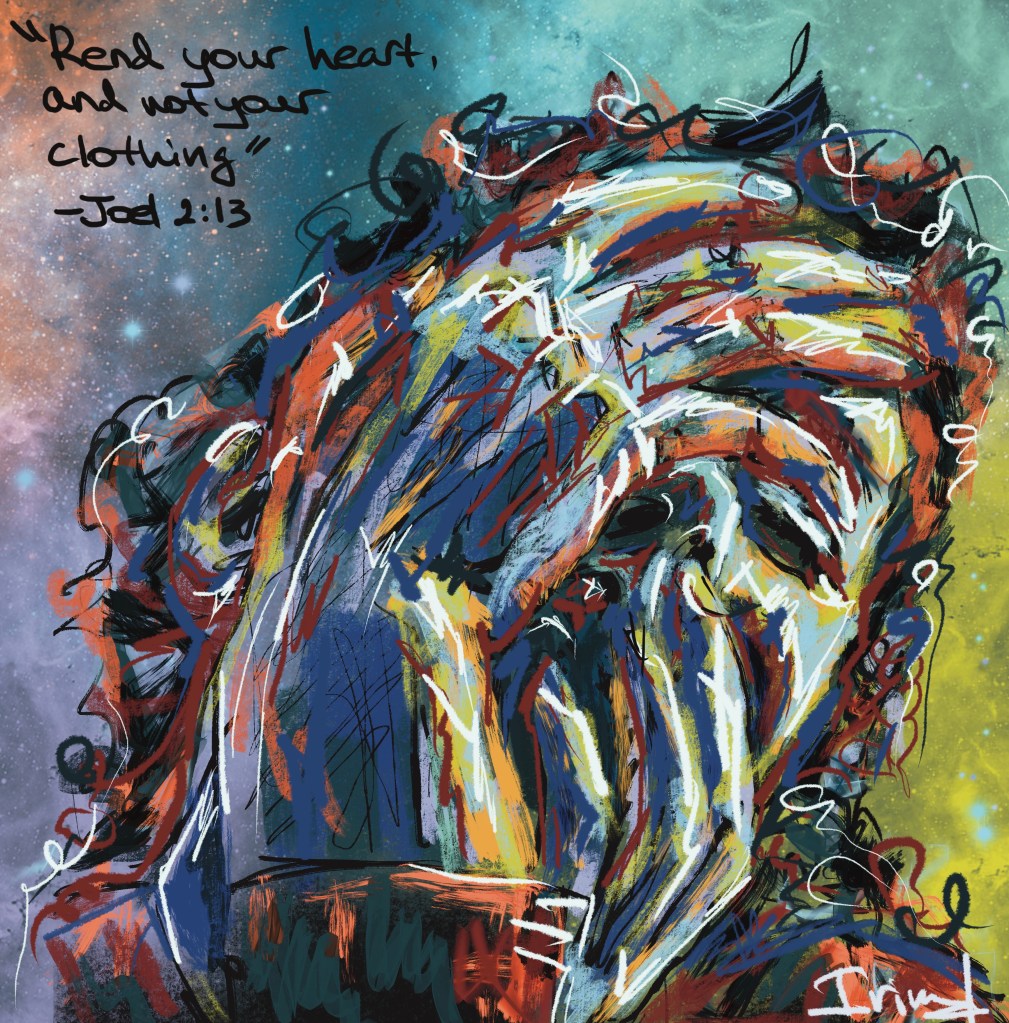
I still like this tradition very much. I believe that we all offend each other much more often than we ever know. Life together and each person’s wellbeing are both fragile and resilient. There is a lot of potential to do wrong, being human as we are, but there is also so much beauty to be gained when we try to “refresh” relationships in such a way that doesn’t put the blame on only one side and to counteract any unknown resentments that may have been accumulating. It’s like my fish tank that requires partial water changes every so often, even when the dirt isn’t obvious. However, might it be that the rituals associated with Lent – prayer, fasting, almsgiving – are a way for us to make amends with ourselves, rather than with God? I think it is in that sense that we are to rend our hearts, not only superficially, our garments.
The response “God forgives” helps to counteract the tendency to appease ourselves above God or others. While the desire for atonement is universal, the awareness of potential disregard for our Creator and the need for that “water change” in our relationship with God, is not. And that’s what the rituals associated with the start of Lent aim to accomplish. The ashes on our foreheads remind us of both humanity and mortality; they symbolize the matter out of which our bodies were made, and how quickly our praises (i.e. palm branches) turn to nothing (i.e. burn) when we forget that life is a gift. That even a clean heart and renewed spirit, for which David asked in Ps 51, are a gift.
We might think, “Well, I’m not King David. He really did have every reason to repent and write this psalm”. But perhaps, he did not. In David’s culture a king had such absolute power over his subjects that he might have felt he was only taking what was rightfully his from Bathsheba and numerous other women who became his wives and concubines. And so the prophet Nathan did not attempt to challenge David on the basis of their pain, or the loss of Uriah’s life; if he did, these words may have fallen on deaf ears. But how Nathan did manage to make an impact on David is by saying that when David devalued human life, he “despised God” by disregarding his/her Image that lived within each human he hurt.
I think there is much healing to be gained whenever we say, together with David, “against God I have sinned” because it acknowledges: 1) our unknown mistakes, 2) the unknown extent of our known mistakes, and 3) the unknown extent of what we thought was not a mistake but was harmful nonetheless. On this Valentine’s Day, may we reflect on the gifts of life and love, the inherent potential for renewal that lives within each of us, and the power of forgiveness that makes it blossom.
 Irina's Art
Leave a Reply