
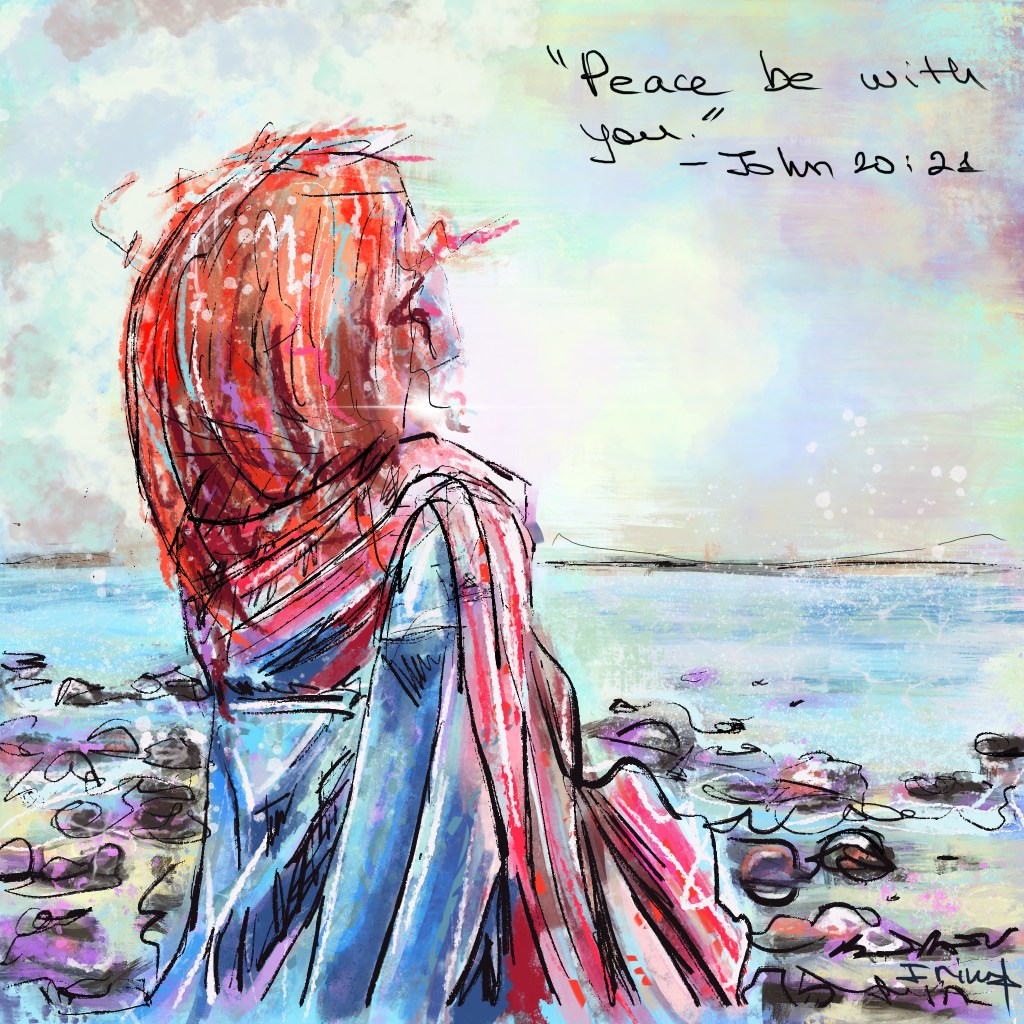
In the early 1940s, in Amsterdam, a child spent the last two years of her life behind locked doors, barred by a bookcase. In the diary she kept through this time, one entry reads, “I see the world gradually being turned into a wilderness, I hear the ever approaching thunder, which will destroy us too, I can feel the sufferings of millions and yet, if I look up into the heavens, I think that it will all come right, that this cruelty too will end, and that peace and tranquillity will return again.” Anne Frank died before peace returned to Europe, but her diary testifies to the possibility of hope in times of terrible fear and great pain. Indeed, if “peace” means the absence of war and conflict, then it’s true that Anne never saw it again; and in our own world and personal lives, at times, we feel its absence acutely, long for it as she did, and question why Jesus is called the Prince of Peace. But if peace refers, first, to inner wholeness and connection – the Greek eirene, from which comes the adjective irenic, and the name, of course! – then we might begin to understand how his words, “peace be with you”, are for us as well.
Today, we read about a group of people huddled behind the locked doors like Anne’s family was, except that here they were hiding in “fear of the Jews”, as the Jews of future centuries would fear their non-Jewish persecutors. Unfortunately, it’s the tone of the gospel of John that may have provided some fuel for the antisemitism of subsequent history. This text is believed to be written for the community of believers in Christ that was expelled from their synagogue, when it became apparent that they’d begun to see a lot more in Jesus than simply a good rabbi executed on charges of insurrection. I think that the gospel author projects and continually emphasises the fears of authorities, and the grief over the split and misunderstanding felt by the members of his fledgling community.
As for the disciples in this story, I imagine they had much to fear apart from “the Jews”, for seeing a ghost would frighten anyone; but then, to recognize him as the one whom they betrayed and wonder what he’d do to them now would be even worse! At the same time, the sight of his wounds would bring out the worst fear of all – of themselves, of what they’d done and who they had become in their denial of him. Yet, Jesus instantly dispelled all this with the seemingly ordinary, simple, familiar words of a salutation, common in his culture for centuries before he used it: “shalom aleichem” (in Arabic, “as-salam alaykum”). An expression of good wish, prayer, hope, and affirmation of no ill intent – but certainly no magic incantation. Yet, once Jesus said it, it cut to the core of all emotional turmoil and self-doubt of his friends. (I imagine they were doubting themselves much more stringly than they ever doubted who he was!) So I think that the story of Thomas we read every Sunday following Easter provides the new antonym for doubt – not certitude, but peace. Not peace in the sense that “all is well”, however; only that of acceptance that we don’t know whether “all shall be well”, and until then, try to live each moment fully.
To me, the moment of Jesus’ appearance that quelled all fears, imparted the Holy Spirit, and encouraged reconciliation represents the glimpses and glimmers of that supernatural peace that we have all known, but cannot hold on to forever. St Ignatius, a mediaeval Spanish mystic and founder of the Jesuits, called it “consolation” – that sense of wellness, rightness, clarity, and above all, the presence of God, available even in situations when the very real reasons for our fears won’t go away. Thomas put it into words by saying, “My Lord, my God”, and expressing what all the disciples probably felt then, and we do sometimes. Can you recall such a moment? How did it happen?
Did your moment of consolation simply surprise you, as it may happen at times, or can you connect it with some words, a familiar voice or presence, embrace or kindness, which worked as “a channel/instrument of God’s peace” for you then? St Francis prayed to become one, and his 19th century Russian equivalent, St Seraphim, invited all to, “acquire the Spirit of Peace, and a thousand souls around you will be saved.” So I feel that Jesus’ words both impart and demand peace of us at the same time, which is why he goes on to speak about forgiveness (Jn 20:23), echoing the Beatitude, “blessed be the peacemakers” (Mt 5:9) and the requirement for reconciliation before worship (Mt 5:23-24), with which his Sermon of the Mount continues. Indeed, reconciliation is the basis of peace, whether it is between people, each person’s past and present, or us and God. Our liturgy provides space to attempt whichever one is needed in the sequence we go through each week: intercessions, confession, and exchange of peace, all of which lead us from Word to Communion. This sequence signifies that we affirm the belief of God’s acceptance of us by accepting each other. Without affirming each other’s belonging in this community, to gather around the altar and share bread and wine would be not only superficial, but also somewhat selfish.
Today, as we stand up and wave hello to each other as we do every week, may this be a greeting, yes – but also more. Jesus’ own words were both a form of a greeting typical in his world, yet affected forgiveness, assuaged fear, and brought inner peace. May our own ordinary words, actions, smiles, coffee, all the “small” things of this world be the instruments of God, for that’s what a “sacrament” means in a sense broader than communion or absolution. As we say “peace be with you”, let’s look around to notice who people around us are, truly “seeing” them, learning their names, asking how they actually feel today – do they look like they need a measure of consolation? If so, let’s try to channel God’s peace through our words and actions. Above all, let us each acknowledge our “Lord and God” as the one true source of peace that surpasses all understanding, transcends the mere absence of conflict, and unlocks all doors barred by fear. Thanks be to God.
Reflection Questions
1. Why is “Peace be with you” a customary greeting in many cultures? And what do the words said at departure have in common: ma’assalama, adios, adieu, farewell, good bye?
2. Is there a particular person in your life who seems to exude peace, and in whose presence you feel instantly “settled”? Or might you have a childhood memory of being comforted and made at ease by a hug, certain foods, a bedtime story or lullaby? How might you tap into the power of such memories, and/or emulate the disposition of these special people, so that you may create peace within yourself and for others?
 Irina's Art
Leave a Reply