
1700 years ago, Constantine the Great decreed that, “on the venerable day of the sun” city dwellers would rest, but farmers were free to work, “lest by neglecting the proper moment for such operations the bounty of heaven should be lost”. As the Jews rested on Sabbath and God rested on the 7th day of creation, in the ex-Jewish Christian mind, Saturday stood for the last day of the original creation that humans messed up, and the following day was therefore the 1st day of creation now made “new” by Jesus’ resurrection. As such, since the 2nd century, Christians chose “Sun days” for worship, some languages even use the same word for Sunday and resurrection, and Constantin realigned the day of civic rest with that of Christian worship, which he had legalized about a decade earlier. But for the Jews, Sabbath was not really about rest – it was mainly about freedom.
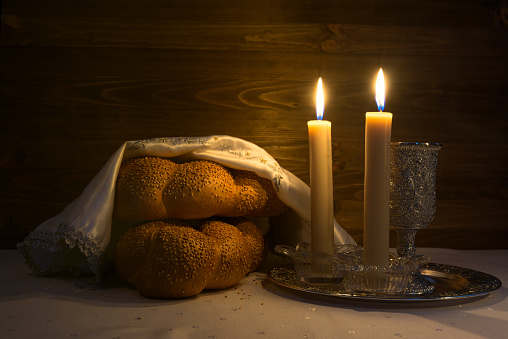
Freedom? To us, the observance of Sabbath may seem like the most arbitrary and legalistic custom of all, especially since Jesus so often pushed back on it. But when Moses taught his people to both “remember” and “observe” the Sabbath in Deut 5:12-15 – hence the two Sabbath candles on the dinner table! – it was because “you were a slave in Egypt” and “God brought you out.” Not because God rested. The people to whom Moses spoke were those who escaped from Egypt or whose parents did. The goodness of God as the Creator paled in comparison to the personal experience of deliverance. And over the 3000 years that followed, by observing the Sabbath and Passover weekly and annually, each devout Jew also learned to regard themselves as though they personally came out of Egypt. This became their paradigm for communion with God.
In the ancient world, slavery was simply part of life. Despite their own suffering in Egypt, even the Jews continued to own slaves. But, for one day of the week, the Sabbath made everyone free to rest, and thus equal – or equal in rest, and thus free. While Constantine’s law was much less rigid and maybe mirrored Jesus’ approach of “you’ve got to do what you got to do”, it was actually unjust. Later on, Christian societies prohibited business and farming, and even many leisure activities on Sundays in much more “Pharisaic” ways; but, the Jewish connotation of equality and freedom with rest was never regained. Today, slavery is still a fact of life, even if for us, the privileged ones, it is only metaphorically so. Could gathering here, and devoting the rest of the day to a simpler lifestyle, help us regain some types of freedom, even if only for a while? Rest from making a living, or freedom from the desire to make money; rest from being busy, or freedom from needing to feel important and be entertained?
In Mark, Jesus told the story about David and his soldiers, who were once allowed to eat the forbidden bread – the 12 loaves set out on the altar in a shrine from Sabbath to Sabbath, only for the priests to eat. Seems legalistic, but how else can the sacred be marked if not by rules and regulations around it that would set it apart? To give it to men was a huge exception – but, they did really need food, like when Jesus gleaned grain. Likewise, how else could Sabbath be kept holy if it wasn’t by excommunicating those who dared to work on it? 1000 years later, Jesus and his 12 friends sat down to a meal that memorialized the freedom gained in Exodus. There, Jesus asked the disciples to continue sharing the bread and wine, now to remember him – his life, teachings, compassion, and death; his special kind of inner freedom that enabled him to act at the intersection of God’s will and his. This was first recorded by Paul 1 Corinthians 11:24–25 and then in the synoptic gospels, in which the meal took place on Passover – the Sabbath of all sabbaths. John’s placement of the meal on the eve of, and Jesus’ death itself on the Passover day has is what created the two-fold meaning of the Eucharist that we now recognize: memorial and sacrificial. We commemorate its institution on Maundy Thursday, but some denominations also observe a dedicated feast called Corpus Christi (“body of Christ”) on the Thursday after Trinity Sunday (i.e. 60 days after Easter, just passed a few days ago).
Indeed, praying over and consuming the bread and wine is the most universal Christian rite, which every tradition practices except for the Quakers and Salvation Army, who still acknowledge it as legitimate for others, albeit not necessary for them. Yet, it is also most theologically divisive. Eucharistos simply means “thanksgiving”, but the range of names by which we refer to it – Holy Communion, Mass, Last Supper, Remembrance, Breaking of Bread – suggests many differences in its emphases and significance across traditions. Is it remembrance or sacrifice or both, do we offer the sacrifice or does Christ, did he offer it once or do we sort of re-do it weekly or he does through us continually, who or what stands for Christ in this rite, who or what is being offered, is Jesus really present – for how long and as of when, summoned by our prayer or via the Spirit, how and when does the bread and wine become transformed (on the altar or in our bodies?), who gets to pray over it and who may receive, leavened or unleavened, wine or grape juice, how often, where and how…
I honestly believe that of all denominations, the Anglicans have worked the hardest and created the most nuanced understanding of the service we call Holy Communion, and of the prayers that we call Eucharistic. Today, we use quite a few eucharistic prayers, all of which are equally permissible, but some are older and some are newer, and each reflects its own theological position that came from different historical periods. Each is also very carefully worded to stop short of explaining anything too specifically regarding when and how and to what extent is Jesus “present” in our bread (mostly unleavened) and wine (certainly alcoholic, but could be white or red). We will ponder these nuances next week; for today, let’s begin by simply listening deeper to the Eucharsitic prayer I will use today. What structure do you notice? Which parts clearly set it up as the act of remembrance, and which are meant to effect some kind of transformation?
As we go on, may we learn to hold in tension respect for our traditions, and the realization that they are but “clay jars” containing “the treasure” – that is, the sense of God’s active presence in our souls and bodies – in tangible, albeit clumsy and limited ways. Despite the many schisms and wars that happened over precisely what jars should be used, they are only a means to an end, as the “extraordinary power belongs to God, and does not come from us” (2 Cor 4:7). Amen.
For Reflection
- To you, is God primarily the Creator or sustainer, helper, and “fixer of messes”?
- From what attachments do you need to be set free, and how does religion or worship help?
- Do you consider religion as a whole binding or freeing? How is the notion of what’s holy and what’s profane/secular supported by rules and obligations?

 Irina's Art
Leave a Reply