
We are reading portions of Ephesians on July and August Sundays this year, and we have already read through this entire epistle at our Morning Prayer services on Zoom over the spring. The letter doesn’t address any specific church or situation, and its main theme is the unity of all believers. To develop this theme, it uses fairly poetic language that many of us may readily recall. For example, last week’s reading contained a beautiful prayer, which I think is worth memorizing and saying continually on each other’s behalf: “I pray that you, being rooted and established in love, may have power, together with all the Lord’s holy people, to grasp how wide, and long, and high, and deep is the love of Christ” (3:17-18). A few other verses have found a stable liturgical role, such as the one we read last Sunday, “Glory belongs to God, whose power is at work in us. By this power he can do infinitely more than we can ask or imagine” (3:20), which concludes most Eucharistic services, and the one we heard today, which opens baptismal and confirmation services: “there is one body and one Spirit… one Lord, one faith, one baptism; one God and Father of all” (4:4-6). The opening portion of the book (1:3-7) has been set to music as a canticle called “God’s Plan of Salvation” (we’ve recently studied it as part of our Eastertide adult education). Memorable images such as “the armour of God” (6:11-17) which we will encounter at the end of August, “the body of Christ” (1:23 and throughout) and “the temple in which you are built together” (2:21-22) also appear in this epistle. This epistle reminds us of wise hallmarks of virtuous life, such as “speaking the truth in love” (4:15, today), and “do not let the sun go down on your anger” (4:26), “do not grieve the Holy Spirit” (4:30), and “giving thanks to God the Father at all times and for everything” (5:20) that are coming up in August. Lastly, today we heard about the importance of finding our place within the church – maybe, as “apostles, prophets, evangelists, pastors and teachers” (4:11). Which of these phrases and images draw your attention today? Why?
As a whole, the author of Ephesians applies faith to living in this world, as opposed to securing a place in heaven (as, say, Paul does in Romans). It seems that this author is no longer concerned with the mechanics of salvation, and whether it extends to the pagans or Jews alone. Unlike Romans, 1 Thessalonians, and a few other works, 2 Thessalonians, Colossians, and Ephesians are considered to be Deutero-Pauline – that is, produced in the early 60s, just after Paul’s death, and continuing his line of thought with notable differences in style and theology. An example of a stylistic difference is that this book consists of only 6 chapters, yet it has 9 sentences surpassing 50 words each, which is equal to the total number of such sentences in all 7 Paul’s genuine letters. An example of a theological nuance is that Ephesians – probably following Colossians, since about ¼ to ½ of their texts overlap – no longer considers Christ as “the body of the church”, but “the head of the body” (a fine, but significant distinction). Based on such characteristics, very few critical historians support Paul’s authorship of Ephesians. Yet, what’s important is that clearly, Paul’s ideas, communicated initially to the few tiny, 1st century Eastern Mediterranean communities, were so important that those who took over his ministry after his death, felt called to apply his thoughts to their own situations.
For example, the author writing to the Colossians uses the metaphor of the “head and body” specifically to argue against the false teachings circulating in their town. Then, the author of Ephesians may have taken this extrapolation of Paul’s earlier metaphor, and instead of using it to counteract the problem hew saw in a particular congregation, made an illustration of a broader theological point – that is, the unity of all believers, which is the main theme of Ephesians. As such, to me, this epistle seems to be the most relevant of all to the life of a modern-day reader – precisely because it does not seem to have been written to any specific church, nor to address any particular trouble. Trustworthy ancient manuscripts do not even contain the words “in Ephesus” as part of the greeting “to the saints who are faithful in Christ Jesus,” nor does the text greet any people by name, as Paul often did. Thus, it was meant for all Christians, of all times and situations, and it’s freeing to be able to read it without wondering whether or not the text deals with something that is no longer applicable to us (e.g., the prohibition for women to speak, which could have been just because a few women in that particular community were getting disruptive).
This text is for God’s followers of all times, and all places. Its central message is finding our unity as the recipients of God’s blessing, and working together with God to find our own ways to bless the world around us. The opening lines of the book use the word “blessed” 3 times: “Blessed be the God and Father of our Lord Jesus Christ, who has blessed us in Christ with all the spiritual blessings of heaven.” (1:3) Evidently, “to bless” may be used in a few different ways: 1) referring to sacred people or objects, as “to hold in reverence, venerate” (e.g., communion bread, beatified saints), 2) referring to God, as “to honor in worship, praise” (e.g. “bless the Lord, o my soul”, Ps 103:1), and 3) referring to ordinary people and places, as “to create in them happiness, pleasure, contentment, good fortune, protection, and favor”. In the Beatitudes, each line begins with the Greek makarioi = “fully satisfied”, indicating the result; other languages, however, emphasize the process, linking blessing to speaking, such as “bene-dicere = “good-speaking” in Latin, “blago-slovenie” = “good-wording” in Russian. Recall that God, too, creates by speaking, as the very first act of blessing the world. May we, as his co-workers, continue to create “everything good” – a renewed reality all around us, insofar as it is possible to do given each of our limitations, both with our words and actions. It is to this end that the author of Ephesians called each of us to find the best match for our gifts with regards to our roles in the church; perhaps, it is to teach, or talk about the future, or encourage each other — what is your calling? Whatever it is, let’s keep in mind that the author used the civic term “citizen” as opposed to “worshiper” to indicate that the ministry of all God’s people extends well beyond the walls of any “temple”, so our call to action may be to reflect on and find ways to exercise these roles also in our families, workplaces, and the wider world. Thanks be to God.


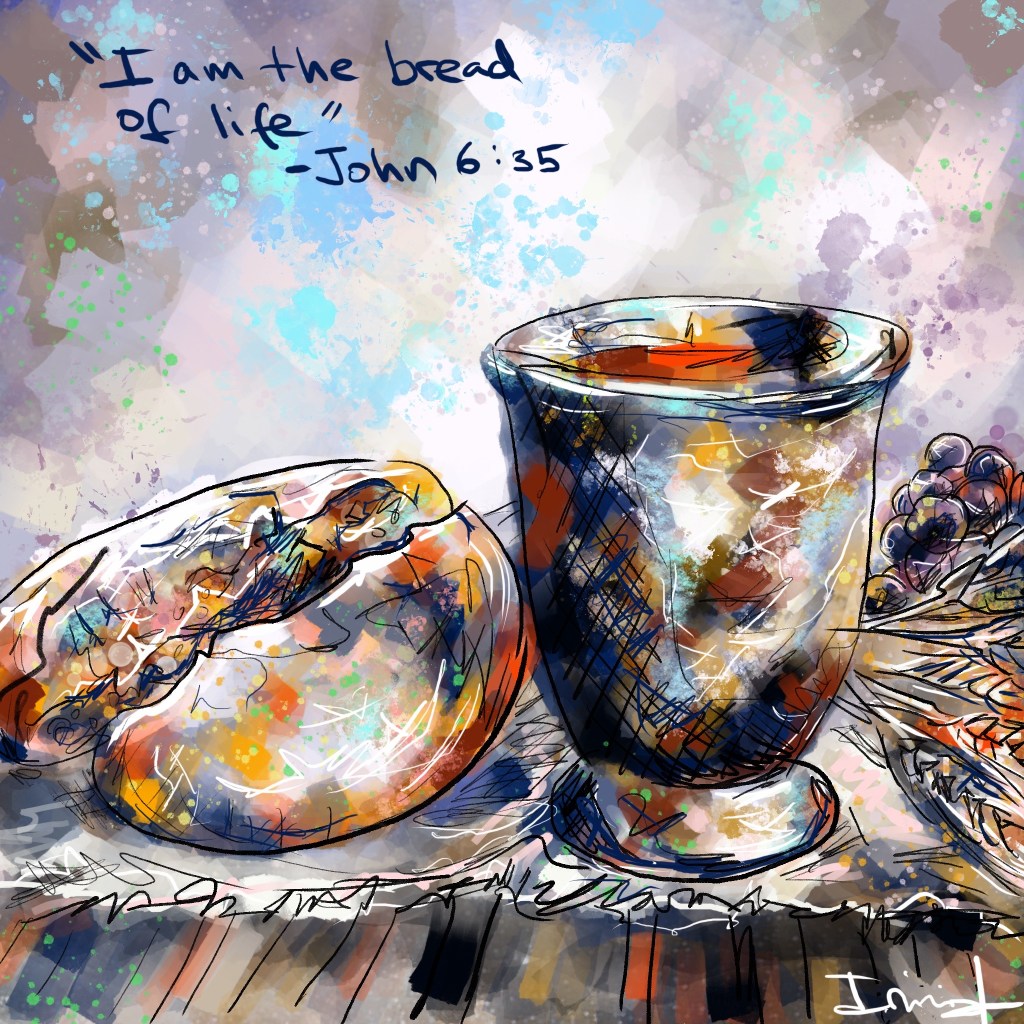
 Irina's Art
Leave a Reply