
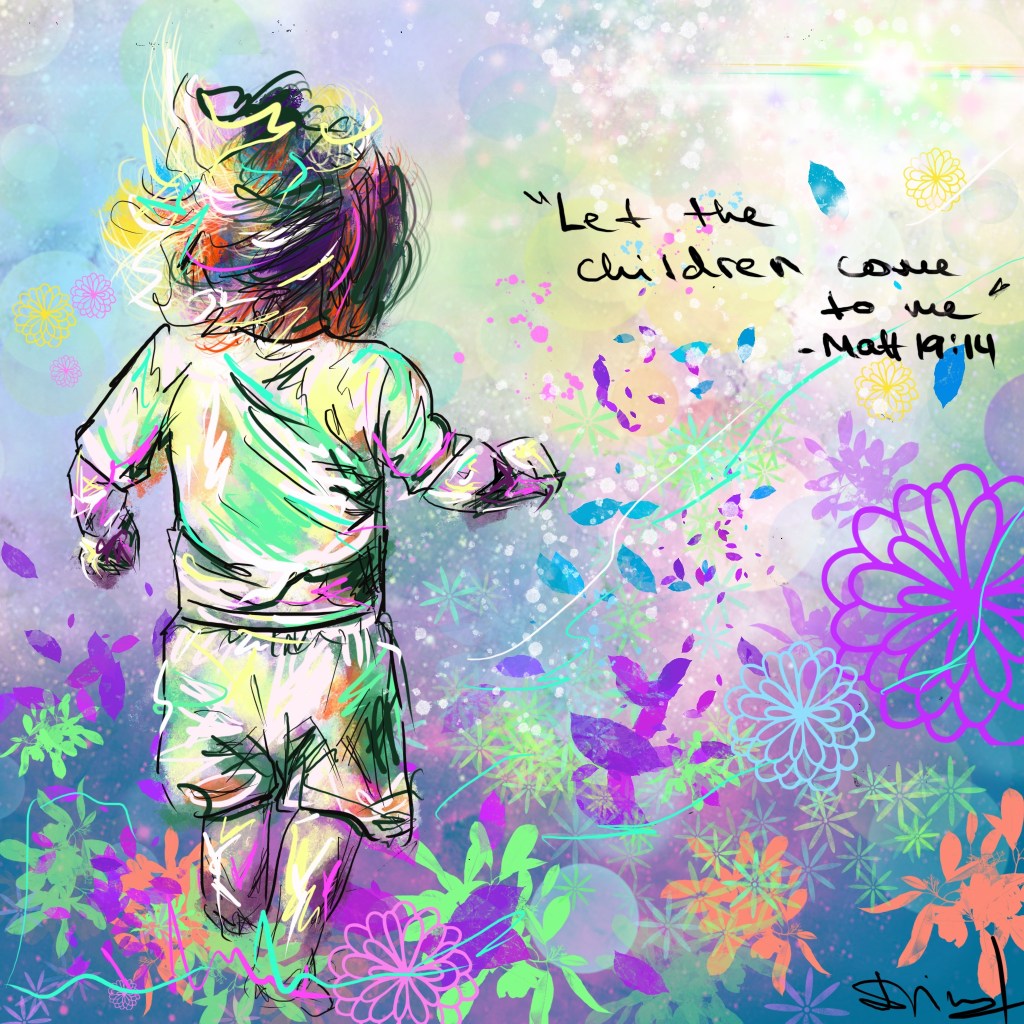
The picture above illustrates the gospel for this week, but once you read the post, can you think of any possible links between this verse and the ones I cite from the letter to the Hebrews?
You may know that I enjoy endurance sports, and participate in a few triathlon races each summer. If you share this interest, you have likely experienced the dubious joys integral to this pursuit: sweating buckets, huffing and puffing, risking an injury, not always seeing the results, never hoping to become the best, and occasionally, totally “hitting the wall”. But if you’re not athletic, you may have worked equally hard on work projects, home improvements, and difficult relationships; and like I do in the middle of each race, you probably ask yourself with some regularity, “Why am I doing this to myself, again? Is this really worth it?” And even in the absence of particular difficulties, we all go through such times in life when the general lack of affection, companionship, or understanding causes us to feel as though we are “strangers and foreigners on earth” (Heb. 11:13). In fact, the original purpose of the Epistle to the Hebrews, the opening of which we read this week, was to encourage the community of people who were asking, “Why?”. Why were they still believing, worshiping, and acting out of faith, when it did little to foster their sense of belonging and peace?
Today we read only the first few of its verses, but I hope my reflection might make you sufficiently intrigued to read the entire text, as it is quite a complex work that is difficult to appreciate fully through the short weekly snippets (though we will hear a few more of them in the coming weeks). In Greek literature, you’d call a passage such as Heb. 1:1-4 an ‘exordium’ – a polished preface that introduces the work by anticipating its themes, like an overture functions in an opera. The main themes here are faith, Jesus’ identity, and enduring hardship. Hebrews is one of the earliest NT texts, written before 95 by a writer clearly influenced by Paul, but using a much more polished and eloquent style and rhetoric. This author’s exposition of faith as a response to God out of trust and obedience is similar to that which we find in Paul’s letter to Romans, with one main difference. To Paul, faith is the way to secure eternal life, whereas the letter to the Hebrews highlights the role of faith in enduring the vicissitudes of the earthly one.
The author was, likely, one of Paul’s contemporaries and colleagues. According to some scholars, it may have even been Priscilla, whose gender might explain why the authorship of such a brilliant work has been lost. And the work is really not a “letter”, but a homily. The congregation is unknown to us, but the number of references to the Jewish scriptures makes recent converts from Judaism a likely audience (hence the title). In the author’s words, they were experiencing the “drooping of hands and weak knees” (12:12) and the “dullness of hearing” (5:12). Some might have been discouraged by the trend of admitting the gentiles to The Way, as Christianity was known back then, without converting to Judaism first. Most had begun to face the ridicule, hostility, and plunder of possessions as the first signs of what was to come over the following two centuries.
To encourage them, the author turned to a few devices. He developed the thread that tied Jesus’ identity, fellowship with humans, his own faith, his priesthood, and suffering, which is best appreciated by reading the letter from start to finish. What’s easier to see at glance is that, similarly to Paul and the anonymous author of James, s/he referenced Abraham as the example of one whose journey was characterized by hope, obedience, and total lack of certainty regarding where he was headed. Additionally, both Romans and Hebrews offer the “halls of fame” of other scriptural heroes of faith; but, note that the Hebrews list is much more diverse. It includes quite fallible individuals, such as one man who murdered his daughter, and others who treated women quite shamefully. It lists kings and judges alongside the marginalized (such as widows, prostitutes, and the homeless). Lastly, for some, faith secured amazing victories such as crossing the Red Sea and entering Jericho, but it offered no escape or relief to many others, such as in the martyrs of the Maccabean period, who are also mentioned. In other words, like us, all those people sinned and believed, experienced miracles and suffered. This paints quite a realistic picture of what it means to ask, and yet sometimes, not to receive.
Indeed, it’s hard to read about Abraham fathering a child, when you are a faithful woman who is unable to conceive or loses a pregnancy. It is hard to read about the healing miracles when you suffer chronic pain, or see others lose their lives too early. Maybe, the key is to reconcile in our minds and hearts the two most iconic lines from Hebrews, “run with perseverance the race that is set before us” (12:1) and “faith is evidence of things unseen” (11:1). How are we to persevere and retain faith, when we don’t necessarily see any evidence that things will get better? Well, did you watch the Olympic Games not too long ago? Did you, perhaps, as a result, not only receive a boost to national pride, but also try a little harder in your personal fitness routines? Likewise, as we undertake the “Ironman” of life, we are surrounded by many inspirational examples of the people of faith.
Some have already crossed the finish line and joined the “unseen cloud of witnesses” (Heb. 12:1), but others still run alongside us, and may not only be a little easier to relate to, but more importantly, offer advice, comfort, and gentle touch that might steady us. Is there someone you know who inspires you to keep worshiping, learning, and praying for the renewed sense of God’s presence? Might there be someone who could remind you that you don’t have to let your failures and mistakes, or those of others, weigh you down. If so, it might also be important not to fall into another extreme of idealizing their lives, and to remember that at times, they, too, have untidy houses, a sink full of dishes, messy clothing, unruly kids, broken relationships, aching joints, insecurities, or whatever it is that drives us to despair. The world is full of “capable women” (Prov. 31) and men who, nonetheless, continually seek balance just as we do. And most importantly, may we keep our eyes on Jesus to study how he “trained” and “performed”.
The author of Hebrews had no issue with believing something that became fiercely debated soon after his or her death, and over the next 300 hundred years – that Jesus, somehow, was fully human and God at the same time, indicating that each of us is also (a bit) God-like and (very) human. May we learn to imitate Jesus’ techniques to deal with the times we feel like “strangers and foreigners”, “hit the wall,” and ask “is it worth it?”: intentionality and awareness of God’s presence, obedience and forgiveness, empathy and self-giving. In doing so, may we be able to maintain a sense of direction and purpose, despite never seeing the finish line clearly. Thanks be to God.
Questions to Consider
What is faith? How would you interpret and apply the phrase “faith is
the substance of things hoped for, the evidence of things not seen”
(Hebrews 11:1)?
What is faith for? Do you see it as a means to
secure eternal life (cf. St Paul’s Rom. 5:1–2 and 3:21–28, Gal. 2:16
and 3:11–14); or does it give you the strength to bear the
“changes and chances of this fleeting world” (BCP collect for Compline) and “run with endurance the race that is set before us” (Hebrews 12:1)? Or both?


 Irina's Art
Leave a Reply