
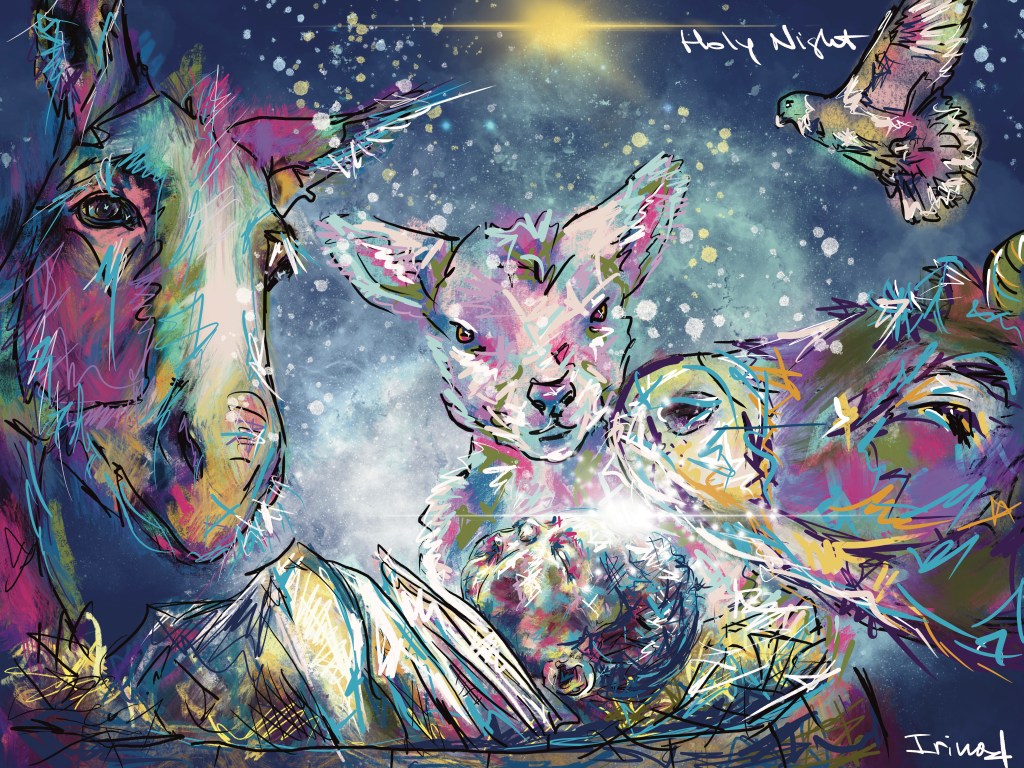
This reflection is inspired by the children’s Christmas play, presented during an intergenerational church service.
Wasn’t it wonderful to see all the animals in our play? You all created a living crèche—a nativity scene that came to life. I brought my own crèche to show you, and this one is special because it’s from Ecuador. Look closely: can you spot the llama? Do you think there was a llama at the manger that night? What other animals do you think might have been there? Or maybe, what animals would you have wanted to be there, and why?
Now, can anyone tell me which two animals are always, always present in nativity scenes? That’s right—the ox and the donkey. These two animals have been part of the nativity story since the earliest days of Christianity. Their presence comes from a verse in the Old Testament book of Isaiah:
“The ox knows its owner, and the donkey its master’s crib; but Israel does not know, my people do not understand.” (Isaiah 1:3)
This verse reminds us that even these humble animals recognize and honor their Lord, while people sometimes struggle to do so. The ox and donkey also symbolize different groups of people. The ox is often understood to represent the Jewish people—Jesus’ own ethnic group, the community he was born into. The donkey, on the other hand, represents all other people, showing that Jesus came for everyone, not just his own people, so we may all connect with God through him.
At the same time, the ox and donkey can also remind us of different personalities. Have you ever noticed that in some nativity paintings, the donkey is shown looking away from the baby Jesus, while the ox gazes directly at him? This detail reminds us of something important. The ox, steady and serious, is ready to work and stays focused. The donkey, playful and curious, can be easily distracted. Which one of them is more like you? Well, both are welcome at the manger, just as all kinds of people are welcome to know Jesus. But when we arrange our crèches, we often prefer to place all of the animals, including the donkey, looking toward the baby, don’t we? This shows our own aspiration to try to focus on Jesus, the Light of the World, as best as we can.
The presence of animals in the nativity also reminds us of the humility of Jesus’ birth. The stable wasn’t a fancy place. It was ordinary and earthy—a space where animals lived. Animals bring us into this reality. But there’s more to it than that. The animals also represent all of nature bearing witness to this holy night. Angels, who are invisible, sang from heaven. Shepherds, ordinary people like us, came to see him. And animals—the creatures of the earth—were part of the scene too. Together, they remind us that the birth of Jesus was for all creation: for the heavens, for the earth, and for all living beings.
In the Middle Ages, a beautiful chant was composed for the service of Morning Prayer on Christmas Day. It’s called O Magnum Mysterium, which means “O Great Mystery.” It speaks about the animals who had the honour of being present at the birth of Christ. As translated from Latin, it says:
“O great mystery, and wonderful sacrament, that animals should see the Lord, born and resting in their manger.”
Imagine that! Animals, so humble and simple, were the first to look upon the face of God (well, after his mother, who was maybe taking a little nap at the time!). What do you think the animals were doing as they gathered to look at the special baby? A charming Christmas carol called The Friendly Beasts helps us imagine the animals as not only being present, but also having special roles at the manger:
“I,” said the donkey, shaggy and brown,
“I carried His mother up hill and down
I carried her safely to Bethlehem town;
I,” said the donkey, shaggy and brown.
“I,” said the cow all white and red,
“I gave Him my manger for His bed,
I gave Him my hay to pillow His head;
“I,” said the cow, all white and red.
“I, said the sheep with curly horn,
“I gave Him my wool for His blanket warm,
He wore my coat on Christmas morn;
“I,” said the sheep, with curly horn.
“I,” said the dove, from the rafters high,
“Cooed Him to sleep that He should not cry.
We cooed Him to sleep, my mate and I;
“I,” said the dove, from the rafters high.
We will sing this song on Tuesday as part of our family Christmas Eve service. The donkey carried Mary to Bethlehem. The cow gave its hay to make a bed for baby Jesus. The sheep shared its wool to keep him warm. The dove cooed a lullaby to help him sleep. Each animal, in its own way, offered what it had to serve and honour the Christ child. And here’s the amazing part: just like the animals, we have a role to play in bringing God’s love into the world—by being kind, sharing what we have, helping others, and loving one another.
So, as we look at this crèche—or as you think about the animals you’ve played today—remember that they teach us something profound. Jesus came to redeem the whole world: everything and everyone, from the highest angels to the humblest creatures. And each of us, no matter how small or simple we feel, has an important role in his story.
Questions to Consider
While the Gospels don’t mention animals, a stable setting implies
their presence. Artists across centuries included animals in their
depictions of the nativity, perhaps, to evoke the ordinariness and
humility of Jesus’ birth, and to highlight the broader connection
between creation and the coming of Christ.
1. What emotions or spiritual insights do you feel when you see
animals in a nativity scene?
2. Are there moments in your life when you’ve found unexpected
companionship or comfort in creation, much like the imagined animals
in the nativity?
3. If you were to add an animal to a nativity scene, what would it be and why?

 Irina's Art
Leave a Reply