
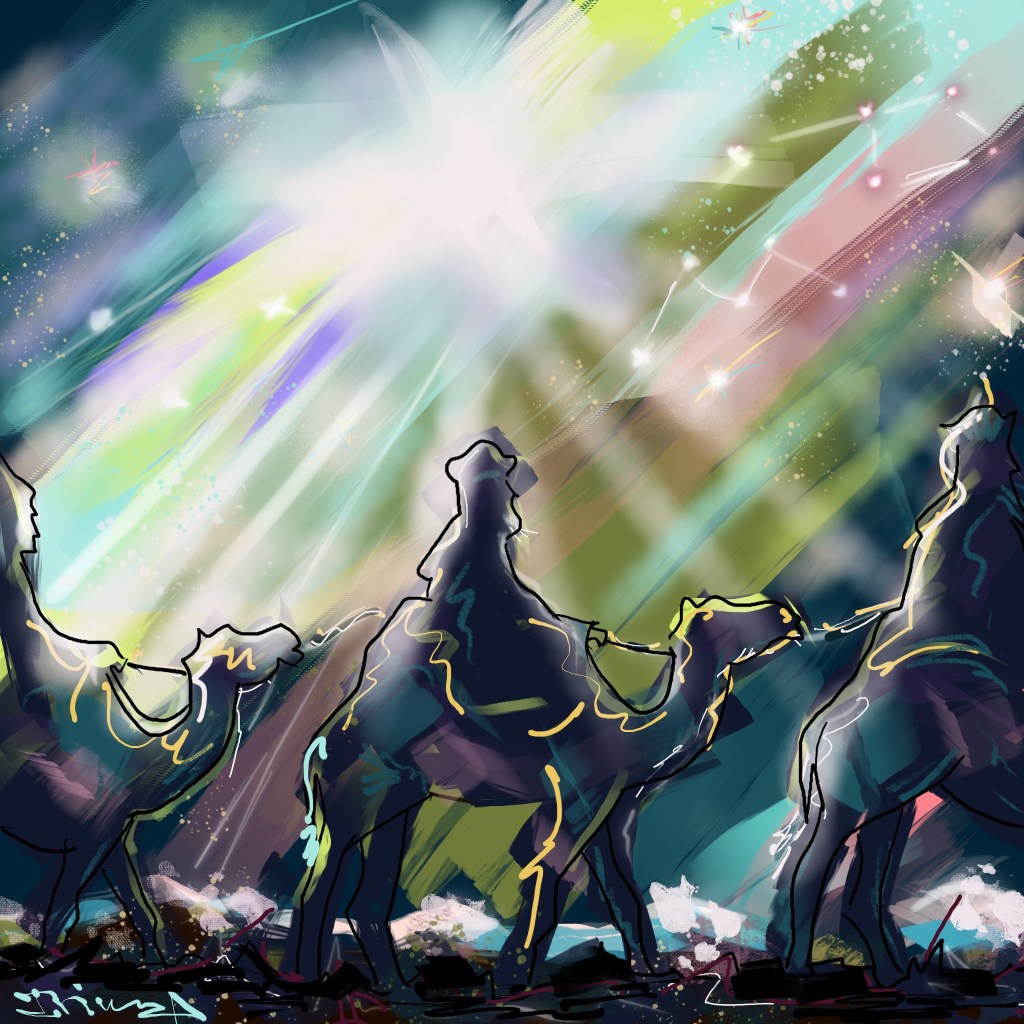
The holidays hold a special magic. Ask any child what they are about, and you might initially hear something about family togetherness and perhaps treats. But with a little persistence, they will eventually confess—it’s about the gifts! Around the world, however, the timing of this magic varies widely. Dutch children are the luckiest, receiving gifts on December 5 with the help of St. Nicholas. In North America and Europe, some children wake before dawn on Christmas morning, tearing into gifts while their parents cling to mugs of coffee, while others are made to wait until dinner. This year, I was touched by an adult who received a small token from me and waited to open it until Christmas Day, preserving a tradition from childhood. In the former Soviet bloc, children still wait until the stroke of midnight on New Year’s Eve for Grandfather Frost to deliver gifts. However, for those who have embraced the state religion more recently, this tradition is often set aside as they fast in preparation for January 7. The most patient of all, however, are the children of Italy, Latin America, and Spain, for whom Epiphany far surpasses Christmas in significance, for on this day La Befana and the Kings arrive.
Yes, the timing and magical characters who bring gifts vary, but the themes of waiting, longing, and hope they represent are universal. For a child, the wait for these magical deliveries feels thrilling, and they are quite forgiving of small issues such as the strong resemblance between Santa’s handwriting and that of Mom. As adults, we try to manage children’s expectations, warn them against the inevitable “now what?” after the magic fades, and downplay the buildup. Yet the longing for the transcendent is not childish at all. It is deeply human, and whether we recognize it or not, we yearn for connection with the divine—for faith, hope, miracles, and love, which we both offer to God and receive as gifts from Him. As we age, we begin to realize that it is up to us to deliver these gifts to others on His behalf, just as every child eventually finds “Santa’s” gifts stashed at the back of mom’s closet.
As for the Magi’s gifts—gold, frankincense, and myrrh—these carry layers of meaning. Gold symbolizes kingship, frankincense divinity, and myrrh burial. They recall the grandeur of Solomon, to whom “the kings of Arabia and the governors of the land brought gold and silver” (2 Chron 9:14). They echo Isaiah’s words: “all those from Sheba shall come. They shall bring gold and frankincense” (Isaiah 60:6). And they foreshadow the gifts presented to Christ at his burial by Joseph of Arimathea, Nicodemus, and the women. Perhaps the Magi were kings, as suggested in Psalm 72: “may the kings of Tarshish and of the isles render him tribute; may the kings of Sheba and Seba bring gifts” (Psalm 72:10). Perhaps they were Zoroastrian astrologers who observed a rare conjunction of Saturn and Jupiter, which we, too, were fortunate to witness in 2020 (next promised only in 2080!). Tradition, dating to the eighth century, states that there were three Magi, named Caspar, Melchior, and Balthasar—perhaps representing the three stages of human life (infancy, middle age, and old age) or the lands of Persia, India, and Arabia. However, the locations of Tarshish and Sheba still remain a mystery. Some suggest Turkey or Spain for Tarshish, and Ethiopia for Sheba—the land of the wise queen who, too, brought spices, gold, and jewels to greet Solomon as an equal (2 Chron 9:1–12).
Regardless of their origins, the size of their caravan, or the timing of their arrival, the Magi’s journey must have been arduous. As T.S. Eliot wrote, “a cold coming we had of it, just the worst time of the year.” Written after Eliot’s own conversion to the Anglican faith, “The Journey of the Magi” (1927) reflects the stages of his own spiritual transformation. In the first stanza, the Magi encounter only whispers of God’s self-revelation, easily dismissed as “folly.” The second stanza echoes the anticlimax many feel after periods of anticipation, such as a child’s experience of Christmas: “it was, you might say, satisfactory.” But by the final stanza, the travellers are changed; “no longer at ease here, in the old dispensation,” they yearn for a new journey and would even be “glad of another death.”
Epi-phaneia means “manifestation [of a god] from above”, and in modern usage, we speak of epiphanies as sudden, almost supernatural insights. I like to think that in the gospel, the Magi’s epiphany came not in the star’s brilliance, which merely sparked their curiosity, but in their encounter with Herod, where they suddenly saw through his scheming and chose to defy him. In Greek mythology, epiphaneia mostly occurred on battlefields! So perhaps, as they “returned home by another road,” they also helped Jesus’ family to escape to Egypt on their swift camels. As such, both the gospel and Eliot’s work suggest that Epiphany teaches us to seek the divine not just in extraordinary moments but in the ordinary. It is in the inward journey itself—the forks in the road, the small acts of defiance, the willingness to change direction, the rebirth of the heart—that we meet God.
Can you recall moments in your life that felt like epiphanies? What gifts did you give or receive at the time? As for the feast of Epiphany itself, to me, it is about the quiet return to normalcy after the holidays. It is in the cleaning up, the blessing of a home through simple acts of tidying, and the recognition that we return to life by another road, transformed by what we have encountered. For example, earlier this week, I decluttered some of my houseplants that had grown leggy. I took a few cuttings and discarded the ungainly plants I had stubbornly held onto. Yet I know I will have them again—more beautiful—from the cuttings. This is something I often do around the turn of the year; a kind of death, but also a promise of new life. An invitation to transformation may begin with waiting, involve letting go, unfold in the mundane, and surprise us. Like the Magi, we long for the transcendent; yet the sacred may manifest itself not in the brilliance of stars but in the quiet courage to take another road.
P.S. My favourite literary reference to the Magi and Psalm 72 appears in “Out of Africa” by Isak Dinesen (the pen name of Karen Blixen). The life stories of both Karen Blixen and Beryl Markham—one of the first female aviators and Karen’s rival—are far more compelling than the eponymous movie suggests. Blixen captures the transcendent moments that nature can offer with striking beauty: “The Cicada sings an endless song in the long grass, smells run along the earth, and falling stars run over the sky, like tears over a cheek. You are the privileged person to whom everything is taken. The kings of Tarshish shall bring gifts.”
P.P.S Speaking of the Queen of Sheba: “Solomon” (c. 1749) is a much lesser known oratorio by Handel (as compared to the “Messiah”). It contains a wonderful, brief instrumental piece for two oboes and strings called “The Arrival of the Queen of Sheba” (Act 3), which has become more famous than the complete work itself.
Questions to Consider
According to psychologists, as we age, we perceive time to pass by faster, partly because we engage in less learning and receive less new information on a daily basis. Looking back over 2024, was there anything you did for the first time, ever? Was it a positive experience? If not, did it still offer something valuable or meaningful – a gift, in a way? Is there anything new you’d like to try in 2025?

 Irina's Art
Leave a Reply