
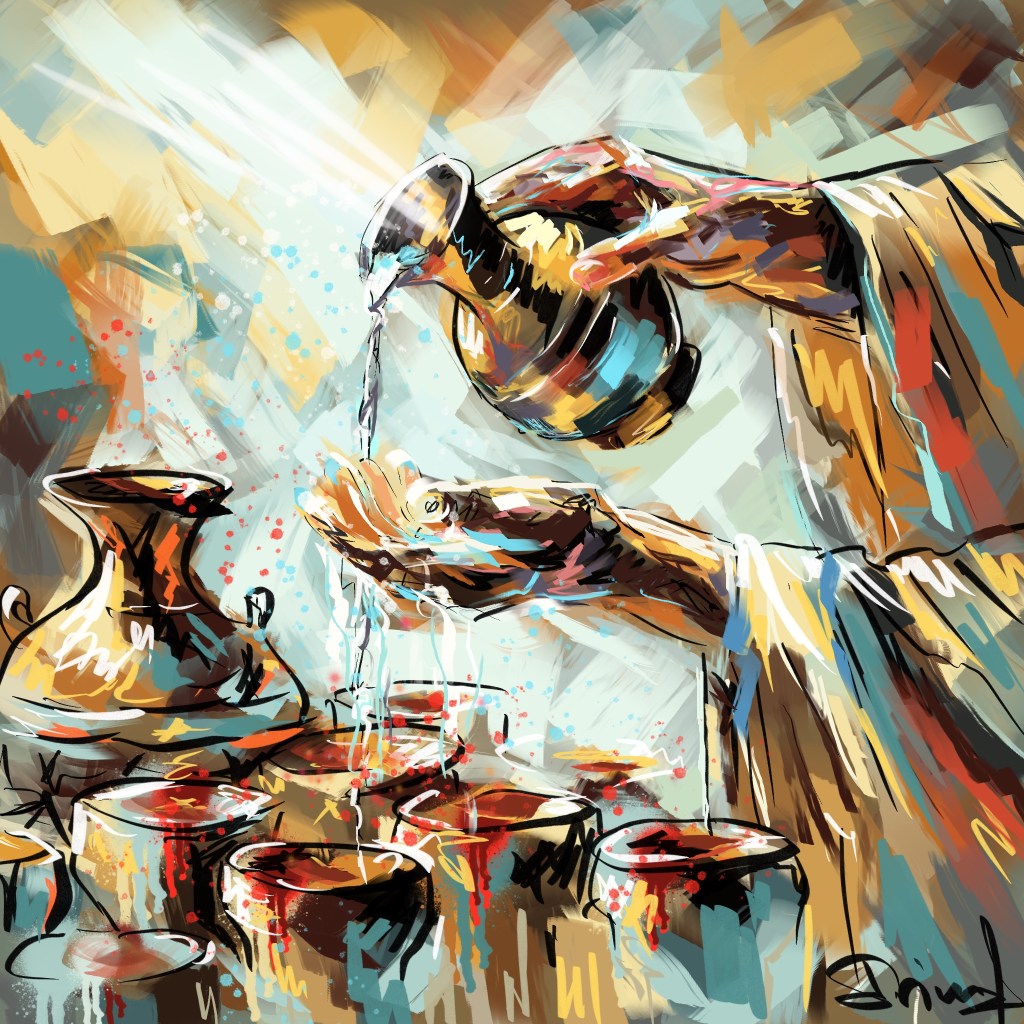
The context in which we read about the miracle at Cana is most often a wedding, which makes sense as there aren’t actually too many scriptural passages that describe wedding scenes. Marriages and love in general—yes, these come up very often; but there are not that many weddings per se, apart from Psalm 45 and the Song of Songs, which are considered to refer to the wedding(s) of Solomon, and the mysterious “wedding supper of the Lamb” in Revelation. So, how central is the context of a wedding to this passage? The reason we read it today is because it continues the theme of God’s self-revelation, which is what the season of Epiphany is about (indeed, what the word itself means), culminating in the Transfiguration, read right before Lent. Through each of the stories we read over this in-between season, Jesus’ divine nature becomes revealed more fully, and draws us deeper into the mystery of the Incarnation. I would say that the miracle at Cana is only secondarily about a wedding, but primarily, it is an epiphany—the first of what John calls ‘signs.’ This term is specific to John, which portrays Jesus’ actions as deliberate, symbolic, and theologically significant.
This is because John is uniquely explicit, right from its opening lines, that Jesus is God: “The Word was God… and it came to dwell among us,” as we read at Christmas. In the Synoptics, which are considered to be earlier texts, Jesus tries to keep his miracles secret, his disciples are frustratingly obtuse, and Jesus never refers to himself as either God or the Son of Man whose impending advent he predicted. On the other hand, John shows Jesus to be fully aware of his divinity and purpose, his mother to have the right intuition to request a miracle, and his disciples to “get it” at the very first teaching moment of turning water into wine – at this first “sign”.
What’s the difference between miracles, signs, and wonders? A miracle is an extraordinary event that defies natural explanation, and a wonder is anything that inspires awe and reverence, including natural events. A sign, however, is any event that points beyond itself. In John, there is some correspondence between Jesus’ seven “I am” statements and his seven signs. Since in Judaism, the phrase “I am” is a name for God, by saying “I am …”, Jesus is understood to have claimed seven divine attributes. Most of his signs seem to support his assertions (though a few require a little stretch!). In a couple of instances, the statement is even placed right before the miracle, as in “I am the light of the world” before healing the blind man, and “I am the resurrection and the life” before raising Lazarus. Similarly, though less proximally within the narrative, “I am the bread of life” matches feeding the multitudes, and as we read today, “I am the true vine”—making wine.
In Scripture, wine is generally a sign of God’s abundance, blessing, and life. In the Anglican culture, wine is quite central—and I don’t mean only that which we purchase at the church store!—as it is also symbolic of hospitality around the world, except in the cultures that prohibit alcohol. My own wedding comes to mind. It took place in the morning and was followed by quite an early lunch, yet my father bought such vast quantities of wine that we were still drinking it over a couple of years that followed… But to do otherwise would mean to lose face! I, too, tend to overestimate the quantity of wine we need to bless at the altar, to the constant chagrin of the sanctuary guilds at every church where I’ve served. The fear of running out must be genetic; but you can’t blame us – it would be a problem in many situations. Symbolically, however, I think that here the lack of wine refers to the times in our own lives when our sense of God’s presence “runs out.” What makes me think of this is the phrase “on the third day” with which the story opens. Yes, it could be a foreshadowing of the resurrection—itself a miracle of transformation—but it also echoes the words of God to the Israelites at Mt Sinai, which they reached after escaping Egypt and traveling in the desert: “Be ready for the third day, for on the third day the Lord will come down” (Ex 9:11). Clearly, what John asserts is that the Lord has already come down—the Word has come “to dwell among us”.
But the Word has come so we may be now with God in the new and transformed ways. Not in the old ways—the old covenant—established on Mount Sinai on that “third day” centuries prior, which required continual washing, sacrifice, and ritual to maintain purity. That’s why Jesus is said to have made the wine in those vessels that previously held water for purification rituals. And in our Eucharistic prayer, we give thanks for the wine as the cup “of the new covenant” that God extends to us out of his self-giving love.
But just as water still remains present in Jesus’ wine at Cana, we will never fully cease to be who we are, at any stage of who we become. God never discards or rejects, but builds on our experiences, temperament, genetics, and history, to bless and create a new way of life. We might find it helpful to consider approaching ourselves, our attempts at self-improvement, and our past, with the same grace! Lastly, the outcomes of Jesus’ miracles are always “natural”—just those that come about in ways that nature doesn’t permit. For example, wine is natural, but you need more than water to make it. Life is a natural state, but not one that comes after death. Mobility or sight are normal, but not after permanent injury, just as storms do cease (just not in an instant) and illnesses do depart (but usually with time or treatment). So Jesus’ “signs” remind us that everything ordinary has the potential to become extraordinary – indeed, there’s not one without the other!
What is it in your life that feels outdated or insufficient? When were you missing a presence or something felt lacking? When did you feel old, worn, or no longer useful? Has God ever shown you your worth in such moments? Such transformations – not so much of who we are, but of how we see ourselves! – are life’s true miracles. These are the signs of God’s continuing work in us. Let us then have the courage to respond! Just as Jesus initially said, “My hour has not yet come,” and still chose to act, may we similarly be encouraged to let compassion move us to act, even when we feel unprepared. And just as Mary trusted Jesus to help, may we be bold in approaching each other whenever we need support. Thanks be to God.
Questions to Consider
1. In the miracle at Cana, the essence of water remains present in the wine. Can you think of areas in your life where God has transformed something without completely removing its original nature? How has that reshaped your understanding of renewal?
2. If water symbolizes something ordinary or even incomplete in your life, what would “turning it into wine” look like for you? What areas of your life are you asking God to transform?

 Irina's Art
Leave a Reply