
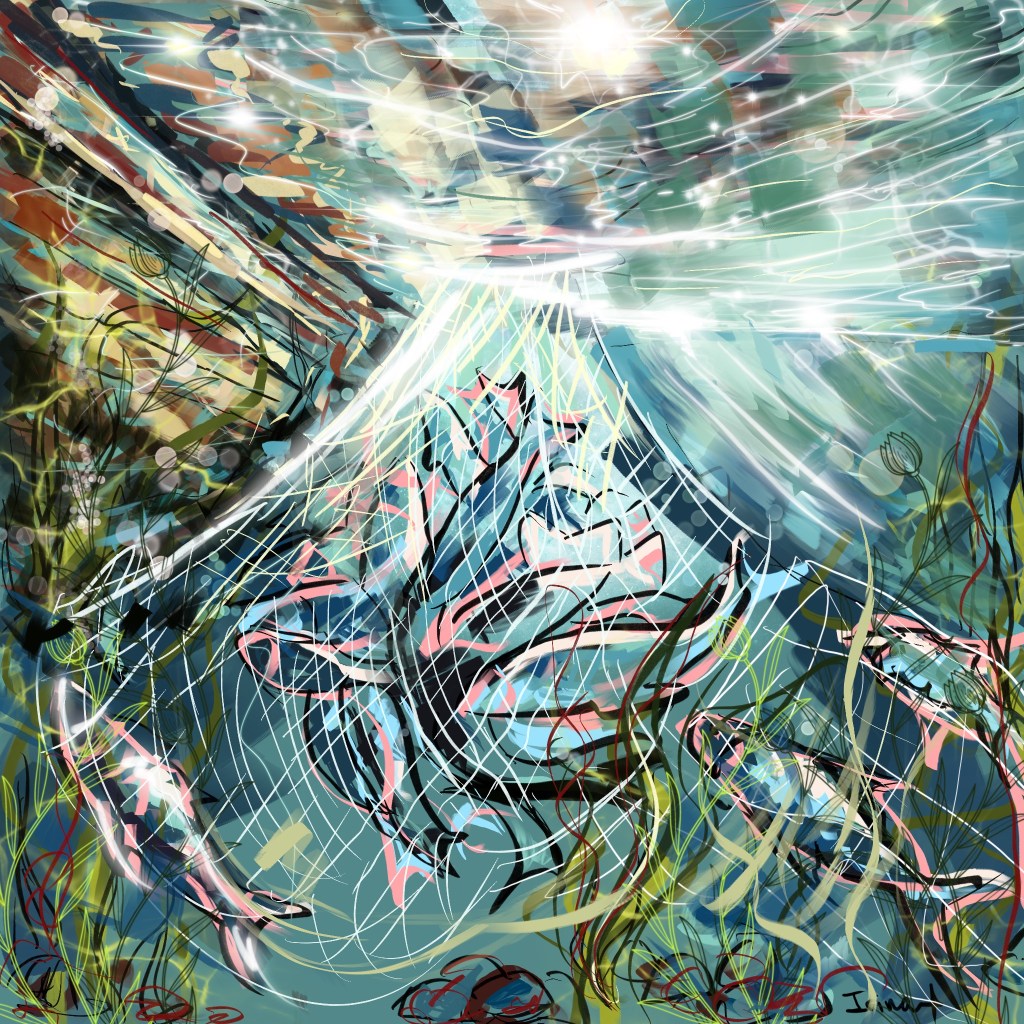
Today, my reflection is on Isaiah 6, while my drawing represents Luke 5.
Today, we heard from Isaiah—an incredibly full book, and a really long one! Its ch. 1-39 (also known as First Isaiah) are attributed to the historical Isaiah of the 8th century BC. Born in Judah’s temporary safety, he witnessed the Assyrian conquest of the northern kingdom of Israel and considered it divine punishment. Then, he too lived through the Assyrian invasion into his homeland, as provoked by his king’s ill-fated alliance with Egypt. So he warned that Judah would share the fate of her neighbour to the north. Over the next two centuries, as Isaiah’s text became expanded, its tone shifted from condemnation to a vision of divine sovereignty (echoing Job 38-41) and ultimate redemption. Known together as Second Isaiah, ch. 40-55 (Deutero-Isaiah) were likely written a century after Isaiah’s lifetime during Judah’s exile in Babylon, and ch. 56-66 ( Trito-Isaiah) emerged after Persia’s Cyrus II enabled the restoration of Judah in 539 BC. Through these texts, later authors interpreted Isaiah’s warnings through history’s lens and offered a hopeful message of redemption enacted by the one whom they called the Servant of the Lord.
Who was this Servant, the focus of ch. 42, 49, 50, and 53—Israel as a whole, her future leader, or even King Cyrus? Perhaps all of the above, since Second Isaiah suggests that it is only God who saves and redeems, albeit through human hands. Many see the book as foreshadowing Jesus as the ultimate Servant of God who brought spiritual restoration to Judah and the entire world. But that was much later. Today’s reading from ch. 6 takes us back to 8th-century Judah under King Uzziah – to Isaiah’s moment of decision to embark on a lifetime of prophecy, and effectively to become his own version of the “servant of God”. By then already married with two sons, how did he dare make such a choice? The passage does not really explain, focusing less on Isaiah’s will, and more on God’s overwhelming presence—more of a painting than a story!
Imagine: the air thick with incense—you can almost smell it—temple lamps casting flickering shadows, distorting your surroundings. Suddenly, the earth trembles as a vast, radiant presence fills the entire space. Have you felt anything like this before? Above, seraphim hover on beating wings, their rolling thunder of voices—Holy, holy, holy!—shakes you to the core. Overwhelmed, would you kneel, overcome by your own smallness? Cry, Woe is me! I am unclean!? You see the seraph descend, a burning coal glowing in her hand. Despite knowing the pain of past burns, you feel drawn to its touch. Then, a voice: Whom shall I send? And your answer? Send me.
Because this passage reminded me of a painting so much, I looked at a few actual representations of Isaiah in visual art through the centuries. Consider the two famous works found in Rome, where in the first decade of the 16th century, Michelangelo and Raphael, teacher and student, created very similar compositions.


Both portray a seated Isaiah, robed and turning, accompanied by cherubs (unlike the fearsome seraphim of Isaiah 6!). Yet there’s one significant difference: Michelangelo has Isaiah hold a closed book, fingers marking his place as though interrupted in reading, and concealing the message, while Raphael lets him hold a scroll open, even with the word “open” visible as part of the text. As Michelangelo’s Isaiah focuses on an inner voice – limbs crossed, shoulders tense, mantle’s arc enhancing the tension – Raphael’s Isaiah steps forward to call the viewer to action. Which portrait speaks to you? Do you believe that God’s promises are reserved for some distant future, or are they for us, to act upon today?
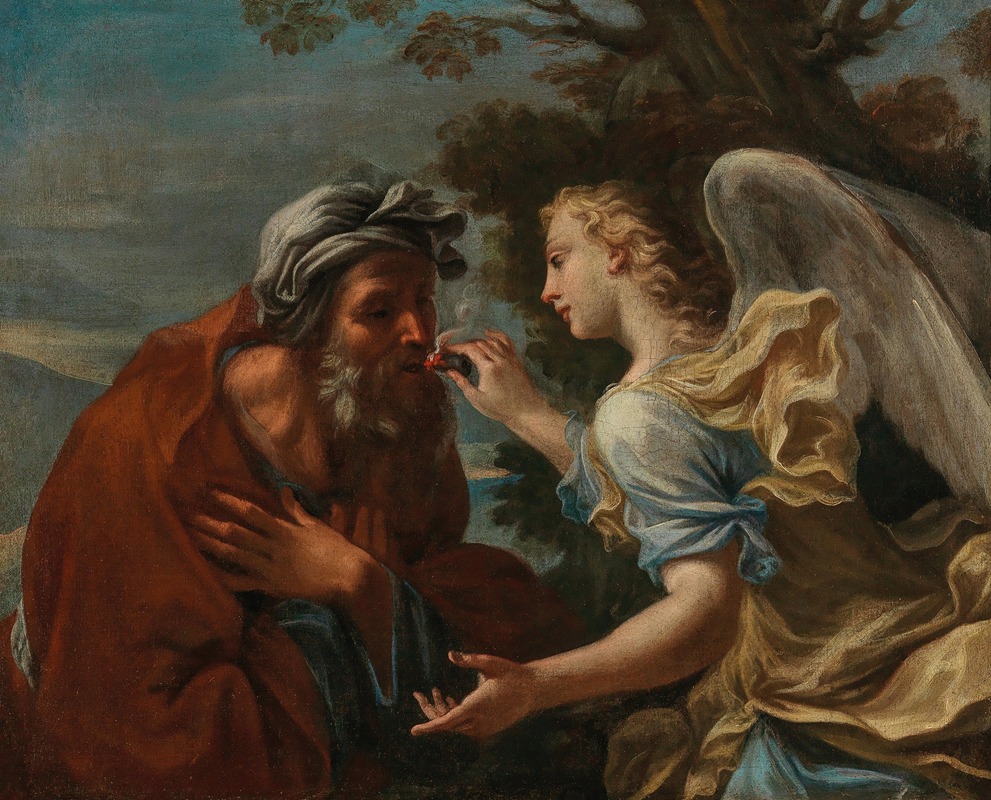
And what of the burning coal? These Renaissance masters omitted it, opting for a general portrait of the man, but many others represented the full scene from Isaiah 6. Here are a couple of Italian examples.

I am always drawn in particular to the two pioneers of Russian modernist art, Mikhail Vrubel and Marc Chagall, who have influenced my own artistic style.


Or how about this one? (I find it most disturbing!)

What do you notice in these paintings – apart from the angels growing older and more feminine in appearance? How do they convey that overwhelming arrival of the divine that disrupts our worldview? What about Isaiah, humbled yet empowered? What strikes me in these paintings is that he does not turn away from the angel. In fact, he is drawn to the fire, where a normal human instinct might be to flinch. Don’t we use the word “burnt” to mean we won’t make the same mistake again, or “burnt out” when we are too exhausted to continue? So it would be normal to hesitate to embrace a new call based on our past experiences; yet Isaiah shows no reluctance.
But what if the coal symbolizes illumination rather than pain? If sin is disconnection—from God, self, and others—and shame is the fear of standing in another’s presence (as Isaiah does here, and Peter in the Gospel), then the touch of the coal becomes a moment of clarity, revealing our purpose that dignifies, empowers, and justifies our impulse to draw near to God and others. When such moments arise through grief, failure, radical honesty, or love, they refine us and enable us to see through the swirling smoke and shadows. At times, insights and calling may also emerge in much gentler contexts—nature, music, literature, art, or the words of other people. Which one has spoken to you recently?
Of course, no prophet is perfect. A prophet is simply someone who, despite the burns of the past and the future obscured by the billows of smoke, says “yes” to God. “Yes” to do what, exactly? Perhaps, in the words of Second Isaiah—that later set of texts that continued Isaiah’s original work— to “Comfort, O comfort my people” (40:1). I always hear this in my mind as the opening aria of “The Messiah”! (Indeed, Handel’s friend Charles Jennens drew heavily on Isaiah for his libretto.) But, if the prophet was called to comfort his people, it meant both that they did long for comfort and that God was willing to provide it through human hands. Maybe this could be our own calling in these uncertain times. So many around us need just this – a simple, human, comforting touch. If you don’t know where to begin, let’s start by noticing what comforts you: hugs or food, words of affirmation or gestures of kindness, or simply time spent together and attention when you need to “vent”. Now, consider offering just one of these gifts to your neighbour or friend. Let’s try it today, and see what happens!
Questions to Consider
1. Have you ever had an experience that made you feel small yet deeply connected to something greater?
2. Notice Peter’s impulse to withdraw from Jesus (Luke 5), Isaiah’s fear of being in God’s presence, and the seraphim covering their faces to avoid God’s direct gaze. What does “sin” mean to you when framed as disconnection rather than wrongdoing?
3. How do you experience transformation in your life—gradually or through moments of intense clarity?
4. What does it mean for you to say, “Here am I; send me,” in your life today?
PS: Here is a poem based on Isaiah 6 by a well-known Russian poet – I recall that this was assigned reading in high school, if not earlier (!), but now it strikes me as a rather graphic representation.
 Irina's Art
Leave a Reply