
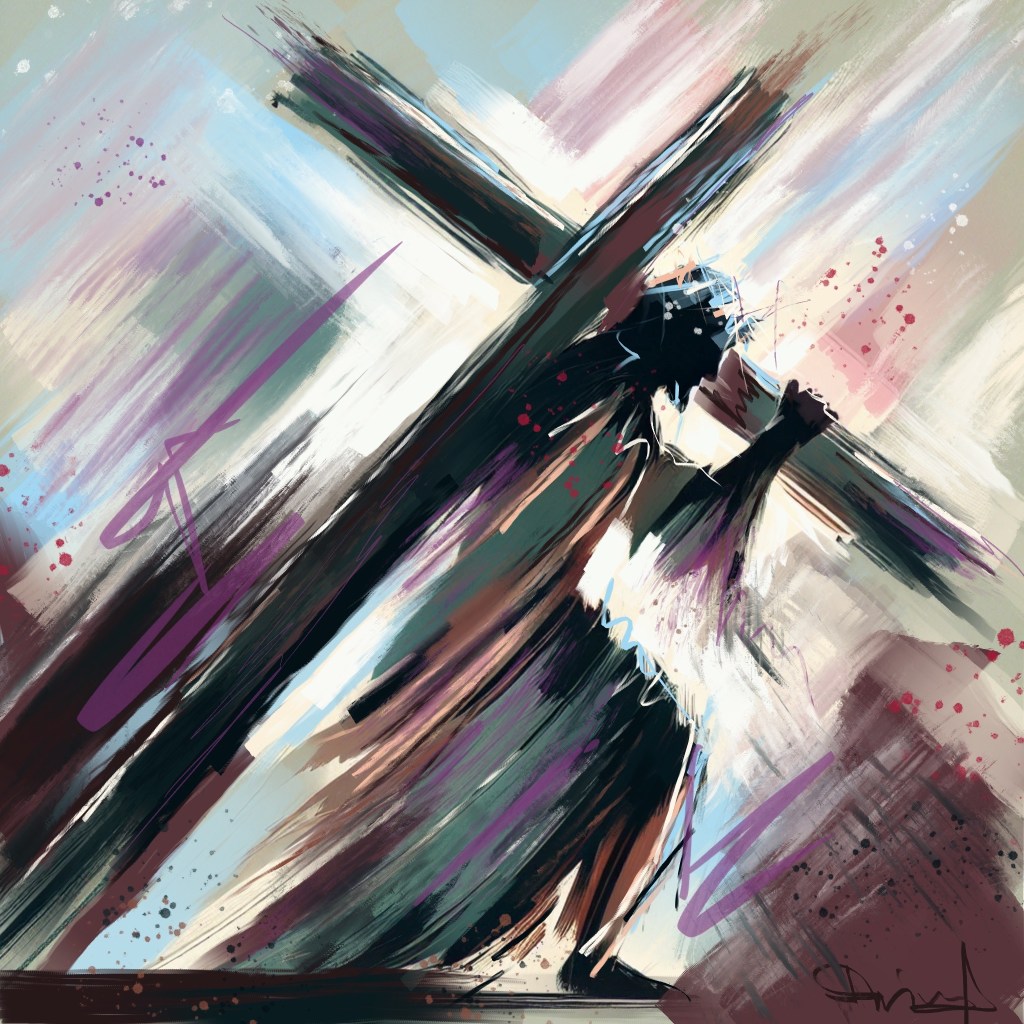
“Second Station: Jesus Takes Up His Cross” is the second artwork in my Lenten series on the Stations of the Cross, created in preparation for Good Friday. In his Lament over Jerusalem (Lk 13:31-35; Mt 23:37–39) — the focus of today’s reflection — Jesus foreshadows his Passion (or at least conveys a sense of premonition).
Do you have a sense of attachment or affection for a special place, city, home, or natural landscape that formed you and bound you to itself through memories, people, decisions, and lessons? As we heard today, Psalm 27:4 expresses our shared longing for such sacred places—our spiritual homes—that serve as glimpses of heaven on earth: “One thing I asked of the LORD, that will I seek after: to live in the house of the LORD all the days of my life, to behold the beauty of the LORD, and to inquire in his temple.” It seems to me that to Jesus, Jerusalem was such a “home”. While he was neither born nor raised there, his life circled around the place, and ended just outside its walls. We don’t know how many Passover journeys Jesus was able to make in his lifetime, but from a narrative perspective, the entire Luke can be read as one long journey to Jerusalem—a journey from bondage to freedom through sacrifice. That’s why the Transfiguration story, which we read two weeks ago, concludes with the words: “As the time approached for him to be taken up to heaven, Jesus ‘set his face’ to go to Jerusalem.”
Jerusalem became the capital when King David, an ancestor of Jesus, chose it for its neutrality among the tribes he sought to unify and then captured it to establish his rule. Over time, it came to symbolize the entire Jewish nation, and its Temple—the deepest place where God resided with his people. Jesus’ parents brought him there as a tiny infant; as an adolescent, he stayed behind to linger after his family had gone home. And last week, we read that as Jesus was tempted to misuse God’s authority, one of the tests took him to the pinnacle of the Temple, where he was shown a view of Jerusalem. This was likely the southwestern junction of its walls, the busiest street corner in the city, where trumpets sounded at festival times and where the Jewish people believed the Messiah would one day appear. Yet, Jesus resisted the temptation to win with a cheap trick. He chose not to reveal his messianic identity prematurely; he remembered what had happened to the prophets before him and was not fooled by the exuberant praise he would later receive in Jerusalem.
In today’s gospel, Jesus expresses his premonition, as well as his love for Jerusalem, through this famous lament: “Jerusalem, Jerusalem, the city that kills the prophets and stones those who are sent to it! How often have I desired to gather your children together as a hen gathers her brood under her wings, and you were not willing!” (Lk 13:31-35; Mt 23:37–39) He was right to identify himself with the suffering prophets of old; for within days, his body and soul were torn by death – and so too was the Temple curtain, which had enclosed its innermost, most holy chamber. All three synoptic gospels use this poignant imagery to underscore Jesus’ symbolic ties to the city and its Temple. As for today’ passage, I love its use of feminine and animal imagery; particularly the contrast between Jesus as a hen and Herod as a fox, the hen’s stereotypical enemy.
Jesus’ sorrow was not just for a city, but for all the times his people and their leaders rejected God’s love and guidance—for a history of broken covenants. The Old Testament contains about twelve of these sacred agreements between individuals from among the Jewish people and God. Unlike the gods of other traditions, who were seen as distant witnesses to human faithfulness, the God of Israel did not merely observe these covenants but entered into them. He even entered participants’ very being, as seen in the transformation of Abram and Sarai into Abraham and Sarah. With the addition of a single consonant—“H”—their names now carried a mark of God’s presence, as the letter H stands for the Hebrew verb to be (hayah), signifying the great I AM joining his existence to theirs.
In the same way, God’s presence is not limited to Jesus alone but is also born in each of us. But of course, as I reflected last week in the context of Jesus’ temptations, God created us in his own image—as creators motivated by free will—and so he never enforces the relationship. We are free to bless the one who comes in the name of the Lord (Ps 118:26 quoted in Lk 13:35) or to push him outside the walls of our souls. As such, might Jerusalem also stand as a metaphor for the human heart? God’s home on earth, the place where the Incarnation happens, the “temple” where God resides? And God’s journey to our hearts must be as winding and indirect as Jesus’ journey to Jerusalem was: stopping in Galilee, venturing into Samaria; north and south, across lakes and rivers, mountains and plains… Here’s a blind man; there’s a leper; a lawyer has a question; a crowd gathers to hear a parable, to witness a miracle. It seems to me that these interruptions were not detours at all, but the very purpose of the journey! Likewise, one interaction at a time, God wins each of us over, even as she shakes her head in exasperation like a mother hen who longs to gather us under her wings, and lamenting our rejection just as Jesus grieved over Jerusalem.
But it is never too late to accept God’s invitation. Recall that Abraham was 75-years-old when he heard God’s call, and it was over the next 25 years that his new life unfolded. Some of us think life will always be what it is, while others keep searching around the next bend and miss the beauty of the present. But God is never finished with us! However, to express our participation in her work more intentionally would require a sacrifice, as every covenant does. In the Old Testament, it was the sacrifice of animals. In the New, it was Jesus’ own life—“This is my blood of the new covenant,” he would later say, as we recall in our Eucharistic prayer. And today, we offer our own self-giving: asking for forgiveness, surrendering grudges, giving up our time and energy for others… It is in such quiet work that God continues to make a home in our hearts. Thanks be to God.
Questions to consider
1) In Luke 13:34-35, Jesus expresses a tender, almost grieving love for Jerusalem, like a mother hen gathering her chicks. What does this maternal image reveal about divine compassion?
2) Jesus’ lament suggests a longing to protect, yet a sorrow at being rejected. Have you ever struggled to accept the love and care that was freely offered to you?
3) What are the “Jerusalems” in your life—the places or people you long to gather and protect, even when they resist? Or alternatively, like in Psalm 27, what spaces—physical or spiritual—help you cultivate awareness of God’s presence?
4) How does this passage invite you to embody Christ’s tender,
persistent love in your relationships and community?
 Irina's Art
Leave a Reply