
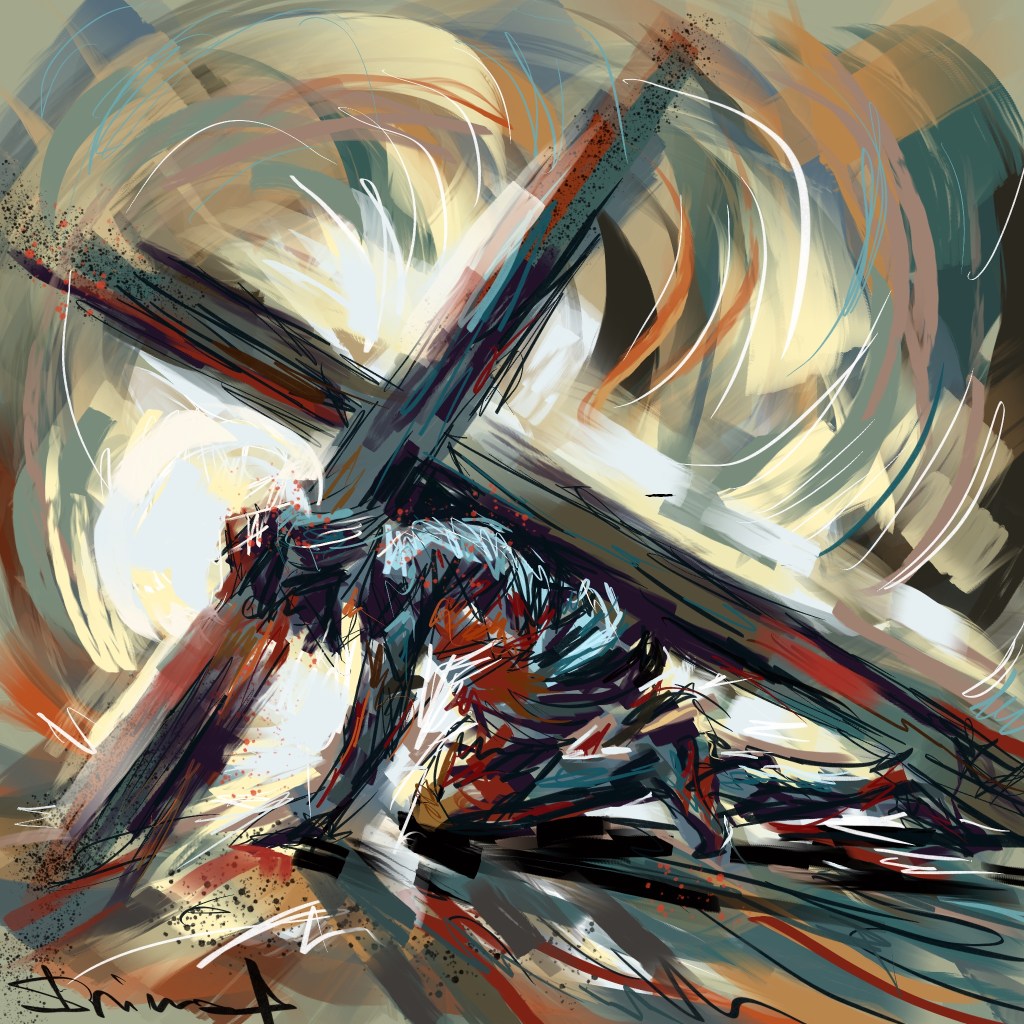
“Third Station: Jesus Falls” is the third artwork in my Lenten series on the Stations of the Cross, created in preparation for Good Friday. It evokes the weight of our own suffering—often as random, unjust, and undeserved as that of Jesus—that at times threatens to crush us. Yet the composition subtly forms a tunnel, leading the eye past the figure on the ground and toward the light in the background, acknowledging the presence of God in all that we endure, and the hope of eventual peace and rest that awaits us all in eternal communion with the Creator.
In the past weeks, our community has been touched by loss, and many of us are processing the grief of recent deaths. It’s natural to ask why bad things happen to good people and why tragedies strike without warning or reason. Is death a natural part of life, or a necessary transition from the material (equated with sinful) to the spiritual (equated with pure) existence? Is the material necessarily sinful? People of all times have asked such questions, and today’s passage from Luke 13:1-5 shows that many came to Jesus in search of an explanation for a tragedy of their day—the Galileans killed by Pilate. In his answer, Jesus cited yet another event that was on their minds—the collapse of the tower that killed 18 people.
Jesus’ Jewish audience may have believed that suffering was a direct consequence of sin, shaped by the idea of divine retribution embedded in the Mosaic covenant in the Torah, many psalms linking obedience with divine protection, apocalyptic scriptures from the Hellenistic period, and Platonic philosophy that linked moral failure to internal discord and, in turn, to suffering. But for modern readers, it is hard to reconcile this view with a God of grace and the Aristotelian worldview that acknowledges external factors beyond one’s moral character—such as poverty or illness—that cause suffering and impede flourishing, even if one is grounded in virtue.
However, not all biblical texts present suffering as punishment and flourishing as the result of obedience. Jesus’ response is one example, to which I will come in a minute, but first, it’s worth mentioning that such a view is not restricted to the gospels.
In the Persian period texts, such as Deutero-Isaiah (Is. 40-55, the last of which we read today) and Job, we find a different perspective—one where suffering is not tied to sin, God is free from covenantal bonds and can neither be fully known nor cajoled by us, and our well-being is tied to grace rather than reward. Even the exile endured by Israel, typically linked to her idolatry, is portrayed as disproportionate to her sin. Further, the text calls on the exiles to return home not because they had earned it, but because God, whose ways are beyond human understanding, desires their restoration and invites those “who have no money” to “buy wine and milk without money and without price” (Isaiah 55:1).
Likewise, while Job’s friends insisted that his suffering was caused by wrongdoing, reflecting a Deuteronomistic belief, God’s response had nothing to do with moral accounting. Instead, God’s speech—very similar in language and tone to today’s Isaiah reading—highlighted the marvel of creation. The book even brings in creatures like Behemoth and Leviathan, whom we cannot tame, as symbols for the Creator who will absolutely not be influenced by human intercession, obligations, justice, or impositions of religious laws. Job’s restoration came as unexpectedly as his trials. As such, neither suffering nor happiness depends on moral failure, God’s retribution, or earning rewards, but are rather part and parcel of the vast, mysterious reality of life in God’s world.
It is more in line with these texts than with the Mosaic covenant that Jesus addresses the tragedies in Luke. He doesn’t explain why they happened or attribute them to sin. Pilate’s execution of Galileans while they offered sacrifices was a shocking act of violence—not only a murder but also a violation of sacred space and rites—that may have touched Jesus, a Galilean himself, on a personal level, possibly costing the lives of people he knew. The people were in the act of worship—shouldn’t that have protected them? This reminds me of the bombing of Sri Lankan churches on Easter morning, 2019.
The Tower of Siloam collapse was equally tragic and more random than Pilate’s volitional act of brutality; it could have been due to a structural fault, much like modern-day disasters involving bridges and dams that have killed thousands. Both types of suffering exist, and neither is deserved. Why then would Jesus turn the discussion into a call to repentance and bring in the parable of the fig tree?
One reason is to move away from judging and direct the focus inward; the second is to focus on the present rather than look for explanations of the past; and the third is to say that while physical death is inevitable and unrelated to moral failure, spiritual death (or the thirst described in Psalm 63:1 or Jesus’ own conversation at the well) is avoidable. Physical death can come unexpectedly to anyone, and therefore we must bear fruit while we can—“come home” to God, as Isaiah called the Israelites to do. The Greek term for repent, metanoeō (change mind), mirrors the Hebrew concept of “shuv”—to return home.
And not to any home, but to one filled with nourishment—“flowing with milk and honey” (Deuteronomy 26:9), or as Psalm 23 says, “my cup overflows,” or Isaiah 55’s imagery of a banquet that contrasts with the time when Israelites paid dearly for basic needs in exile (Lamentations 5:4). This banquet metaphor also recalls Wisdom’s feast in Proverbs, where food represents wise teaching and spiritual richness: “Come, eat of my bread and drink of the wine I have mixed. Lay aside immaturity, and live, and walk in the way of insight” (Proverbs 9:5-6).
To repent, then, is not simply to regret the past, but to change one’s mind to realign with God’s grace. The return of the Jews to a banquet came to be read as describing the spiritual journey of every believer to our home in God. Likewise, the fig tree, which had not borne fruit for three years, is not cut down but given care and nourishment, suggesting that while we may feel inadequate or fruitless, God continues to nurture us, giving us the opportunity to grow.
Most importantly, our admission to eternal life is not earned by following rules but is a gift rooted in God’s desire to be in relationship with us. To be sure, for the exiles to return to Judah in the sixth century B.C.E., at the dawn of Persian rule, would involve uprooting themselves and moving to an ancestral land their generation never knew—much like our own living, enduring, and trying to do what’s right.
Repentance is neither about avoiding catastrophe nor about the certainty of reward, but rather about preparing ourselves to endure whatever comes, and “come home”—stay connected to God—despite the circumstances, knowing that God will support us: “No testing has overtaken you that is not common… he will also provide the way out so that you may be able to endure it” (1 Corinthians 10:13).
Most importantly, Luke’s highlighting of the disconnect between suffering and sin subtly prepares the reader to see that when Pilate ordered Jesus’ execution—mixing his blood with Passover sacrifices—it would not reflect divine justice but the brutality of the Roman empire, resulting in the unjust suffering of the innocent, parallel to much of what every person endures throughout their lives for no fault of their own.
Yes, this has been extended in the Middle Ages to the penal substitutionary theory that Jesus is actually suffering for a reason—our sin. However, the earlier theories of atonement do not make such a quid pro quo connection. Rather, the innocence of Jesus, who willingly suffered something he did not deserve, somehow broke the hold of evil on this world (as represented, for example, by what Aslan did for Narnia!).
I don’t want to end this reflection without saying that while much of our suffering remains inexplicable, some pain does arise from our choices. In this season of reflection, let us ask ourselves if there are areas of our lives, character, or relationships that could bear more fruit. How can we embody grace and compassion, as Jesus did, rather than judging those who suffer or make mistakes? And when faced with the mystery of suffering, may we find strength in God’s presence. Amen.
Questions to Consider
1. How does Jesus’ response to these tragedies compare to the
arguments of Job’s friends, who insist that his suffering must be
caused by sin?
2. Isaiah 55:8-9 reminds us that God’s ways are higher than ours. How does this challenge our desire for clear explanations when bad things happen?
3. Instead of explaining suffering, Jesus calls for repentance. What
kind of repentance do you think he means, and how does it relate to suffering?
P.S.
“God’s Speech To Job” from “A Masque of Reason” by Robert Frost (1945)
Yes, by and by. But first a larger matter.
I’ve had you on my mind a thousand years
To thank you someday for the way you helped me
Establish once for all the principle
There’s no connection human can reason out
Between their just deserts and what they get.
Virtue may fail and wickedness succeed.
Twas a great demonstration we put on.
I should have spoken sooner had I found
The word I wanted. You would have supposed
One who in the beginning was the Word
Would be in a position to command it.
I have to wait for words like anyone.
Too long I’ve owed you this apology
For the apparently unmeaning sorrow
You were afflicted with in those old days.
But it was of the essence of the trial
You shouldn’t understand it at the time.
It had to seem unmeaning to have meaning.
And it came out all right. I have no doubt
You realise by now the part you played
To stultify the Deuteronomist
And change the tenor of religious thought.
My thanks are to you for releasing me
From moral bondage to the human race.
The only free will there at first was humans ……..
Who could do good or evil as they chose.
I had no choice but I must follow them
With forfeits and rewards they understood –
Unless I liked to suffer loss of worship.
I had to prosper good and punish evil.
You changed all that. You set me free to reign.
You are the Emancipator of your God,
And as such I promote you to a saint.
“A Masque of Reason” is a comedy play that purports to be the new ending to the book of Job, in which Robert Frost, like John Milton in Paradise Lost, wants to justify God’s ways to man.

 Irina's Art
Leave a Reply