
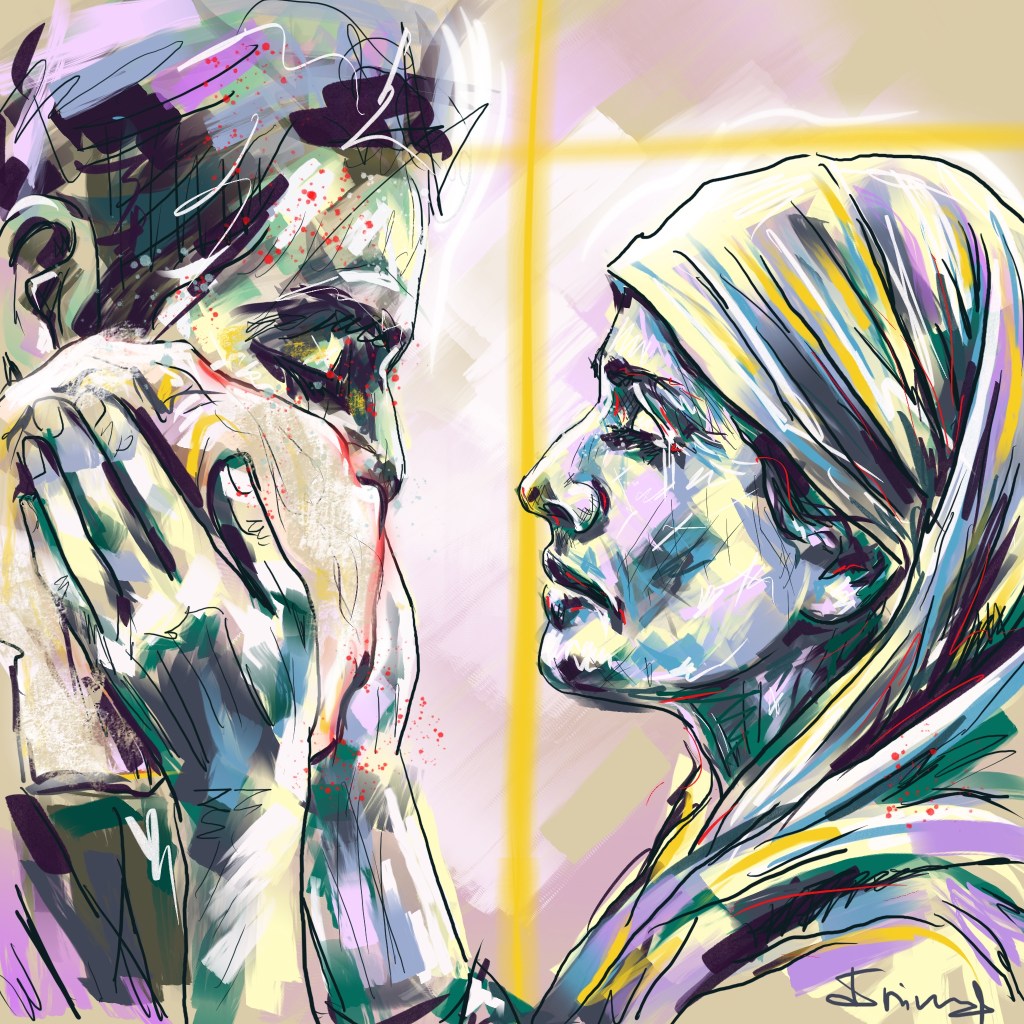
Fifth Station of the Cross: Veronica Wipes Jesus’ Face
Like the woman who anointed Jesus, Veronica steps forward with bold compassion—reaching out, touching, offering what she has. Where one poured ointment and tears, and wiped Jesus with her hair, the other wiped his own tears, sweat and blood. Both acts tender, decisive, and scandalous. Both remembered. In tradition, Veronica names and continues the story of the woman who touched Jesus’ cloak and was healed. Whether at his head or feet, these women anointed Christ with courage and compassion.
The story of Jesus’ anointing resonates deeply with me because it features a woman who was put in her place for doing something so unique and exuberant that it was perceived as scandalous. A familiar situation, sadly. We have all either seen or experienced it. At the end of this reflection, I’ll share some historical examples of women whose remarkable wisdom “got them in trouble,” but let me first review the story.
Mark and Matthew recount it similarly, while the version in John is different as expected, and interestingly, even Luke diverges from the usual consistencies of the synoptic Gospels. It’s possible that they each described separate events or that they adapted a shared story to serve distinct theological purposes. The scene takes place shortly after Jesus’ acclaimed entry into Jerusalem, just as the council of Jewish leaders began plotting to dispose of him before Passover. A few days later, Jesus was in Bethany, at the house of Simon the Leper (Matthew and Mark), or perhaps at the home of Lazarus (John). Or maybe it happened a year earlier, while Jesus was still in the north, in the home of a different Simon, a Pharisee in Nain, where Jesus had just raised a young man from the dead (Luke). The woman anointed Jesus’ head (Matthew and Mark) or his feet (Luke and John). The disciples became indignant, especially Judas, who is said to have wanted the money for himself. When that opportunity vanished, he delivered Jesus to the authorities in exchange for silver. Finally, at the Last Supper, Judas seized the moment to betray Jesus, sealing the deal with whatever information he provided—Jesus’ location, his intentions, or perhaps evidence of political threat—and thereby setting in motion the events leading to his death. Afterwards, Nicodemus, Joseph of Arimathea, and the so-called “myrrh-bearing women” went to anoint Jesus’ body. But they found the tomb empty and could not perform the burial rites. However, in a deeper sense, they didn’t need to! The unnamed woman had already done it, ahead of time.
Despite Jesus’ words that “what she has done will be told in memory of her” (Mark 14:9), only John names her: Mary of Bethany, sister to Martha and Lazarus. Matthew and Mark do not identify her at all. Luke mentions only that she “lived a sinful life,” whatever that may have meant. The criticism she receives focuses on the intimacy of the act in Luke, but in the other Gospels it’s the costliness that raises eyebrows. As a result, Jesus’ response also shifts, from framing the action as a holy necessity not to be weighed by moral utilitarianism (Matthew, Mark, John), to connecting the act with forgiveness and contrasting it with the lack of hospitality (Luke). But whatever reasons were offered for the men’s indignation, the act likely seemed scandalous to them because it was prophetic, prodigal, and unashamed. Let me speak to each in turn.
Anointing an honoured guest was customary, but typically with everyday oil, not costly burial ointments. Anointing kings, priests, or the sick was also not unusual but required priestly authority. Anointing a body for burial was nearly universal across cultures. But here, the woman’s gesture echoed the gifts of the Magi—frankincense and myrrh—which themselves prophetically symbolized Jesus’ kingship, divinity, and coming death. As such, her act anticipated what the others would not or could not understand. She publicly affirmed Jesus as mashiach in Hebrew or christos in Greek, meaning “the oiled/anointed one”. In Matthew and Mark, she anoints his head like a king. In Luke and John, she anoints his feet like a servant, or for burial.
Yet her act was not only prophetic but also extravagant. She washed Jesus’ feet with her tears and dried them with her hair, just as Jesus would later wash the feet of his disciples at the Last Supper. She broke the alabaster jar and held nothing back, just as Jesus’ body would break, pouring himself out in his Passion. To me, these parallels seem deliberate, and are quite moving.
We often find prophetic and prodigal actions uncomfortable because they disrupt convention. But I suspect the deeper discomfort for the men was that the woman acted without shame. While anointing was recognizable, wiping with one’s hair was unprecedented. There is no record of it in the literature of the time. What kind of woman allows herself such intimate contact? A sinful one, they assumed. “A woman who had done this sort of thing before”, perhaps. In 591, Pope Gregory I claimed in a sermon that the woman in Luke must have been a prostitute and identified her with Mary Magdalene, from whom Jesus had cast out “seven demons” (or epilepsy, perhaps?). That conflation stuck. For centuries, the Church taught that Mary Magdalene was a penitent prostitute. It wasn’t until 1969 that Pope Paul VI formally corrected this mischaracterization.
Even in today’s liturgy, the Church continues to overlay the story with its own assumptions. In the Eastern Orthodox tradition, the Holy Wednesday hymn—written from this woman’s perspective—is considered a highlight of the liturgical year. Lasting up to 25 minutes, it is often sung by a woman from the congregation rather than the ordained cantors. Despite, or maybe because of, this powerful platform, the hymn leans heavily into repentance, which I find excessive:
“… for me night has become a frenzy of licentiousness, a dark and moonless love of sin. Receive the fountain of my tears, O You who gather into clouds the waters of the sea… I will wash your immaculate feet with kisses and dry them again with the tresses of my hair; those very feet at whose sound Eve hid herself in fear when she heard You walking in Paradise in the twilight of the day…”
So, was the woman a saint or a sinner? Both! Like us, who at our worst may resemble Judas, Peter, or the disciples who fled, and at our best, resemble Mary, John, and the faithful who remained at the cross and sought to bury Jesus with dignity.
Throughout history, women have been shamed or dismissed for actions that were later recognized as wise, brave, or even holy. Do you remember Dr. Ai Fen, a physician at Wuhan Central Hospital, who was the first to raise internal alarms about what would become COVID-19? (I wouldn’t be surprised if you don’t.) She risked her career and safety by speaking out. Her warning was buried, censored, and her name forgotten, until time proved her right.
Likewise, consider Hildegard of Bingen, a visionary abbess and polymath. In 1178, she permitted the burial of a young man whom the Church labeled a heretic. When she refused to exhume him, her convent was placed under interdict, barred from singing the liturgy and receiving the Eucharist. She defended her decision in fiery theological letters. Eventually, her integrity was recognized, and centuries later, she was canonized and named a Doctor of the Church.
Lastly, I already mentioned Kassia (or Kassiani), the Byzantine hymnographer, the author of the Holy Wednesday hymn I quoted a few minutes ago. As a young woman, she participated in a bride-show, a custom in which the emperor selected a wife. When Emperor Theophilos remarked, “Through a woman came forth the baser things,” referring to Eve, she famously replied, “And through a woman came forth the better things,” referring to the Virgin Mary. He passed her over, and she went on to found a convent, write dozens of hymns—23 of which remain in liturgical use—and defend icon veneration during a time of fierce opposition. She wrote under her own name and left an indelible legacy in music, theology, and religious life.
Like the woman who anointed Jesus, these real-life figures remind us that acts of courage, insight, and devotion are often misunderstood in their time, yet remembered and vindicated in the fullness of truth. How do we honour unnamed or misremembered women today—in faith, in history, in our communities? Recall that Mary of Bethany is the only person in the Gospels who appears at Jesus’ feet not once but three times: when Martha did all the chores (Luke 10:39), when Lazarus died (John 11:32), and when she anointed Jesus (John 12:3). She stands alone as the one who had clarity about Jesus’ identity, to which she responded with lavish devotion, and who approached him without any reservations. And Jesus always defended her.
Jesus affirmed the women’s right to learn, to grieve, to offer costly gifts, and to lead by example, even in the presence of those who tried to silence or shame them. Above all, he allowed them to come as close to him as they dared, just as God allows us to approach and connect with God at the very core of our being. It is from that closeness that wisdom comes. May we be encouraged to draw near, to experience God’s prodigal love for ourselves, and to let that love shape us into bearers of wisdom, courage, and beauty. Amen.
Questions to Consider
- Given that women’s voices have often been silenced in public and religious life, what does it mean that a woman takes it upon herself to anoint Jesus — an act typically associated with prophets and priests? Can this moment be read as an act of resistance or reclaiming spiritual authority?
- How might the woman’s story read differently if told from her own perspective? Kassiani’s Hymn is one example — would you write a different one?
- Jesus says about the woman who anoints him, “Wherever the gospel is preached… what she has done will be told in memory of her.” And yet, the 3 out of 4 evangelists do not remember her name. What does it say about our collective memory that we remember her as “the sinful woman,” rather than by her courage, prophetic insight, or gesture of love? How do we honour unnamed or misremembered women today—in faith, in history, in our communities?
- The woman brings something materially costly (alabaster jar, nard) and emotionally costly (tears, vulnerability). How do you give gifts that are both lavish and deeply personal—and how are those gifts received or dismissed?


 Irina's Art
Leave a Reply