
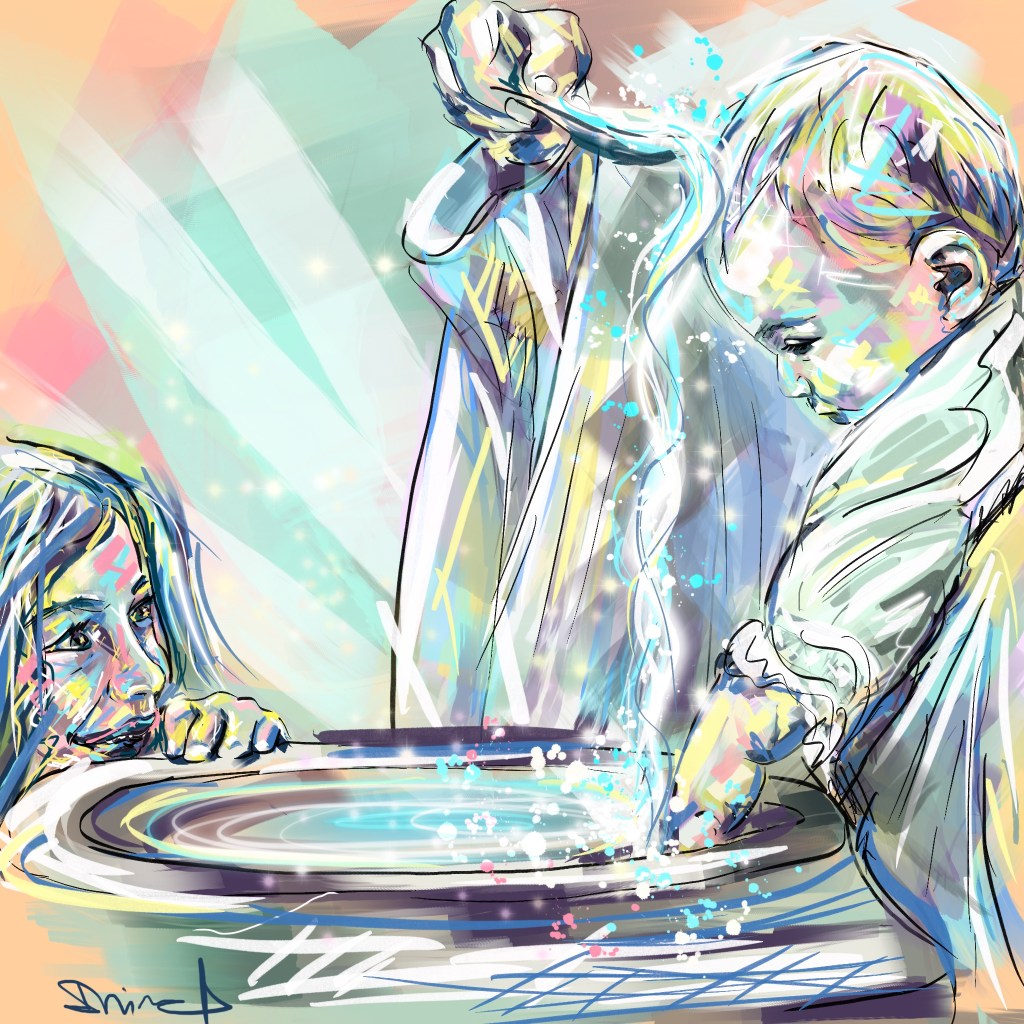
In a few minutes, I will pour water over a child’s head and apply oil to mark her with the sign of the cross. Later today, several individuals from our parish will stand before Bishop Andrew to be confirmed and reaffirm the promises once made. These distinct sacraments express the same longing: the desire to be assured and affirmed, which the story of Thomas in the Gospel of John also embodies.
In baptism, we will recognize God’s presence in this child’s brief life to-date, and open the door to her future belonging. She may not yet have the language of faith, but she is already held in God’s grace, and I hope that even later in life – say, after the turbulence of adolescence – she will still know that God accepts her as she is. Likewise, for the confirmands, who are currently navigating their teenage years, and for the mature adult reaffirming her faith, this afternoon marks not a conclusion but a deepening of faith. As Thomas in today’s Gospel, they will remember that their “Lord and God” has been walking with them all along, and always will.
When Thomas declares, “My Lord and my God” (John 20:28), it is the first time in Scripture that anyone explicitly addresses Jesus as God. Because of this, I have always preferred the Orthodox title for this episode, “The Assurance of Thomas,” rather than the Western label, “Doubting Thomas.” I appreciate the emphasis on what Christ gives rather than on what Thomas supposedly lacks because I think that, in fact, Thomas was no more hesitant than the others. They too believed only after Jesus appeared to them, and Thomas simply had missed the first opportunity.
Thomas was also every bit as loyal as they were, if not more. When Jesus decided to return to Judea following Lazarus’s death, despite the danger, it was Thomas who said, “Let us also go, that we may die with him” (John 11:16). As for Thomas’ questions, I believe they arose from integrity rather than resistance. When Jesus spoke of preparing a place for them, Thomas inquired, “How can we know the way?” (John 14:5). Many of us can relate to this. Perhaps we are the kind of people who always need a map, read instructions for every appliance, and consistently ask, “How do you know?” – not to challenge but to learn, and never to feign understanding. He may have also needed to touch Jesus in order to feel connected, just as many of us do rely on touch for a sense of closeness and support. As such, I think his reluctance to accept the disciples’ report was not a rejection of Jesus, but a reflection of reasonable hesitancy to trust those who had only recently fled in fear and broken their promises.
And yes, at the moment of Jesus’ appearance, each disciple was forced equally to confront the memory of their failure. The vision of resurrected Christ must have evoked not only awe, but also a deep sense of shame. And of course, the sight of someone believed to be dead would unsettle anyone. Yet Jesus met them with grace, greeting them with the most familiar of phrases, “Shalom aleichem” (“Peace be with you,” John 20:19), as a customary blessing and reassurance that he returned without judgment.
And to Thomas, Jesus offered not a lesson or rebuke, but what was most needed: his own wounded body, available to touch, connect with, and answer questions. It seems to me that Jesus accepted Thomas’ intellectual honesty and craving for touch just as he never condemned Peter for his impulsiveness, or Mary Magdalene for her single-mindedness in searching for his body. To each of them, he gently revealed the truth that their personality traits had momentarily obscured. In the same way, today, God’s peace meets us where we are, in our own fears and longings. It still rarely provides every answer we seek, but it surpasses our understanding, imparts the Spirit, and calms our hearts. Many of us have experienced such moments of peace, and know that they are fleeting. This is why we find such assurance in the sacraments – they invite us to return to that peace again and again. They confirm what is already true not through magic or human effort, but as signs of God’s grace in the material world.
Historically, baptism and confirmation (laying on of hands, in the West) or chrismation (anointing with oil, for the Orthodox) were all part of one unified rite that bishops conferred. However, as Christianity spread into increasingly large regions, bishops could no longer be present for every baptism and priests began to baptize on their behalf. Bishops would later visit to invoke the Holy Spirit upon those who had been baptized in the years between their visits, as a rite in which those baptized as infants were “strengthened by the Holy Spirit” and “bound more closely to the Church” (BCP). Over time, it became customary for young people to use this moment to declare their own faith – though not to supply anything lacking in baptism, but rather to give voice to the faith that had taken root. I am glad that in recent decades, the Anglican Church has returned to the understanding of confirmation as a response to baptism, not a prerequisite for receiving Holy Communion, as many of you might remember it.
As such, our confirmands will stand before the bishop today not to become something new but to name who they already are. Like Thomas, they will stand in the moment of encounter, and say “I do”, even as they may still be wondering, “So, where are we going?” This is healthy because presumption hinders learning, and faith grows through asking questions. That’s why, I think, Jesus taught that we must become like children; not to imitate their naivety, of course, but rather their openness to wonder, willingness to ask, and longing to touch. Thomas’s faith was childlike in the best sense: sincere, courageous, and tactile. I hope that we, too, never outgrow that kind of faith.
I love the prayer with which we always conclude baptismal rites, which confirms that the desire for continued learning is, in fact, among God’s many gifts to us: “… Give them an inquiring and discerning heart, the courage to will and to persevere, a spirit to know and to love you, and the gift of joy and wonder in all your works” (BAS). This prayer is for us, too, so we may find the fulfillment of Jesus’ words to Thomas: “Blessed are those who have not seen and yet have come to believe” (John 20:29). We continue to ask questions of God, and encounter him/her through the many mysterious ways in which the Spirit moves. Whether you are just beginning the journey of faith or walking a path long familiar, filled with both questions and trust, may you now hear Christ’s blessing: “Peace be with you.” May your faith be assured and continue to grow strong enough to speak truth, and tender enough to reach for grace. Amen.
Questions to consider:
1. In the Orthodox Church, this Sunday’s theme is not called the “Doubting Thomas” but the “Assurance of Thomas.” What might that tell us about the nature of authentic faith? How does the story of Thomas help us understand that faith is not opposed to seeking, but strengthened through it?
2. What do you remember of your early experiences of faith—as a child, or when your faith was young? Were questions welcomed? Did you feel that God was someone you could seek, reach toward, or question? What aspects of childlike faith do you still carry?
3. Thomas’s willingness to speak his uncertainty opened the door to one of the most powerful confessions in Scripture: “My Lord and my God.” In what ways have your own questions led to deeper clarity or devotion?


 Irina's Art
Leave a Reply