

Over the Eastertide, we take our first readings from Acts instead of the Old Testament, and today we read about the conversion of Paul. Acts recounts this event three times—first in third person (ch. 9), then in Paul’s speeches (ch. 22 and 26). Curiously, Paul writes little about it in his own letters, aside from saying that it happened (Gal. 1:13–16; Phil. 3:4–8; 1 Cor. 15:3–8). He never mentions the ensuing blindness in his letters, references it only once in a speech, and says that he alone heard God’s voice, while Acts 9 states that all present heard it. On the other hand, the purpose of Acts was not to introduce Paul or quote his letters from forty years prior, but to show the succession of authority from Jesus to the twelve disciples. So Acts portrays them as wise, decisive, and unified, and states that they commissioned Paul to evangelize the Gentiles, following his general turn toward Christ. Paul’s letters, however, deal openly with conflicts and present the disciples as secondary to his own discernment. Some scholars suggest that Mark’s Gospel, which shows the disciples as remarkably obtuse, may have even been written by a supporter of Paul to elevate him at their expense… Be that as it may, what’s clear is that from Paul’s perspective, on the road to Damascus, God not only called him but gave him a specific mission.
We do not have to reconcile all these discrepancies, and may instead learn to appreciate the voices of each author. The theme of sight and blindness strengthens the connection between Acts and Luke’s Gospel—two volumes by the same author—where Paul even tells Agrippa that God sent him to the Gentiles “to open their eyes” (Acts 26:18), just as his own were opened. Likewise, in his letters, Paul admits past ignorance and acknowledges his enlightenment, to send the same message: encountering Christ leads to clarity of vision. Indeed, Paul came to know Christ personally, despite never meeting him. Only a few years older and formed in the same theological strand of Judaism, Paul was born outside Israel and studied in Jerusalem, while Jesus rarely left Galilee and visited Jerusalem only for the feasts. Yet the vision on the road to Damascus alone was enough to cause Paul to reconsider his identity, vocation, Judaism, and concept of God.
My own perception of Paul has also changed, once I learned the extent of his intellect, education, and perseverance—and how empowering his view of female leadership actually was compared to other biblical voices. As for his tone, I used to see it as arrogant, but now recognize it simply as defensive. Like many of us, he faced rivalry and skepticism not just from outsiders, but from the disciples, local church leaders, and missionaries who came later. And his life was hard even before Damascus. Studying in Jerusalem meant being 600 km from home, possibly from age ten, with which those of you who went to boarding schools may empathize. Some believe he had once been married; if so, he knew the loss of a spouse, as many of you do. He didn’t receive a new name post-conversion but always carried his Greek nickname, Paul (meaning “small”), alongside his Hebrew name, Saul. As such, his “thorn in the flesh” may have been short stature and physical disability, or residual blindness from the light, or epilepsy or psychosis that may have caused the experience in the first place—or simply deep remorse about the past. Either way, he lived with pain and guilt, as we do.
With this in mind, might we look differently at the man sprawled beneath a horse in so many paintings, or at the central figure in Mendelssohn’s oratorio Paulus, if you prefer music? Paul’s conversion was rarely depicted before the Renaissance, but its drama certainly captivated Baroque artists who almost universally included the Horse. The horse is absent from Scripture and earlier works depicting this story, but once introduced in High Renaissance (cf Michelangelo, Parmiggianino) it became central going forward. After all, how else would a person of high status travel 200 km? But more importantly, horses, especially white ones, symbolized the ideals of the Baroque era: freedom, nobility, and power.
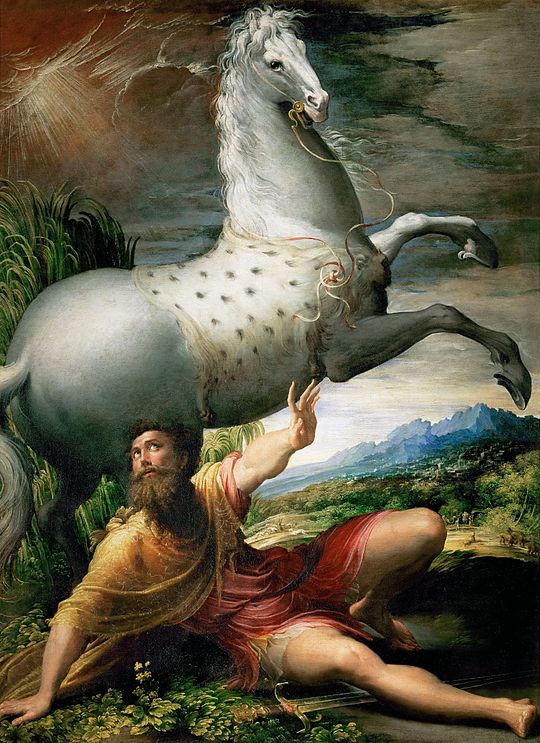
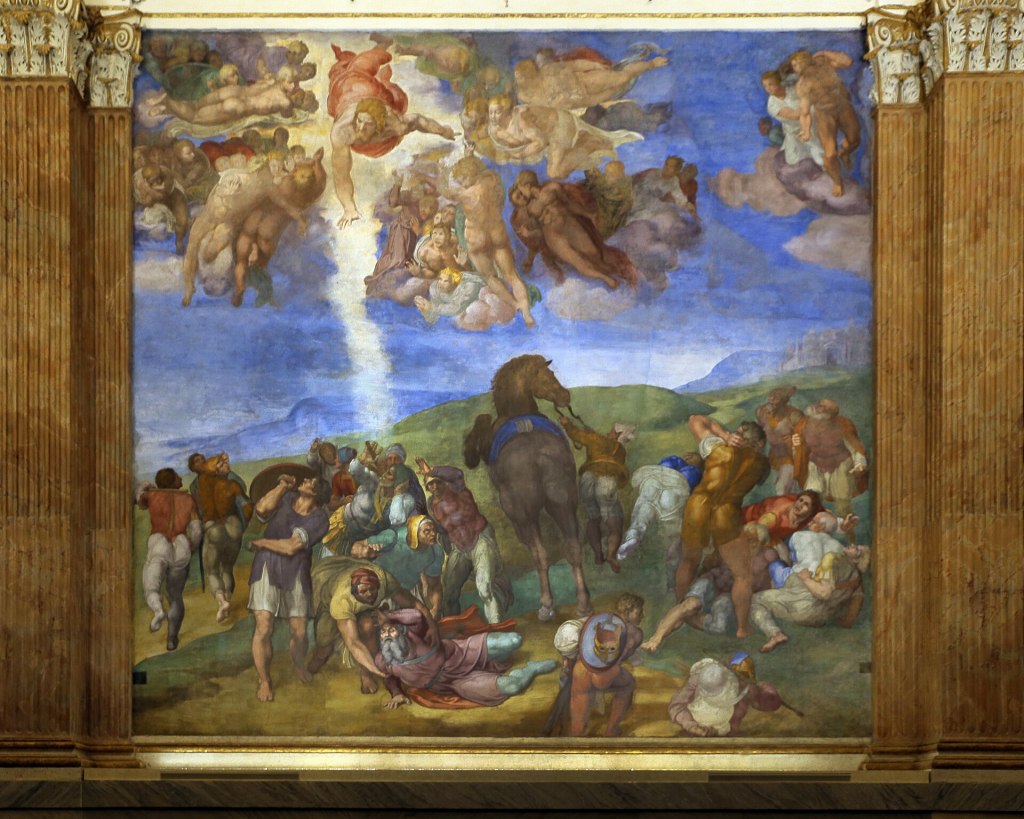


Of these works, Caravaggio’s version (1601) became the most iconic. He painted both Conversion of Saint Paul and Crucifixion of Saint Peter for Santa Maria del Popolo in Rome, to flank an Assumption of Mary by another artist.

If Caravaggio was irked at missing the central commission, it may explain why both paintings prominently feature backsides, equine and human…
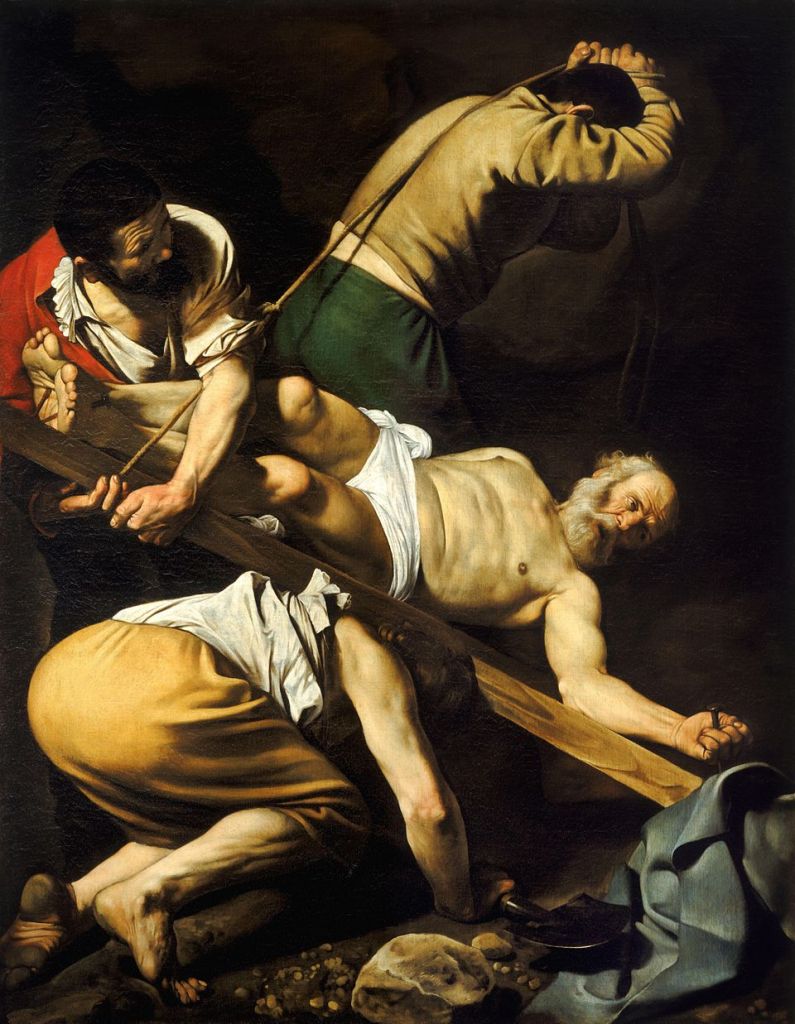

Both works are actually second versions, revised for reasons unknown, resulting in a bolder, more innovative style, yet still employing characteristic chiaroscuro and unidealized representation. Compare them with Caravaggio’s first attempt at the Conversion, still displayed in a private collection in Rome. The first Crucifixion has been lost, but is said to have looked similar to the one below, by a different artist, displayed at the Hermitage:

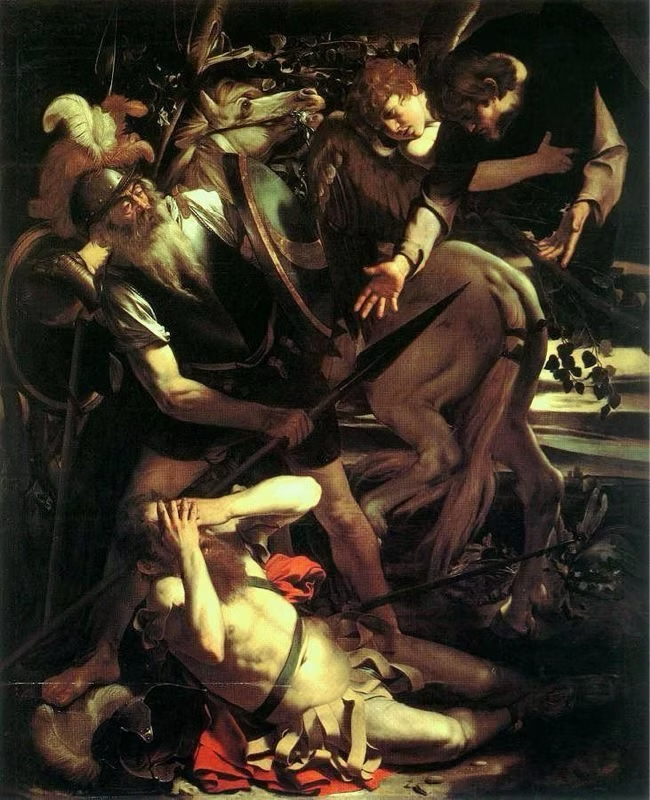
In the first version, Christ, supported by an angel, reaches toward an older Paul, who resists the light by shielding his face. The overall composition is busy and chaotic. The second version, by contrast, shows Paul as young, surrendered, and with no audience but an aloof groom. The horse is not a war steed, but a modest plough horse; unsaddled, piebald, and placid. It neither throws, bolts, nor collapses. The innovation lies in emphasizing internal, individual experience—the prevailing paradigm of future art, though still radical in the Baroque era. You can also see it in the face of St Peter in the second version. This is what drew me to Caravaggio’s second version of St Paul’s experience.
In my own composition (at the start of this post), I echoed Paul’s posture and his red and green garments as shown by Caravaggio (as did the French Neoclassical artist Lépicié, 18th century); however, my work differs in three key ways that reflect my theological understanding of this episode. First, whereas Caravaggio’s horse is detached, and other versions show wild, rearing beasts, mine stands steady—engaged, empathetic, and active even in stillness. It does not flee, but meets Paul’s gaze. It becomes a symbol not of lost power, but of waiting strength. It embodies Paul’s gifts—his intellect, charisma, poetic instincts—which remain with him, ready to be harnessed for new purposes. Second, I chose to show Paul and the horse both with eyes open, receiving the light; vulnerable yet receptive. The light forms a visual triangle between Paul, the horse, and the radiance above, suggesting that God’s call comes to us not only from above but through the created world, fellow travellers, and the natural order, never apart from the sacred. And third, I kept Paul’s age in his early forties, because that’s the time when many of us begin reevaluating their priorities and experience so-called midlife crises, which the Damascene experience may represent. But while some of us acquire red convertibles or similar in response, Paul gave up his status, home, and career to embrace danger, labour, beatings, imprisonment, and execution.
As such, change always carries a cost, but grace can call us unexpectedly, and Paul’s story reminds us that this possibility never closes. I know of public figures—politicians and philosophers—who completely reversed their convictions later in life and acted on that change. For, of course, no conversion is complete without love. In Paul’s own words: “If I do not have love, I am only a resounding gong or a clanging cymbal” (1 Cor. 13:1). Love is not only the goal of transformation but its measure. Without love, all brilliance—of mind, speech, or art—is noise. With love, it becomes music. May we never reject who we are, but continually reorient our gifts toward a deeper, humbler, and more radiant purpose. Amen.
Questions to Consider
1. Are there assumptions, habits, distractions, guilt or fears that keep me from seeing clearly in my daily life (as Paul temporarily couldn’t see)?
2. In which areas of my life am I following the plans I may have already outgrown, rather than being open to new possibilities? What small daily choices could help me better listen and respond?
3. Ananias was the ordinary person who helped Paul take his next step. Who are the people in my life who encourage me toward growth and healing? How might I be an Ananias for someone else today?
5. Paul’s conversion was not something he orchestrated; it interrupted him. Am I willing to be surprised?

 Irina's Art
Leave a Reply