


The readings for this Sunday and last work in concert to help us develop a theology of care. So many among you, when confronted with the illness or medical crisis of a fellow parishioner, respond with swift and thoughtful compassion. You prepare meals, offer rides, check in with quiet persistence, and remember one another in prayer. This capacity to respond with kindness and attentiveness, and without fanfare, in moments of crisis is already a genuine gift within our community. And yet, the Gospel always calls us further. Last Sunday’s parable of the Good Samaritan (Luke 10:25–37) affirms what we already practice while inviting us to a still more expansive vision of compassion. And today’s readings—the story of Mary and Martha (Luke 10:38–42) and Abraham’s hospitality (Genesis 18:1–10)—can be read as building upon that foundation.
As we recalled last week, the Samaritan’s compassion is striking because it is not reserved for a friend or someone of his own ethnic group. In Jesus’ telling, the Samaritan is not the object of love (as in “love your neighbour”), but the subject who acts as a neighbour. He loves the enemy—a wounded man from the very group that had for centuries oppressed his own people—and, in doing so, turns the other cheek as Jesus taught. The parable compels us to ask: might those whom we habitually fear, reject, or dismiss be the very ones who reveal to us what love looks like? And can we begin to extend that same depth of care not only to those we naturally connect with, but also to those whom we barely know or find difficult?
If the Samaritan challenges the scope of our compassion, Abraham teaches us its tone: joy mixed with duty. When three strangers appeared near his tent in the heat of the day, Abraham hurried to meet them, bowed in reverence, and prepared a feast. He welcomed them as if they were bearers of a blessing—as indeed they were—and treated them with extravagance: three measures of flour (over 24 litres) for just three guests! If these were angels, as the New Testament author suggests (Hebrews 13:2), then their visit parallels another, where centuries later, Gabriel would bring a similar message to Mary, announcing the birth of a promised child. Later still, this triadic pattern—along with Abraham’s shifting between addressing the visitors as singular and plural—prompted the association of the guests not just with angels, but with the Holy Trinity, most famously represented in Andrei Rublev’s 15th-century icon.
Just as Abraham perceived something divine in his visitors, so too did Mary of Bethany. She seemed to recognize that her guest was not merely a teacher or friend, but the incarnate God who once again appeared among the people to break bread with them. So while Martha busied herself with preparations, like as Abraham and Sarah did, Mary sat and listened at Jesus’ feet (Luke 10:39). We meet Mary a couple more times: when she anointed Jesus at another dinner in anticipation of his burial to the consternation of male guests (John 12:3), and prior to this, when her brother Lazarus had died (John 11:32). At that time, while Martha ran to meet Jesus and ask for help, Mary remained in the house until called. When she did come, she fell at his feet and echoed her sister’s words: “If you had been here, he would not have died.” As such, Mary is the only person to kneel at Christ’s feet on three occasions—and each time, Jesus defended her choice, understood her motives, and honoured her presence.
But Jesus did not dismiss Martha’s work either, and Abraham is clearly commended for his hospitality in Hebrews. It is by holding all three models together—the Samaritan on the road, Abraham at the tent like Martha in the kitchen and demanding help from Jesus, and Mary at Jesus’ feet—that we arrive at a comprehensive theology of care, where caregiving is not merely a list of tasks, but a posture of the heart that brings together both action and stillness, hospitality and contemplation, and touches both friends and strangers.
A pragmatic, task-oriented caregiver is essential, whereas contemplative, present-hearted companionship sustains what mere action cannot. We need both within ourselves and among one another. Most of us feel more useful when we are busy, but there inevitably comes a time in caregiving when all the doing that is generally so important falls away, and we find ourselves at a loss as to what can be fixed or managed. There comes a time when love no longer looks like productivity, but simply like staying to the end.
Some time ago, I read Alison Acheson’s moving memoir Dance Me to the End: Ten Months and Ten Days with ALS (2019), in which she reflects on caring for her husband Marty through his final year of life. I remembered it now because Acheson devotes an entire chapter (ch. 24, pp. 68–72) to the story of Mary and Martha—one she had heard as a child, dismissed as irrelevant, and later rediscovered as a caregiver. She wrote:
“There were too many of me… I wanted to be… a loving spouse, or artist daydreamer…. This other person I was revealing myself to be seemed incapable of anything beyond list-making and research and careful cooking.” (p. 68)
Reflecting on the sisters’ grief at losing Lazarus, Acheson drew parallels to her own anticipatory grief:
“In my heavier months of caregiving, they just showed up without being asked, and stepped through the doorway—Martha with a look of superiority in her unflagging energy, and Mary with such accusation: What was wrong with me that I didn’t understand that love—simple love—had all one needed to get through?” (p. 70)
Acheson felt much more comfortable in Martha-mode, as many of us do:
“As a mother of three, working in and out of home, I’ve had to be Martha… We’re the ones who opt to be designated driver with one glass o’ red, no more, over taking a cab… We make meals that result in real leftovers… keep straight in our minds and on our calendars all those classes and practices and games, alongside our own work schedule. Martha is capable and convenient.” (p. 70)
Yet even as she leaned on Martha’s steadiness, Acheson began to understand her own longing to follow Mary’s path of intuitive presence:
“As a wife, I’ve ached to be Mary” (p. 70), and “Even as a writer, Mary has been my go-to desirable—the bohemian, the artist, the one who eschews the everyday concerns and can spend hours looking out the window. Mary indulges. And I am pulled towards her.” (p. 71)
But still, “left entirely to Mary, would the words get on the page?” (p. 71) And so she concludes with grace:
“The ability to take on new roles is imperative—to slip in and out of either Martha or Mary and to suspend judgment on which is more significant or needed” (p. 293) and “Martha’s going to lift her sister Mary from where she is kneeling, and together they’ll dance” (p. 312)
Martha’s dedication to action and Abraham’s instinctive care illustrate what many in this parish already embody: we know how to set a table, literally and figuratively. And Mary’s contemplative stance and desire for spiritual nourishment—both for herself and others—are also present among us.
So let us not turn away from what we already do so well, and continue offering both practical and spiritual care: our unflinching presence and unceasing prayer, meals and visits, rides and flowers… But let us also stretch. Let us notice whether we tend to lean toward action or presence, and if so, discover “the other sister” within ourselves. Let us extend that same compassion to unfamiliar faces, as exemplified by both Abraham and the Samaritan, and discover joy in doing so as Abraham did.
Are we prepared to widen the circle of belonging, trusting that we might be entertaining angels—or at the very least, honouring the image of God—in those who are quieter, newer, or less visibly connected? Is there someone you have noticed here but never spoken to? Someone returning after a long absence? A face you recognize, but a story you do not know?
The church is sustained not merely by shared values, histories, and acts of care, but by the continual forming of genuine relationships in Christ, in ever-widening circles.
“Do this,” Jesus said, “and you will live” (Luke 10:28).


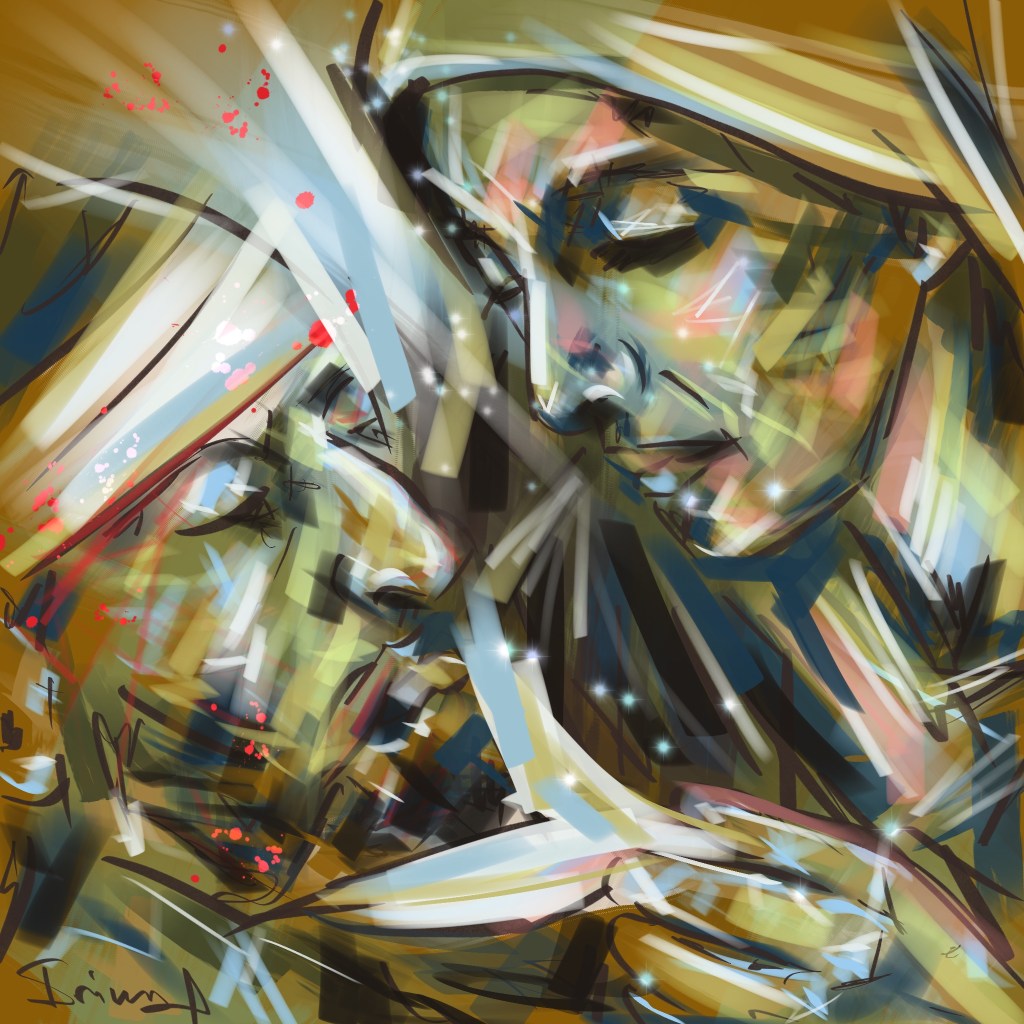
 Irina's Art
Leave a Reply