
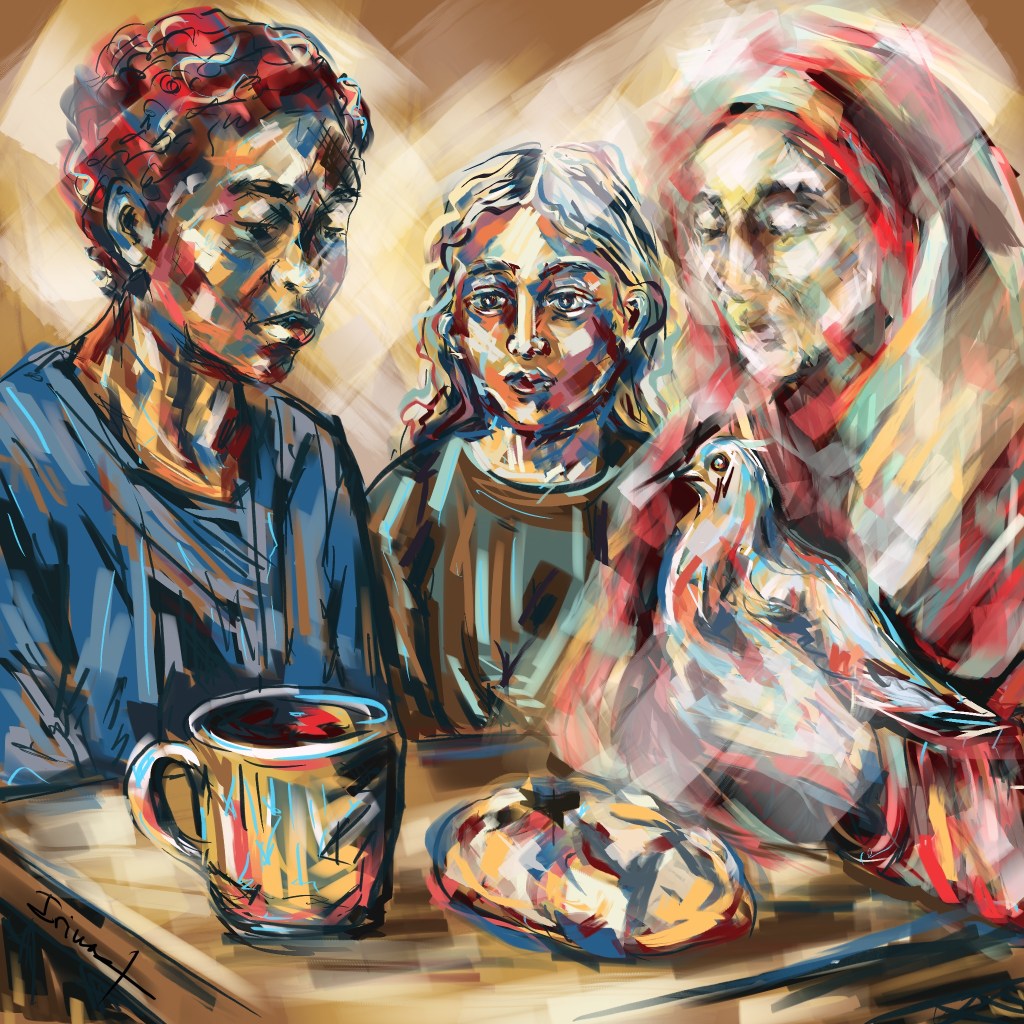

“Do not neglect to show hospitality to strangers, for by doing that some [i.e. Abraham in Genesis 18] have entertained angels without knowing it.” (Hebrews 13:2)
A few weeks ago our readings paired the stories of two meals: Mary and Martha’s dinner with Jesus, and Abraham’s with his three mysterious visitors. It is to the latter that the writer of the letter to the Hebrews alludes in today’s reading, saying, “Do not neglect hospitality, for through it some have unknowingly entertained angels” (13:2). So let’s return to the theme of hospitality.
Central to human life even now, hospitality in biblical times and places was more than courtesy. In an arid land where water and food could mean life or death, it was both a mechanism of survival and the currency of honour because anyone could suddenly be in need. In the Old Testament, we find this duty illustrated in the stories of Abraham’s three visitors, Lot and the angels in Sodom, Abraham’s servant receiving water from Rebekah, David and his army fed with the sacred bread normally reserved for ritual purposes, prophets Elijah and Elisha housed by the poor, and many sections of the book of Proverbs, where the Wisdom of God herself sometimes serves as host.
Today’s Old Testament text from Proverbs 25:21-22 is quoted by Paul in the New Testament: “If your enemy is hungry, feed him; if he is thirsty, give him drink” (Rom 12:20). Likewise, Jesus said in today’s gospel: “When you give a banquet, do not invite your friends or your rich neighbours, but the poor, the crippled, the lame, and the blind” (Lk 14:13)—that is, not those whom you like, or expect to reciprocate. Jesus spoke from experience, for he and his disciples often relied on the kindness of strangers. Several women funded his ministry. The Samaritan woman gave him water. Peter’s mother served him after being healed. The disciples on the road to Emmaus invited him to stay before realizing who he was. Mary, Martha, and Lazarus invited him for dinner more than once, as did many other figures in the gospels. And unlike the guests in his parable, Jesus was able to return hospitality, not only through food miraculously multiplied and water turned into wine, but also through healings, compassion, and the restoration of dignity.
But in biblical times, hospitality was also governed by a rigid societal code. First, messengers or servants of those with higher status were to be treated as though the master himself had arrived. That is why Abraham’s servant, sent to procure Rebekah as a wife for Isaac, and Abraham’s three visitors, sent by God himself, were treated so generously. In addition, in this honor-and-shame culture, where one sat at a table reflected one’s social standing, so the book of Proverbs counselled: “Do not put yourself forward in the king’s presence or stand in the place of the great; for it is better to be told, ‘Come up here,’ than to be put lower in the presence of a noble” (25:6–7). This is the teaching that Jesus, in Luke’s Gospel, expands into a parable (Lk 14:7-11). He imagines a banquet where guests scramble for places of honour, and warns them not to choose the best seat lest they be asked to move down in shame. Instead, he counsels taking the lowest place, so that one might be asked to move higher.
Public humiliation was to be avoided at all costs, while public honour was life’s highest goal; thus it is understandable that people would try to advance, even if only in appearances. However, to me, this parable includes more than guidance on etiquette, or a call to modesty. It is, I believe, also about trusting God to guide us into the vocation and purpose that are truly ours – to place us where we truly belong.
Have you ever literally chosen the wrong seat (say, in a theatre or on an airplane), or perhaps claimed a role, a recognition, or a place that was not yours, only to be gently corrected, and then to find that the host’s kindness overcame your mistake? That moment itself may serve as a parable of God’s grace: we make mistakes, but God’s hospitality covers them and re-seats us where we belong. I find myself thinking, too, of moments in my own life when I longed for a place that was not right for me. Countless times I desired one or believed I deserved one, and life humbled me, particularly in the academic world: papers rejected for publication, interviews that did not lead to jobs, scholarships missed by a single ranking, unfair student evaluations, and working in a research associate role when I saw myself as a principal investigator, which in time led to a period of depression. Looking back, I could say that my entire attempt at an academic career was the process of seating myself in a place that was not necessarily undeserved, but not the best fit, or not as life-giving as what I do now.
We are rarely ready to take the lower place, to let God seat us where we truly belong, and to trust that what may feel like failure in the moment can, in time, become the better path for us. That is why both scripture and the church’s rituals and traditions help us to remember this. For example, this weekend may be a good time to recall the customs that mark the close of summer and that also focus on hospitality, reminding us of our dependence on God and on one another. In England, Lammas, or “loaf-mass,” on August 1 honoured the grain harvest with bread baked from the first wheat offered in church. The day coincided with the Celtic festival of Lughnasadh, one of the pagan cross-quarter days (halfway between solstices and equinoxes), which Christianity transformed into a feast of thanksgiving, as it did with other days of astronomical and agricultural significance that occur roughly every six weeks: Michaelmas (Sept 29), All Saints (Nov 1), Christmas (Dec 25), Candlemas (Feb 2), Annunciation (Mar 25), May Day (May 01) and Nativity of St. John (June 24).
In Russia, August brings three Spasi, or “Feasts of the Saviour.” The first is the Honey Feast of the Saviour, kept on August 14 in the Gregorian calendar, which happens to be the same date as Lammas, August 1, in the Julian calendar used by the Orthodox Church. Honey is blessed and eaten, and the day honours beekeepers. It is also called Wet Spas, because of water blessings, or Makoviy, in reference to the blessing of poppy seeds. This feast leads into the Dormition of Mary fast (called Assumption of Mary in the Catholic world), and is followed by the Apple Feast of the Saviour on August 19, and the Nut Feast on August 29. Evidently, pre-Christian harvest customs linger here too, transformed into Christian thanksgiving.
Lastly, in our Anglican tradition, echoes of seasonal hospitality also remain. The old “Stir Up” collect – “Stir up, we beseech thee, O Lord, the wills of thy faithful people; that they, plenteously bringing forth the fruit of good works, may of thee be plenteously rewarded” – was prayed on the last Sunday before Advent, when households would literally stir their Christmas puddings that needed weeks to mature. Now we say it on the first Sunday of September, which in our parish neatly coincides with the beginning of the “Christmas Kitchen” baking. Here again, faith and food meet in tradition!
Beyond seasonal variation, in the Eucharist we celebrate each week, we also sanctify the ordinary gifts of food, and we know that no one takes the higher seat. We are all guests of Christ, sanctified by his mysterious presence. Thereby, this meal erases the divisions of powerful and weak, rich and poor, honoured and dishonoured, friends and strangers.
Wine and bread, baskets of apples, jars of honey, and loaves of fruitcake: is there still room in our spiritual life for these tangible offerings, reminders that God sanctifies the ordinary? I believe so. As another summer ends, may the fruits of the harvest and the words of scripture remind us to be willing to give and to receive.
We practice hospitality to God directly in prayer, worship, and daily choices, or indirectly by welcoming others as bearers of God’s image—not because we like them or agree with them, but because Christ is present in every human life. And we also receive the hospitality of God and of other people, both in the consolation that comes through prayer and sacraments, and in the “cups of water,” those large and small kindnesses, that are the true currency of God’s kingdom. Which of these comes more easily to you? We all have unique gifts and preferences, but our shared task is to welcome humbly, to sit lightly in whatever place is given us, and to give thanks for every small taste of the abundant hospitality available to us through God and through one another.
 Irina's Art
Leave a Reply