
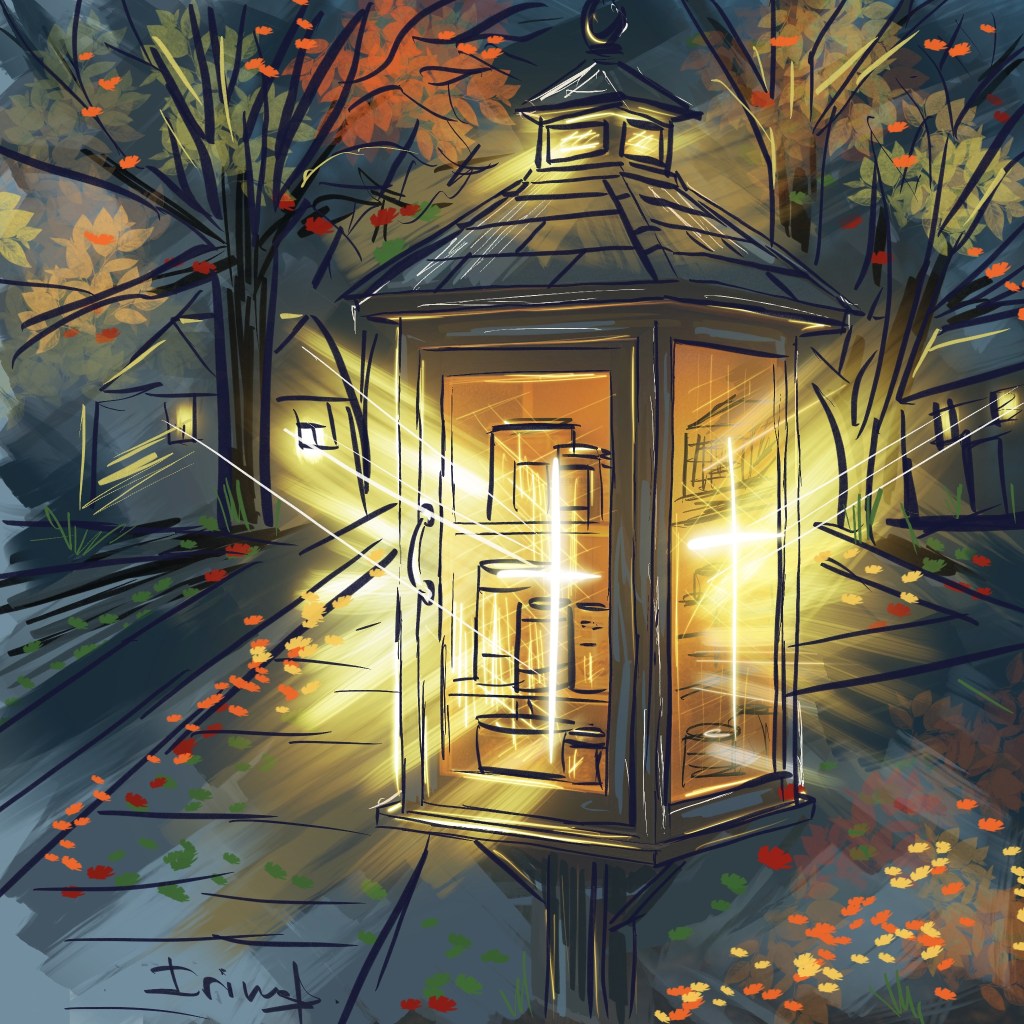
As I began to reflect on our readings for this Sunday, three recent events in parish life directed my thoughts.
First, over the summer, L.L., who was managing the work associated with our Little Free Pantry (LFP)—the box outside our building stocked with canned tuna, peanut butter, toothbrushes, juice boxes, granola bars, and similar items—asked the twenty or so volunteers involved in this ministry for their feedback. The survey focused on whether we should continue the Pantry in its current form, as we have since its installation during COVID, and whether we should still stock it with the same items – does the food truly reach those in need and make a real impact? A couple of weeks ago, as we discussed these results at a wardens’ meeting, I was asked to share my view with the larger congregation, since the questions touch on theological and pastoral concerns that may reach beyond the LFP and our parish life.
Second, last weekend I attended, for the first time, our annual work weekend at Moorelands camp in Algonquin Highlands. This project may not be widely visible in our congregation today, though it was our own parishioners who started it and have participated faithfully for more than three decades. While there, I realized that the same kind of questions arose as with the Pantry. Why do we keep going there? Is it a parish ministry, or simply a project for a group of families and their friends from outside our parish? What does it mean for St Tim’s to help at a camp that is not explicitly Christian, and with seemingly non-essential work?
The third event was our Advisory Board meeting, where again the issue of investing in our community surfaced. As it often does, the conversation turned to spending versus saving, prudence versus recognizing that we are blessed with abundance. Which programs, building modifications, or equipment purchases truly benefit the parish, and should we do what we can now, while we have the funds and the wardens willing to invest their time, or wait and make changes over the years? What about improvements that go beyond safety codes and basic accessibility, such as those that enhance human dignity and allow us to enjoy beauty in our common life?
So, I began to read today’s Scripture through the lens of these questions. The prophet Amos spoke in the eighth century BCE, during a time when Israel was materially prosperous (like our parish is today). Crops were plentiful, trade routes secure. Yet, as it is with the larger economic systems in our contemporary world, beneath the surface lay grave injustice. Merchants cheated the poor with rigged scales and short measures, even selling what should have been discarded as waste. For Amos, this was about more than dishonesty in trade—it was Israel forgetting its own story. The people who had once been strangers welcomed, and later slaves oppressed in Egypt, should not have been oppressing their own.
Centuries later, Jesus preached on a hillside in Galilee. To fishermen and villagers, he declared: “You are the light of the world. A city built on a hill cannot be hidden. No one lights a lamp and puts it under a basket, but on a stand, where it gives light to all in the house. Let your light shine before others, so that they may see your good works and give glory to your Father in heaven” (Mt 5:14-16). Light in Scripture is always a significant metaphor: it is the first act of creation, the pillar that guided Israel in the wilderness, the radiance of God’s glory in the temple, Jesus’ glow at transfiguration, and etc. And Jesus told ordinary people: you are that light. Amos named the darkness; Jesus called people to shine within it.
So, back to our own concerns. Why continue the Little Pantry? What about “clients” arriving by car, or those who appeared well dressed? Would our resources not go further if we sent our money to a large food bank? Are granola bars the best way to address food insecurity? Well, our Pantry is not the most efficient way to feed the hungry, to be sure. But, it is certainly a lantern on a stand, as I represented it in my bulletin cover illustration. It is small but embodies light, saying to our neighbours and to ourselves that this parish is alive, attentive, and caring; that we see the need; that food is not a commodity but a gift. Our direct impact on poverty may be modest, but the symbolic and communal impact is deep. Money given to large food banks is important, but it disappears into an anonymous sea of need. The Pantry, on the other hand, is tangible, local, and allows us to help in small ways, here and now. It teaches us to suspend judgement and remember that appearances can deceive: a car or neat clothing does not guarantee a full cupboard. Many who rely on Ontario Disability Support, for example, live well below the poverty line and work hard to preserve their dignity. To give daily without “strings attached” is a way of shining light.
It is for the same reason that we go to Moorelands. Presence matters, and children of every background—not only Christian—deserve to experience nature, movement, and beauty. Our work at camp this year included tidying, repairs, inventory, painting boats, arranging rocks, refinishing furniture, and chopping wood for campfires. These are not urgent tasks by any means, yet they free staff for essential work and add joy and beauty to the camp. And as a few of us imagined the camp during the summer months while we walked the grounds—children running through the woods, paddling boats, or sitting by fires we had prepared—we felt as though we glimpsed the light.
And what about our own building? Should we spend or should we save? Should we invest in “extras”? My view is yes: if we are called to be a lantern, then we should become as accessible, dignifying, and beautiful as we can afford to—today.
Accessible, so that no barrier of architecture, sound, or language excludes anyone from belonging. We’ve made some progress with this recently, and it’s clear that we can do more.
Dignifying, so that no one must endure challenges that make participation harder. As we discussed at the Advisory Board meeting, yes, it is possible here to use a chair lift each time one needs the bathroom during a service, or in case of fire to escape the Loft through a pull-down window. These meet legal codes. But are they as dignified as visiting a washroom on the nave level without having to ask for help with the lift, or a pivoting window that allows easy exit onto a roof even for those who use mobility devices? And what about creating a burial space such as a columbarium on our grounds? Not essential, not immediately profitable, and yet what a comforting and powerful reminder of the communion of saints who worship together in life and in eternity, and whose love transcends death.
And then there is beauty. We may overlook it out of concern for practicality. But for nearly two millennia—from the painted catacombs to the soaring cathedrals, to gleaming vessels, embroidered vestments, and choirs that blend professional skill with parish voices—the church has borne witness through beauty as well as service. Beauty glorifies God, lifts our spirits, and attracts the attention of newcomers, even when we ourselves have grown desensitized to it.
So to invest in the accessibility and beauty of our building, and to enhance our dignity, does not seem to me a lack of prudence, but rather our testimony and our light.
Hunger is about more than scarcity; it is about systems, choices, and who gets seen or unseen. Good works are not private charity but visible witness; they let people glimpse another way of living freely out of our God-given purpose. Amos shows us the injustice that comes when needs and dignity are forgotten, while Jesus calls us to embody the opposite: community, visibility, generosity. In a culture that prizes efficiency and scale, Scripture reminds us that feeding, welcoming, and beautifying are all part of the same call.
Almighty God, who called your people to be the light of the world and a city set on a hill. Grant that this parish may be a lantern in our community—accessible to all, dignifying every person, and adorned with the beauty of holiness—that through our witness your name may be glorified, through Jesus Christ our Lord, who lives and reigns with you and the Holy Spirit, one God, now and for ever. Amen.
Questions to Consider
Key Verse:
“In the same way, let your light shine before others, so that they may see your good works and give glory to your Father in heaven.” — Matthew 5:16
- Amos warns against trampling the poor. How does our food pantry serve as a small but visible act of resistance to that kind of neglect?
- Why is it important that we sometimes support organizations and people outside explicitly religious circles, like Moorelands camp? How does that reflect the spirit of generosity without “strings attached”?
- How do you feel when you see people taking from the pantry who don’t “look poor”? How might we move past judgments about who is “worthy”?
- In what ways can we invest in making our building more accessible, dignifying, and beautiful? Which of these speaks most to you right now?
- Just as at Moorelands we did tasks that weren’t strictly essential but made the camp more welcoming and joyful, what “beautiful extras” might God be calling us to tend to in our church?


 Irina's Art
Leave a Reply