
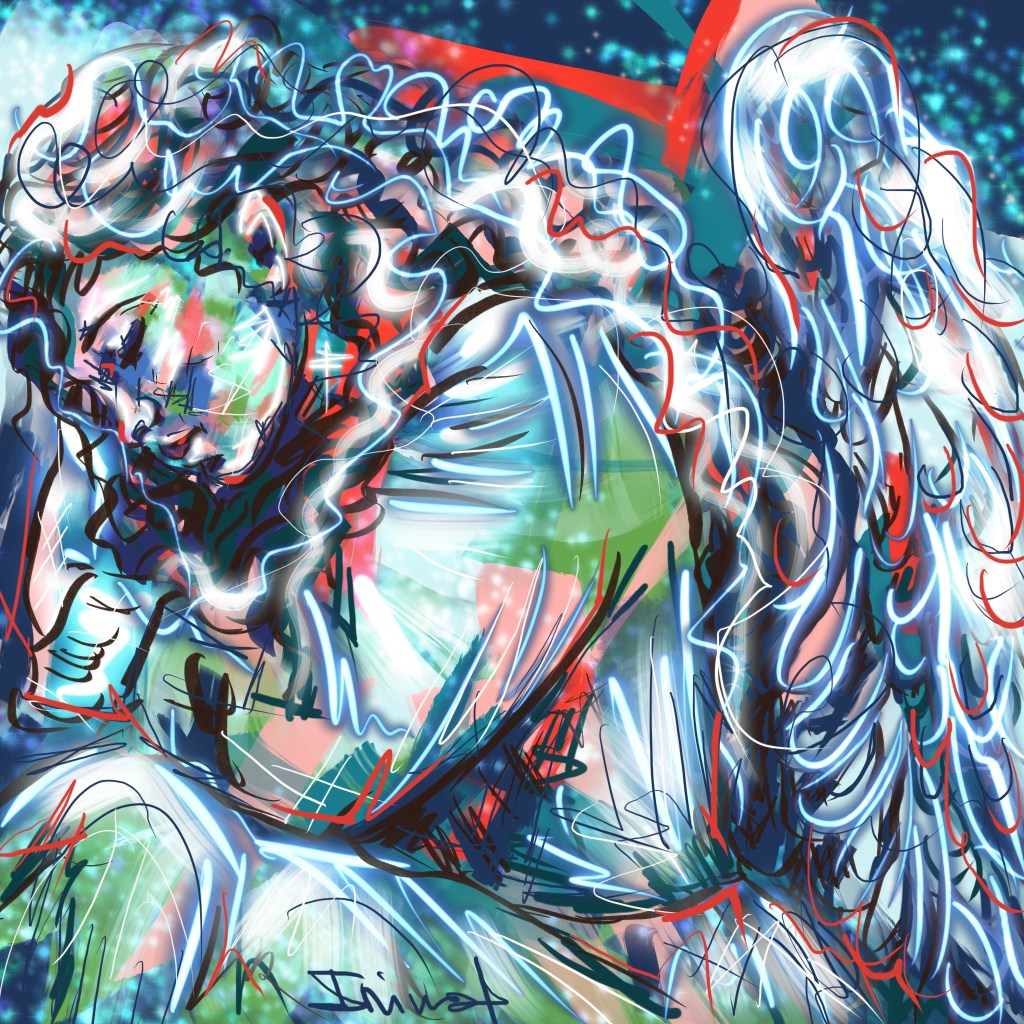
In scripture, angels often arrive hidden in the ordinariness of life, and are glimpsed only once human eyes adjust to the mystery. This drawing invites us into that same experience: the angel is present, yet veiled in colour and motion, light and line. Where do you begin to see the angel take form? In the bowed head, the arc of a wing, the radiance of light? And what does it mean that the holy is not always obvious, but discovered through attention and patience?
In my children’s message this Sunday, I will reference K-Pop Demon Hunters, the recent animated film that shows both singers-hunters fighting demons in the streets and young people wrestling with doubt and despair within their hearts. Clearly, this modern-day fairy tale has renewed the interest in an archetypal battle between good and evil in a wide range of audiences. Since its release in June, it has become Netflix’s most-watched film ever! I get it — you can’t beat the combination of incredibly energetic music, accurate cultural references, slightly dubious humour, a fairly complex plot for this type of a movie, and even the feminist touch: the girls are finally shown as hunters rather than those hunted for their danger and allure, as witches, sirens, Lilith, and all kinds of mother-death goddesses have been in mythology and history.
And I feel that the Feast of St. Michael and All Angels is the one day a year we can discuss such a film in church — the day when we, rational and intellectually inclined Anglicans, pause to remember that line of the Nicene Creed which affirms that our lives engage with the realities that are both “visible and invisible”.
Scripture presents us with its own set of symbols to represent these. Revelation 12:7–10 tells of a war in heaven between Michael and his angels and the dragon and his demons who were, in fact, once angels and rebelled against God. In Genesis 28:12, Jacob dreams of a ladder reaching from earth to heaven, with angels ascending and descending upon it. And in John 1:51, Jesus references that very passage in his hint to Nathanael that he himself is the fulfillment of Jacob’s ladder — the ultimate spiritual conduit through whom people may encounter God.
At first glance, these readings might feel distant from our experience. Even Led Zeppelin couldn’t tell us exactly where we may go to buy a stairway to heaven… And yet we can readily connect these symbols to reflections of human psychodynamics in our own popular culture. They are about the constant reality of spiritual battles in our hearts and in societal systems. Most strikingly, the demons in Revelation are cast out of heaven only to begin terrorizing the earth — hardly a victory, but rather the beginning of the war, in which we are all active participants.
In the Bible, both Satan and the Dragon are called “the accuser.” They personify the main way that evil exerts its hold over the world: deception and distortion. It works in our hearts and minds like the head-demon Gwi-Ma in K-Pop Demon Hunters, who told the character Jinu, “You can’t do anything for your family, and only I can make you good enough to help them”. Like the serpent in the garden, who said to the archetypal parents, “Did God really say that…?” Like the evil spirit in the wilderness, who presented Jesus with distortions of his true calling.
The temptation is never to abandon God outright, but to turn trust into suspicion and bend the truth just enough to make it a half-truth — a shadow of what was true, as the demons themselves were once angels. Tolkien captured the same idea in the orcs, who were once elves mutilated and twisted by Sauron into dark creatures. As St. Augustine said, evil is “no thing” — it is never a creation in itself (for God made everything good!) but always a parasite that feeds on what is good, as Gwi-Ma feeds on human souls.
In a few days, we will celebrate the seventy-fifth anniversary of the laying of the cornerstone of this church — September 30, 1950. St. Timothy’s first rector once said that this building was “a dream which God put in the minds of men.” This language brings me back to Jacob’s dream in Genesis — the ladder stretching from earth to heaven. Isn’t it incredible that what was once only a dream has now helped to connect people to God for seventy-five years! But we would do well also to remember the world into which that cornerstone was laid, where systems of care, first presented as respectable and well-intentioned, became distorted and morphed into places of cruelty and deception.
The tragedy of residential schools in Canada, which we remember this week by wearing orange, is that they were introduced as being “for the betterment of children” but became instruments of cultural genocide. Sadly, this is far from the only crime against children, sanctioned by our government and carried out by the church, that paved the road to you-know-where with seemingly good intentions.
At the same time that St Tim’s was built in the 1950s and residential schools reached their peak enrolment, church-run “homes for unwed mothers” were being established, lasting well into the 1960s and 70s. Their stated purpose was to provide shelter and care for pregnant teenagers, but in practice they imposed inhumane, punitive conditions and coercive adoption practices — pressuring and forcing young mothers to surrender their babies without even the chance to name them or say goodbye — and profiting greatly from the adoption fees.
Meanwhile, an earlier tragedy was just winding down: the so-called system of British Home Children, in which over 100,000 children from poor families and workhouses in the UK were sent to Canada between 1869 and 1948 as indentured labourers. Supposedly an opportunity, it was in fact exploitation, marked by neglect, abuse, and death.
Each of these systems was cloaked in respectability, yet fuelled by deception, profit, and the willingness to call evil “good” when it served power. The Government of Canada has formally apologized to the first group of survivors — those of the residential schools — but not to the others, which I find regrettable. Yet that was the wider landscape of Canada’s dreams in that generation: some dreams built ladders toward heaven, and others distorted what was good and turned it into harm.
So no, angels and demons are not only supernatural beings somewhere in the sky or underground, and their battle is not merely a myth. They are images of the impulses and influences that push and pull us, and shape our lives on both the systemic and the individual levels. We all know the voice that tells us we are not enough, urges us to despair, and tempts us to selfishness or cruelty. And we also know the voice that strengthens us, the presence that comforts us, the nudge toward kindness or truth. These voices are real, even if the angels and demons are not.
Like the magnetic north of a compass, which pulls the needle but is not true north, our lives are subject to many such pulls — habits, approval, trends, and beliefs that look persuasive but can mislead. Demons are the voices that distort the compass. Angels are those influences that draw us toward the true north. Sanctification — the lifelong process of becoming holy — is learning to recognize, again and again, when we have been pulled off course and turning again to God.
Paul names this inner struggle plainly in Romans 7:19: “I do not do the good I want, but the evil I do not want is what I do.” But he also assures us that, “God’s Spirit is changing us bit by bit, making us shine brighter and brighter with God’s goodness” (2 Cor 3:18). The Spirit is at work, protecting us like that golden shield in K-Pop Demon Hunters, which was maintained by the characters’ singing as our own prayers and worship strengthen us.
Yet our task is not only to hide under that shield from all that is wrong. The challenge for us today is to discern which kind of dream we are living into. Are we building ladders of connection, where heaven and earth meet in healing, truth, and welcome? Or are we allowing deception and distortion to creep in, twisting good intentions into something destructive? Our church’s cornerstone still asks us that question.
Like Jacob’s ladder, this place was built to be a connection between heaven and earth. And like Jacob, who woke from his dream and said, “Surely the Lord is in this place — and I did not know it” (28:16), we know intuitively that God is present here, but we cannot always anticipate exactly how that connection will appear: what new ministries will be born, what persons will be touched, how Christ’s love will be made manifest, what healing might be offered without our realizing it. The stones alone do not make the connection. It is our life together, our worship and prayers, our acts of love and service, that become the rungs of that ladder, joining God’s presence to the world around us.
May our church building continue not as a fortress, citadel, or stronghold from which we hide from the world and fight against it, but as a foundation for healing and welcome. A place that helps us recalibrate our compass in alignment with the true north, where we come to know that we are seen by Christ, as Nathanael was: “I saw you under the fig tree” (Jn. 1:48). To be seen is to be recognized, to be called, and to be told, “You’re good — you’re enough.” Thanks be to God.
Questions to Consider — for Adults
Key Verse: “Bless the Lord, all you his hosts, you ministers of his who do his will” (Psalm 103:21)
- Have you ever recognized God’s presence, or encountered an angel, only in hindsight?
- Do you believe in “angels and demons,” “all that is seen and unseen,” and the “powers and principalities” — forces that can comfort and strengthen, or else distort and oppress?
- In Revelation, demons were once angels who turned away from God. Can you think of good intentions that ended up leading to harmful outcomes, in your own life, and in the world today or in its history?
- What distracts you from noticing the holy in daily life? What helps you slow down and see?
- How might you practice finding God’s messengers in the midst of busyness, struggle, or doubt?
Questions to Consider — for Children
Key Verses: “Sometimes I don’t do the good things I really want to do. Instead, I end up doing the things I don’t want to do” (Romans 7:15) and “God’s Spirit is changing us bit by bit, making us shine brighter and brighter with God’s goodness” (2 Corinthians 3:18)
- Good vs. Evil in the Heart
The main demon Gwi-ma tries to trick and control others, and to create more servant demons such as Jinu. Sometimes “bad voices” we hear in our minds or from others try to make us feel small or unloved.
- How can you tell when a thought or a comment from another person is from God or not?
- Who helps you remember the truth?
2. The Gold Shield / Spirit’s Protection
The hunters’ Honmoon barrier turns gold when they sing together.
- What are some ways we can make our “hearts golden” (praying, singing, helping others, saying kind words)?
- What song or prayer makes you feel stronger inside?
- Who are the “angels” in your life who help you fight those bad thoughts?
3. Imperfection and Value
In the movie, the demon hunters fight not just monsters outside, but also struggles inside. One singer, Rumi, shows “stripes” because it’s part of her heritage, but she’s still valuable and brave.
- What’s something about yourself that makes you different — and how could that be a strength?
- Do you think God loves us only when we’re perfect, or even when we’re struggling? Why?
- What’s one way you can be like a “demon hunter with God” this week?

 Irina's Art
Leave a Reply