
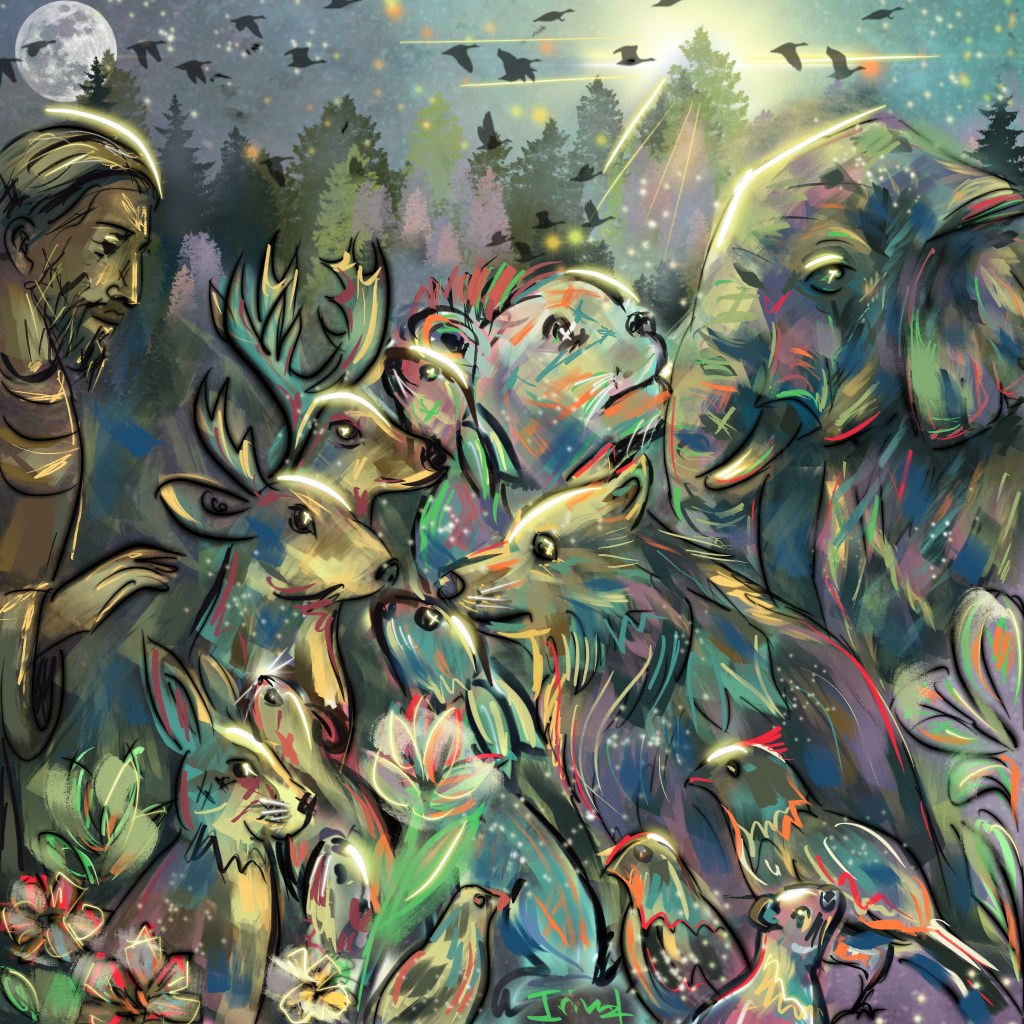
This image depicts St. Francis worshipping with animals and the whole of creation. But it could also be seen to represent the story of Adam naming the animals—setting the robes aside, of course! The creatures’ interactions with one another, with the human figure, and with the holy light that filters from above, remind us that it is the divine presence in the world that fosters true understanding and communion among all living beings.
Today we remember St. Francis of Assisi, who lived more than 800 years ago, yet whose witness still feels relevant. He is remembered not only as a friend of animals and the natural world, but also as a reformer who challenged the injustices of his day. He stepped away from wealth and privilege to live in solidarity with the poor, and he established a brotherhood of itinerant preachers and healers who immersed themselves in the lives of the communities they served. He preached peace at a time of war, traveled and engaged in dialogue with people of other faiths (including a Muslim sultan), and called his followers to see all creation as one family under God, calling sun, moon, fire, wind and water his siblings. This makes him not only a patron of ecology but also of social justice, and a model of teaching the faith through word and example, with courage and respect. Despite the centuries that separate us from him, we can still imitate his stance of compassion.
Indeed, compassion is the heart of both social justice and ecology. Our Gospel reading conveys God’s compassion for all creation. Jesus says, “Are not two sparrows sold for a penny? Yet not one of them will fall to the ground apart from your Father… so do not be afraid; you are of more value than many sparrows.” (Matt 10:29-31) God notices even the smallest and most ordinary of creatures. Nothing is too insignificant for divine care. If sparrows are watched over, then so are we—and so are the animals who share our homes and our lives. Likewise, in the story of the first human naming all the animals in Eden (Gn 2:19-20), the act of naming is one of recognition and connection. Together, these form the basis of compassion.
To name is to see another creature as unique, worthy of dignity, and part of God’s good world. We always name our pets. My kids have even attempted to name all twenty of the identical fish swimming in my aquarium! Farmers, on the other hand, often say they avoid naming animals destined for food. How do you choose a name for your pets? Have you ever started with a “serious” or “clever” name, only to find that it morphed into a dozen affectionate nicknames until you forgot the original name, as it happened with my childhood cat? Naming, then, is not a one-time act but part of a growing relationship. Or perhaps you once gave a pet a name that at first glance didn’t quite fit their personality—like calling a turtle “Speedy”—but then they truly lived into it? Well, naming is not about boxing them in, but about slowly discovering who they are. And often naming is a family affair, with competing ideas and lively debates. For our current cat, I found an easy way out of the debate: she came from the shelter already named! Still, the children all had to agree that the name suited her. So a name, in the end, becomes a communal gift. It signals identity, belonging, and purpose. St. Francis, too, was actually named Giovanni at birth, but later on his father began calling him Francesco – “a Frenchman,” or “a free man.” The name proved prophetic of the latter, even though his father had only chosen it out of fondness for France, where he had enjoyed some business success.
So what are we doing here today? A blessing is a continuation of naming. We name aloud the goodness of God in this creature, and ask for God’s protection and care, and we also remind ourselves of our responsibility to tend to their needs and to understand them even when they do not always understand us. My own cat, for example, seems to embody selective understanding. She knows perfectly well when I am about to feed her, but somehow “misses” the point that she should not be sitting on the kitchen counter while I cook. I can fully identify with her because I too sometimes “miss” the messages that God or my conscience is trying to communicate to me!
The prayer attributed to Francis ends with these words: “O Divine Master, grant that I may not so much seek to be consoled as to console, not so much to be understood as to understand.” This is the heart of blessing. To bless someone is neither to expect something in return nor seek our own comfort, but to understand the needs of another and offer love freely. If we can learn to do this with our pets, perhaps we can extend the same compassion to our neighbours, strangers, and the earth itself. As we bless our animals today, let us give thanks for Francis, who showed us that love can cross every boundary. May we, too, learn to understand more than we demand, bless more than we grasp, and treat every living creature as deserving of care, just as God cares for and understands us all. Amen.


 Irina's Art
Leave a Reply