
St. Luke is one of the most multifaceted figures in the early Church: a physician, a writer who produced the first systematic history of the Church in Luke–Acts, and an artist credited with painting the first Orthodox icon of the Theotokos. Luke’s creativity was an expression of faith, through which he applied his artistry, storytelling, attention to detail, and methodical approach. Among the New Testament writers, his voice stands out for its focus on restoration and compassion. This is the main reason Luke became the patron of healing — his association with care, both in what is said about him and in how he tells the story of Jesus and the Church.
The simple line in 2 Timothy, “only Luke is with me” (4:11), attributed to Paul, conveys the strength of quiet companionship in suffering that “the beloved physician” (Col 4:14) offered to his friend. Luke’s approach to writing mirrors that of a good physician to healing—listen, observe, collect facts before attempting to “fix”—and it combines a keen sensitivity to the human details of Jesus’ ministry with a poetic touch. Luke’s Gospel alone opens with the Nativity story enriched by the canticles of the Magnificat and Benedictus. It alone includes parables that reveal the depth of care: the Good Samaritan, the three “lost and found” stories (sheep, coin, and son), and the one leper who returns to give thanks to Jesus for his healing. Luke offers a distinctive abundance of stories of Jesus’ mercy directed toward those whom the society casts out to its margins. Acts, too, continues this theme, recounting the healing miracles performed by the disciples.
Even the passage we read today is another distinctive feature of Luke’s Gospel, as it places Jesus’ reading in the synagogue at the very beginning of his ministry: “The Spirit of the Lord is upon me, because he has anointed me to bring good news to the poor” (Luke 4:18, quoting Isaiah 61:1–2). The key word here is anointed, which today means “marked with oil,” but is derived from the Latin inunguere via the Old French enoindre, both of which originally referred to the act of smearing more so than to the use of oil itself. The modern English words anointed, unction, and ointment came to denote oil because it has nearly always been part of ancient rites used across cultures to mark people, places, and objects as sacred—that is, “made holy, belonging to God”.
In the Old Testament, anointing consecrated objects such as vessels and stones, and people such as prophets, priests, and kings. The Hebrew mashiach (“anointed one”) points to the promised figure who would unite those three offices, the latter two of which are still marked by anointing today. Its Greek equivalent is Christos — not a surname but a title! — and the same root gives us Christian, meaning “belonging to the Anointed One,” or “anointed like him.” The Spirit’s anointing in Luke is thus a self-proclaimed commissioning of Jesus; his mission statement to be holy himself and to make others holy as well, to bring release, recovery, freedom, and grace.
Later on, Jesus transformed this traditional sign of empowerment into one of humility and surrender to a vocation when he allowed himself to be anointed not by a prophet or priest, as Samuel anointed the first two kings in the history of Israel (1 Samuel 10:1; 16:13), but by a woman who, also by Luke alone, is said to have been labeled as a sinner (Luke 7:36–50).
I don’t think the label is either Luke’s or Jesus’. To me, it seems that Luke intentionally juxtaposes Simon the Pharisee’s judgment with Jesus’ openness not only to bless but also to receive a blessing. Because it is also in Luke alone that the woman anoints not the head that would rule, but the feet that would walk toward the cross. The gesture crossed boundaries of power, gender, and propriety, as the woman acknowledged and blessed both the suffering and its purpose.
To bless both the suffering and its purpose is, quite simply, what anointing does as a church practice today — yet it tends to be as misunderstood by us now as the woman’s act was then, despite being an ancient tradition! The two essential elements of the practice are, of course, oil and touch, so it may help to explore the significance of each.
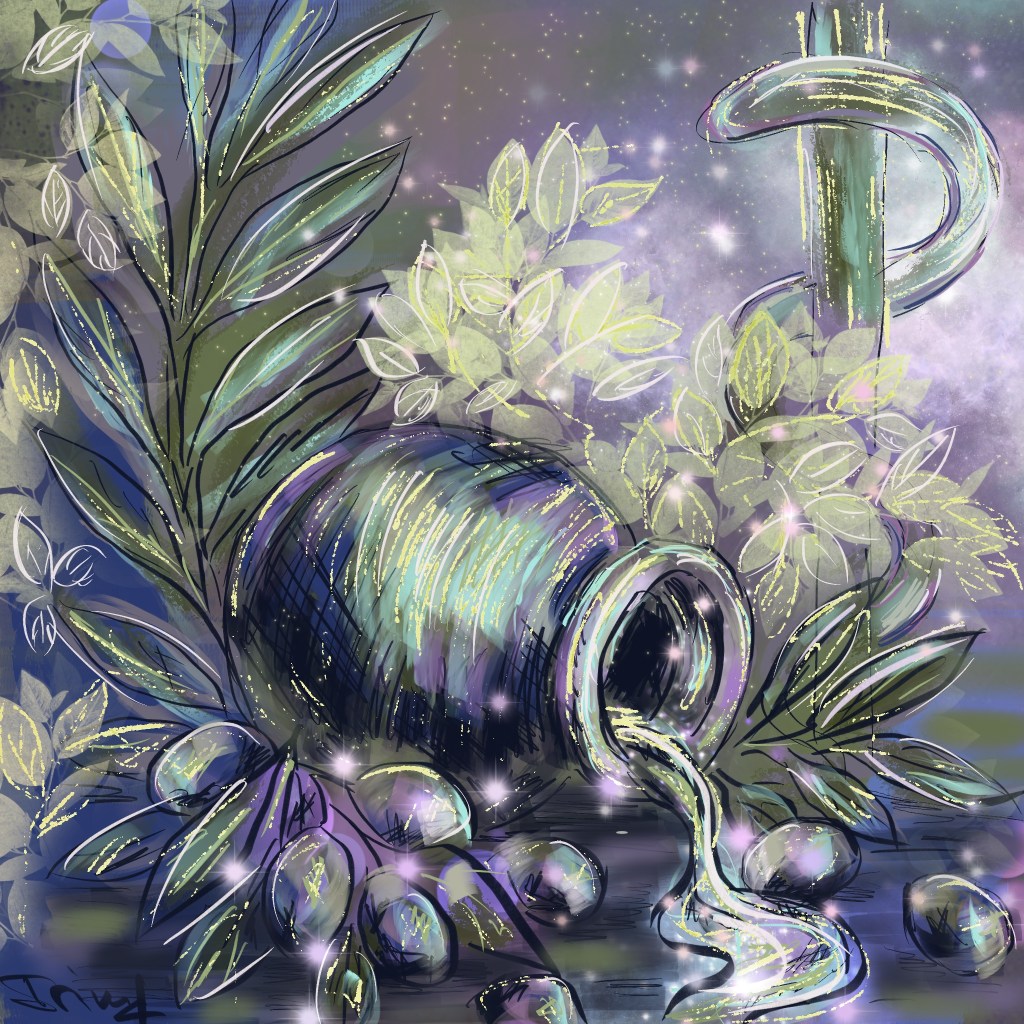
Where does this oil come from, who may offer it, and in what situations? Every small vessel of oil used in parishes is drawn from the gallons blessed each year by the bishop on the Tuesday of Holy Week during the cathedral service. Its base is just plain olive oil — a pantry staple and symbol of peace — reminding us that the sacred, along with nourishment and protection, most often rests within the ordinary. Oil is used in baptisms, coronations, healing (James 5:14) and “last rites.” But it may, in fact, accompany any need: grief, anxiety, discernment, or even thanksgiving. It may be applied by clergy or trained lay people, such as the two individuals in our parish who have discerned a call to this ministry. The rite is accompanied by simple words invoking the Spirit and acknowledging Her inward work. Various liturgical phrases exist, but today we will simply say, “May the Spirit of God heal you in body, mind, and spirit.”
Touch, on the other hand, was perhaps what made the woman’s anointing of Jesus so scandalous, even if the stated objection was the “waste” of expensive oil (Matthew 26:8–9; John 12:4–5). Touch is incredibly powerful and vital to well-being, which is why it is so often constrained by social propriety — norms that attempt to regulate our freedom to express affection and access care. When I think of healing touch in particular, I recall a diverse range of my own experiences. After my knee surgery some years ago, I remember waking from anesthesia wrapped in the warmest blanket imaginable. It was that warmth that somehow conveyed to me that I had safely crossed to the other side of the ordeal. The comfort was absurdly simple, yet I can still picture it so clearly. I also remember the deep trust I developed toward the nurses during the births of my children, as I quite literally, paced myself and my babies in another’s hands. And, of course, I will always remember my midwives: the first who made a significant mistake, and two others who became sources of calm, skill, and renewed trust despite the first one’s failure.
The word midwife means “with the woman,” and that, I think, captures the essence of spiritual care — to be with another in uncertainty, pain, or transformation. Midwives do not create life, and they do not even draw it out as a surgeon might; they can only accompany it into being. Like all healers and caregivers, they sometimes err — as do clergy, and as do all who are human. Yet the vocation remains one of presence. Spiritual care, in the same way, is not about fixing or forcing but about attending, waiting, and helping something sacred emerge in its own time — not making something happen, but helping it unfold within a context of trust and human limitation.
It is no coincidence that Luke, the evangelist of healing, tells us most explicitly of Mary’s role in bearing God into the world (Luke 1:26–38; 2:6–7) — literally, as each of us does figuratively. This kind of labour is never finished, which reminds me also of my grandmother, who at ninety-seven still counsels people about their medical concerns. A physician, teacher, and caregiver — once a healer, always a healer! Healing is a lifelong art that blends knowledge, compassion, and creativity, and, in the way we are made by God, it almost cannot be helped or retired from. It is part of our anointing by the Spirit, our life’s purpose. Every one of us, both trained medical professionals and their patients, participates in that mystery. Whenever we comfort, listen, stand by another’s bedside, pray, or anoint, we take part in God’s continuing incarnation.
Our reading from Sirach (c. 175 BCE) reminds us that God’s wisdom works through human skill and compassion:
“He has endowed human beings with skill so that he might be glorified in his marvelous works. Through them the physician heals and relieves pain, and the pharmacist prepares suitable medicines. Thus, there is no end to the works of God, from whom well-being continues to spread” (38:6–8).
Scripture never separates body from soul, or prayer from medicine. It never presents healing as a competition between divine and human means; it is God being born through both. Anointing is neither a medicine or a treatment. We cannot erase pain or remove its causes — for that, one rightly turns to physicians, pharmacists, and psychotherapists. What we can do through anointing and spiritual care is remind each other that, whatever our circumstances, our purpose remains to love God and neighbour.
Anointing is both comfort and commissioning. Well or ill, able-bodied or disabled, professionally trained or intellectually challenged, the oil marks us all as people who are wounded yet capable of Christ’s healing work. It restores the sense of meaning that illness or struggle can easily blur. It tells us that even in our weakness, we are not only recipients of care but its bearers as well. It says: God sees you. God’s love surrounds you. Your life has a purpose.
As we honour St. Luke today, may our hands continue to bring comfort, our words give hope, and our community become a place where the healing Spirit of Christ works through us beyond all that we can ask or imagine.
Questions to Consider
Sirach 38:12–14: “Give the physician his place, for the Lord created him; let him not leave you, for there is need of him. There is a time when success lies in the hands of physicians, for they too pray to the Lord.”
Sirach reminds us that God’s wisdom works through human hands — the skill of doctors, nurses, therapists, and caregivers — and also through prayer, compassion, and community.
- When have you experienced care that was both practical and spiritual — someone tending your body and also your heart?
- What does it mean for you to see your own work, whether professional or personal, as part of God’s healing in the world?
- When you receive prayer or anointing, can you allow it not only to comfort you but to remind you of your ongoing purpose — to love, serve, and embody God’s compassion?
 Irina's Art
Leave a Reply