
Why do we gather, year after year, to mark Remembrance Day? For many among us, these stories are not mere history: we remember parents, grandparents, or siblings who served, suffered, or never came home. Even for those born long after the great wars, their losses still echo in our families and shape our world. Yet there is something deeper than memory that compels us to pause. Perhaps it is because remembrance answers a human instinct for integration. Even when the wars are not ours, the human spirit still seeks wholeness and redemption.
To remember—from the Latin re-memorari, “to bring to mind again”—is an act of both heart and mind. Over time, the folk etymology of re-member has offered its own poetry: to re-join what has been dis-membered, to make whole what has been torn apart. In that sense, remembrance is more than recall; it is restoration. What we do inwardly, we also enact outwardly: we gather as a community and reach toward that unseen communion of saints and witnesses. This is why Remembrance Sunday so naturally follows All Saints and All Souls, when we hold together memory and hope.
In Jewish wisdom this sacred work is called tikkun olam—the mending of creation. In the Talmud it begins with rules for the common good. In the medieval mystical tradition it speaks of repairing a fragmented world through prayer and compassion. In modern practice it calls us to humanitarian care, environmental stewardship, and solidarity with the vulnerable. Even the word repair carries layered meaning: folk etymology hears re-pair—to join two fragments again—yet its Latin root, re-parare, means “to make ready again.” Likewise, peace, in its truest form, is integration: piecing together what has been pulled apart, and readiness for healing and wholeness.
The Scriptures we read today speak of such divine wholeness—the living and the dead, the seen and the unseen, held together in eternal love: “The souls of the righteous are in the hand of God” (Wisdom 3:1). And Jesus promises, “I should lose nothing of all that he has given me, but raise it up on the last day” (John 6:39). That same integration is mirrored in our own inner lives, where the anxious and wounded, the wise and compassionate parts of our being are all drawn into harmony around the indwelling Christ (Galatians 2:20; Romans 8:10; Colossians 1:27; Ephesians 3:17)—that calm and creative centre which speaks peace to our storms and gives us our life’s purpose.
Creativity is one of the surest ways to that centre. It gathers what is scattered and gives it form. The mystical side of tikkun reminds us that art, music, and prayer all participate in healing. This is why every war has moved artists to imagine and show how creation itself can become an act of repair. As a footnote to this post, I include a broader list of examples from around the world—many unsettling, yet each revealing how beauty and truth can rise from devastation. Here, I name only a few “gentler” works that have a Canadian or personal connection.
From the great wars, I am drawn to two examples. The first are the paintings of A.Y. Jackson (1882 -1974, the only member of the Group of Seven to experience combat), in which broken trees and churned earth depict nature itself enduring the wounds of battle. Yet even there, his light suggests a quiet resurrection, as shattered landscapes seem to gather the world’s fragments back into coherence. The second is The Heart from Auschwitz—a small, heart-shaped booklet made secretly for a young prisoner named Fania, covered with messages of courage written at great risk by her fellow inmates. It survives today in a Montreal museum as a quiet, defiant artifact of love stronger than violence.
Turning to our own century and to the conflict close to my heart, the war in Ukraine has inspired artists who transform instruments of destruction into works of witness. Blacksmith Viktor Mikhalev forges shrapnel into delicate War Flowers; jeweller Stanislav Drokin shapes shell fragments into wearable art; and Banksy paints murals on ruined walls that call the world to see and to remember. Even the Last Post and Reveille we heard today—once calls to arms and to awakening—have been repurposed by remembrance itself, becoming sacred music for mourning and resurrection hope. Across borders, music carries the same vigil and the work of redemption. Anglican composer John Rutter’s A Ukrainian Prayer, written in Church Slavonic and sung a cappella, gives that witness a luminous, choral voice of lament.
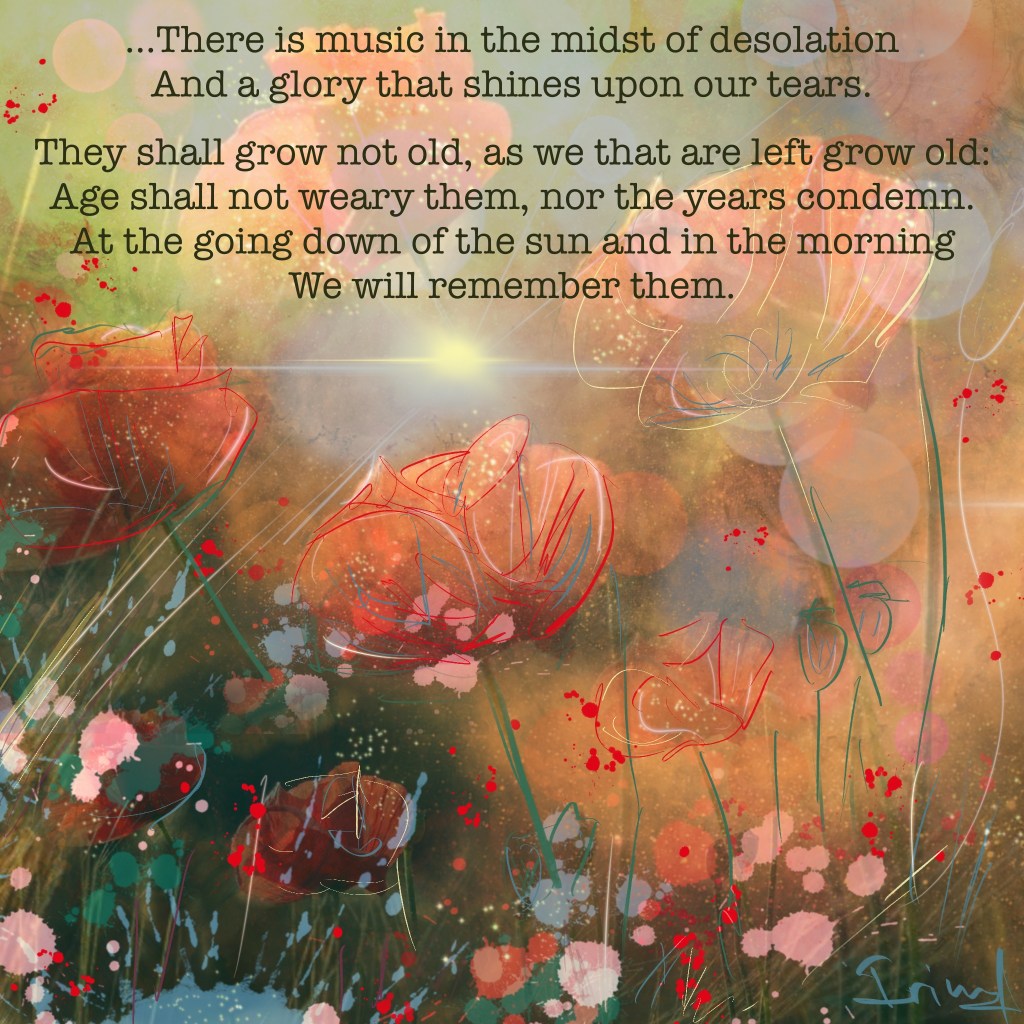
Literature, too, bears this work of re-membering. Laurence Binyon’s For the Fallen is printed in today’s leaflet and sung as our anthem. Its middle stanza, recited each year, has entered our national liturgy: “They shall grow not old, as we that are left grow old…” But it is the line “music in the midst of desolation” that seems to express Binyon’s intuition that art itself—of which music is one form—can heal even amid devastation. Likewise, John Gillespie Magee Jr.’s High Flight, read by a child in today’s service, transforms experience into transcendence. The poet, who served in the Royal Canadian Air Force, wrote of having “touched the face of God” even as he trained for destruction. Yet it is in writing itself that he touched eternity; his act of recording became its own ascent.
Even the beloved tales of Winnie-the-Pooh carry a wartime legacy and a Canadian connection. The bear was bought from a hunter by a Canadian veterinarian, named “Winnie” after his hometown, Winnipeg, taken to England with his regiment, and left at the London Zoo—where she met A.A. Milne and his son Christopher. Milne, who lived with post-traumatic stress after serving in the First World War, wrote these gentle stories for his son. That son, burdened by unwanted fame, enlisted in the Second World War as an act of quiet defiance and a way to recover the anonymity his childhood had lost. The tales thus hold both tenderness and tragedy; yet through them, generations of children have found comfort in darkness. Even stories for the young can participate in tikkun olam.
Though none of these works can undo tragedy or erase trauma, to create, to sing, to write, to paint is, somehow, to gather what has been shattered into wholeness again. So what might this work of re-membering look like for us? As a first step, we name the members of the body—those we love and see no longer, those who serve, and civilian victims of war. In prayer, memory becomes mercy, lament becomes intercession, and the body holds its parts together.
Still, in a world where the news cycle continually brings distant tragedies into our living rooms, we may feel powerless and ask, “What can we do?” On a personal level, we cannot end these wars. Yet creativity can help us feel that we are doing something to respond—to keep vigil, to witness—and in doing so, transform helplessness into compassion.
Within each of us, too, lies a battlefield. Every trauma leaves some part of the soul fearful or restless. Over time, the mind may exile those inner “family members” associated with hurt, and anxiety grows from that loss of wholeness. To aid this work of personal healing and integration, we may follow the lead of the artists and choose, each day, one small act of creation or reflection.
We might spend a few quiet minutes with an image or a piece of music, or read a poem that names both sorrow and hope. I recommend watching Goodbye Christopher Robin, the film about the creation of Winnie-the-Pooh, and pondering how storytelling can heal generational wounds. If an artwork unsettles us, we may sit in silence before it and pray, “What truth are you asking me to carry and share today?” Then we may choose to create something ourselves: paint a poppy, sketch a loved one, bake bread for a neighbour, write a psalm. Meditate on these creative acts. Notice how creation transforms anxiety into wholeness and, in doing so, repairs both us and the world.
In Christ, the broken are re-membered, the scattered gathered, the silenced given a voice. Peace is not the absence of conflict but the restoration of wholeness—in lives, in memories, in souls. Perhaps Remembrance answers that ancient pull to transform grief into compassion and memory into blessing. In doing so, we begin to share in “the peace of the righteous,” who “shine like sparks through the stubble” (Wisdom 3), and join in the divine work of mending the fabric of creation.
May the One who promised, “I should lose nothing” (John 6), hold us all in his peace—until the last trumpet sounds the Reveille, not for death, but for life.
Reflection
For further reflection, I suggest a number of artists whose work engages directly with the memory and aftermath of war. For reasons of time—and in respect for those who may find such images painful—I will not mention these works as part of my spoken reflection on Sunday. They are listed here for those who wish to explore further. Please note that most of these are graphic and distressing. I offer a clear trigger warning: do not search them if you are sensitive to depictions of violence or suffering. This is why I provide no hyperlinks. However, each of these works, represents, in its own way, the human effort to redeem horror through truth-telling, beauty, and witness—to turn memory into a work of mercy.
As you explore these works—or simply hold them in mind—what moves within you? How might encountering another’s act of remembrance, whether in paint, metal, word, or song, become a form of prayer for you? In what ways can bearing witness help heal both your own spirit and the world’s wounds?
- Käthe Kollwitz (1867–1945), whose son died in WWI, etched grief, solidarity, and the cry “Never again war,” giving maternal compassion an indelible public voice.
- Otto Dix (1891–1969), a German veteran of the First World War, engraved fifty unflinching plates Der Krieg (The War, 1924), refusing to beautify carnage and compelling viewers to look with the eyes of truth.
- Pablo Picasso’s Guernica (1937) was painted in response to the bombing of the Basque town during the Spanish Civil War. Its stark monochrome palette teaches our eyes to mourn, making lament both public and enduring.
- David Olère (1902–1985) was a Jewish artist forced to work as a Sonderkommando in the crematoria of Auschwitz-Birkenau. Olère survived to paint what few others could describe. His post-war drawings and canvases transform unspeakable horror into visual testimony, ensuring that memory is not erased but transfigured into witness.
- U.S. Combat Artists Program (especially the Vietnam War series, 1966–1973) began officially in WWI with commissioned artists, and subsequently recruited soldier-artists who recorded the human side of conflicts, sketching amid danger, ensuring that suffering was neither faceless nor forgotten.
- Martha Rosler’s House Beautiful: Bringing the War Home photomontage series confronts viewers with the contrast between domestic comfort and distant destruction, demanding moral and emotional integration.
- Kester (Cristóvão Canhavato), Throne of Weapons (2001) — Part of Mozambique’s Transforming Arms into Tools initiative, forged from decommissioned AK-47s. Where instruments of death once were held, a seat of peace now stands.
- Doris Salcedo, Fragmentos (2018) — The Colombian sculptor melts confiscated guns and incorporates victims’ belongings into installations, embedding their stories into public space rather than hiding them.
- Saba Jallas (b. 1980s; active 2015–present) — A Yemeni artist who transforms photographs of smoke rising from air-strikes into tender images of mothers and children, reclaiming the very substance of destruction as a medium of peace.
Each of these artists, in their own time and way, has practiced remembrance as tikkun olam: mending the fragmented world through the courage to see, to create, and to love.


 Irina's Art
Leave a Reply