
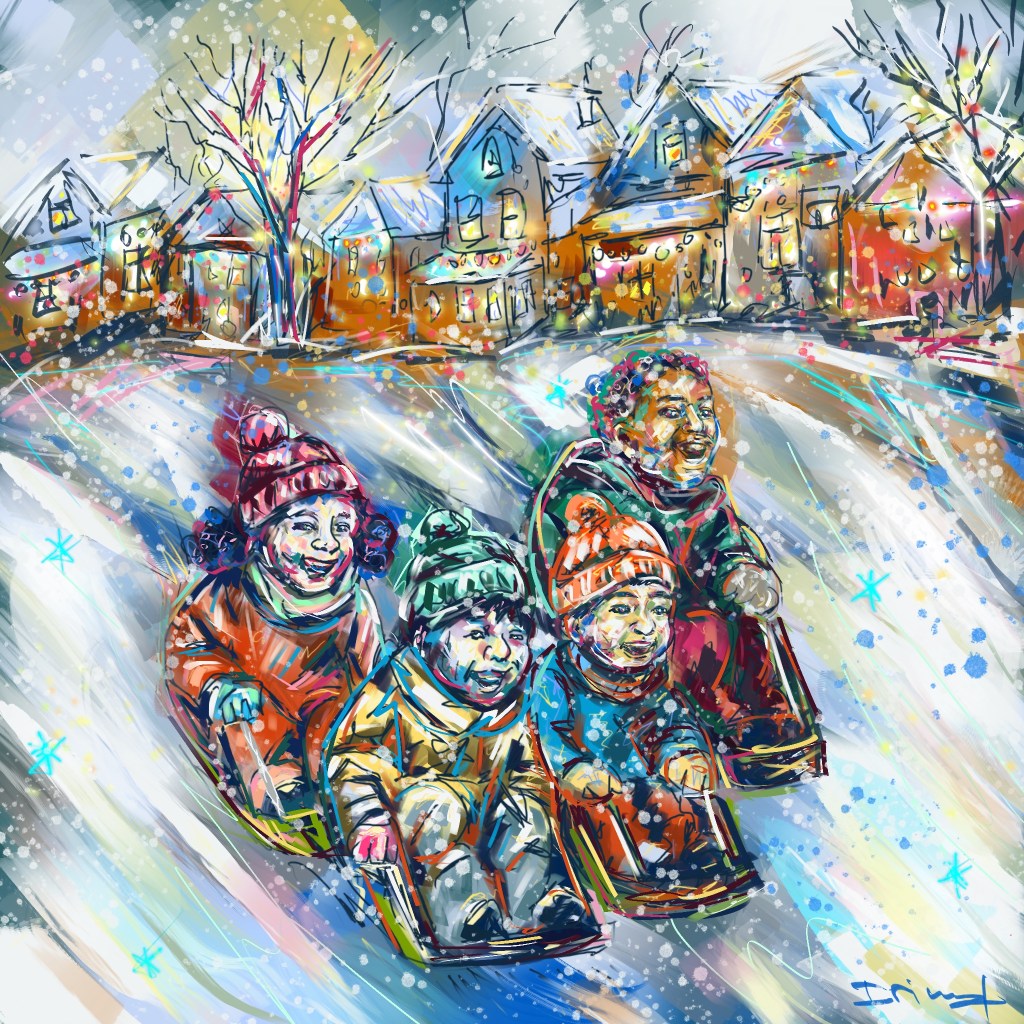
An image of childhood as it is meant to be: playful, communal, alive with colour and momentum—lifting one another into joy, even as we remember how fragile this gift remains.
On the Sunday after Christmas, the carols are still echoing, and the tenderness of the season is still close at hand. We may want to stay a little longer in that quiet, luminous space where life feels gentle and hopeful. Yet the Gospels do not linger there. In Matthew’s telling, what follows the nativity is the Flight into Egypt, and in the church calendar, after Christmas we observe Holy Innocents Day.
Sometimes we choose to commemorate it on January 11, after Epiphany, so that it follows the Magi’s visit—the episode that, in fact, provokes Herod’s fearful and violent response to murder every baby boy of Jesus’ age in Bethlehem. That ordering makes narrative sense, but by then we will have also moved on to the Baptism of the Lord, which the Anglican Church places on the Sunday after Epiphany, and may miss the opportunity to engage with this painful story. Yet the Church insists on holding these events together. This keeps Christmas from becoming overly sentimental, reminds us that God does not hover above the world’s pain, and calls us to speak up for those who cannot speak for themselves.
The Nativity narrative makes the same point. God is born directly into pain. Jesus’ birth takes place like that of any child: through the labour and suffering of his mother, intensified by conditions created by oppressive political power. His life is endangered almost immediately, and his family’s first moments of parenting are shaped by fear and flight. The light shines, but it shines in real darkness—then and now. Children still suffer through war and displacement, poverty and instability. Many live as refugees, their lives shaped by great forces and decisions made far from them. And even in loving homes and stable times, childhood is not free from fear, loss, or unmet need. Each of us was once a child and carries various degrees of trauma from that time. These early experiences shape how we trust, how we form relationships, how we make sense of the world. In that sense, the Holy Innocents are not only the children of Bethlehem, or innocent victims of injustice. They are all children. They are, in some way, all of us.
One detail we sometimes miss is that the Gospels speak of more than one Herod (six, in fact; where Herod was the first name of the progenitor of the Idumean dynasty, and his descendants adopted his name as a surname, in addition to their Roman titles and given names). The massacre of the Holy Innocents was ordered by Herod the Great (the first in his dynasty), the ruler of Judea at the time of Jesus’ birth. History remembers him as brilliant and brutal, capable of extraordinary building projects such as the Jerusalem Temple, and extraordinary cruelty. Paranoid and obsessed with threats to his power, he trusted no one and turned his fear even against helpless children. Later in the Gospel, however, we meet Herod Antipas, one of Herod the Great’s sons. This is the Herod who imprisons and executes John the Baptist, mocks Jesus during his trial, and ultimately hands him back to Pilate. He is less overtly violent, more evasive—curious but unwilling to act with courage or responsibility. Different men, different moments, but the same underlying fear: the anxiety of power clinging to itself.
Through these two figures, the Gospels show how fear and insecurity take different shapes across generations. In Matthew’s infancy narrative, the threat is immediate and catastrophic. A child king is imagined, power feels fragile, and children die. Thirty years later, Jesus is again named “king,” though never in a way that seeks to seize control. His goal was never to inspire political revolt, and yet he was too unsettling for an unjust system to ignore. Violence follows—not because God wills it, but because fearful power defends itself at all costs, and the vulnerable always pay first.
Into this reality, Christian theology speaks of the mystery we call atonement—a theme to which we will return more fully in the seasons of Lent and Passiontide. Scripture offers more than one way to name it. God enters our brokenness to heal and reconcile. God absorbs violence rather than inflicting it. God draws us to himself through self-giving love. God sets before us a pattern of life shaped not by domination, but by mercy. These are not competing ideas, but facets of a single truth: God works from within the world’s damage to restore relationship, meaning, and hope.
Perhaps this is why today, alongside the story of the Holy Innocents, the lectionary gives us Psalm 148, which summons the entire creation—sun and moon, storms and mountains, animals, rulers, and children—to praise God without waiting for him to “fix” the world. It stands within a long biblical tradition of cosmic praise, likely dating to the post-exilic period (after 538 BCE), and later finds dramatic expression in the Song of the Three (Benedicite) as part of the Greek additions to Daniel. These texts reflect the experience of the Babylonian exile (597-538 BCE) but may have been composed as late as the period around Jesus’ birth. Here, the theology of Psalm 148 is sung from inside a fiery furnace, into which Shadrach, Meshach, and Abednego—companions of Daniel, young Judean exiles serving in the Babylonian court—are placed by king Nebuchadnezzar. Another fearful ruler, he erected a massive golden statue and demanded its worship. When the Judeans refused, he reacted with rage. This was not a measured judicial act, but a spectacle of power, meant to terrify dissenters and reassert control—much like Herod’s Massacre of the Innocents was, or the Roman crucifixions were, including Jesus’ own death.
Yet the youths bless God while still inside the furnace, not after rescue, reminding me of how Jesus speaks from the Cross. Centuries later, Psalm 148 finds its voice yet again in Francis of Assisi’s Canticle of the Sun, the earliest surviving literary work in Italian, which paraphrases it. Many of us know this poem through the hymn All Creatures of Our God and King. Francis names various parts of creation as his companions in praise, including wind and fire, water and earth, and even death itself, as it too is part of nature. As such, the three authors—Francis, the author of apocryphal Daniel, and the psalmist—shared the idea that to praise meant first and foremost to acknowledge God as the Creator who remains with us in all circumstances and challenges of life.
Another feature that all these stories share is that God does not speak to us through displays of force, but through attentiveness to the material world and embodied life. It is no accident, then, that in Matthew’s part of the Christmas story, God speaks almost entirely through dreams, guiding Joseph to accept and then to save Jesus’ life. We may dismiss dreams as strange or inconsequential, yet they are places where fear, grief, longing, and unresolved wounds speak before we have words for them. Dreams become a meeting place between the vulnerable child we once were and the adult we have become. Joseph trusts that God can speak there. On Christmas Eve, I shared how my child once asked how she is supposed to know whether a thought comes from God or from her imagination. I said to her that it can be both. God made our inner lives and can work through them. Discernment is not about predicting the future, but about noticing whether what we hear aligns with love, justice, and our deepest integrity.
In Joseph’s life, discernment led to flight. The Holy Family became refugees, even as they never left the country (Egypt being part of the Roman Empire). As such, Jesus shared the experience of exile with his ancestors. And yet Matthew frames this painful escape with words of promise: “Out of Egypt I have called my son.” First spoken by the prophet Hosea about Israel’s exodus from slavery—the same broad historical memory in which Daniel and his companions praised God in the most challenging circumstances—here the quote is applied to Jesus to indicate that the exile is not forever, trauma does not have to shape the rest of our lives, and death is not the final word.
Yet in the meantime, God accompanies suffering instead of preventing it. The Incarnation is God’s decision to enter the world fully and to be present in fear and displacement, in childhood vulnerability, and in the long work of healing. Praise, in this light, is not cheerfulness or denial but the steady insistence on Emmanuel—”God with us“—which is the very heart of Christmas.
 Irina's Art
Leave a Reply