
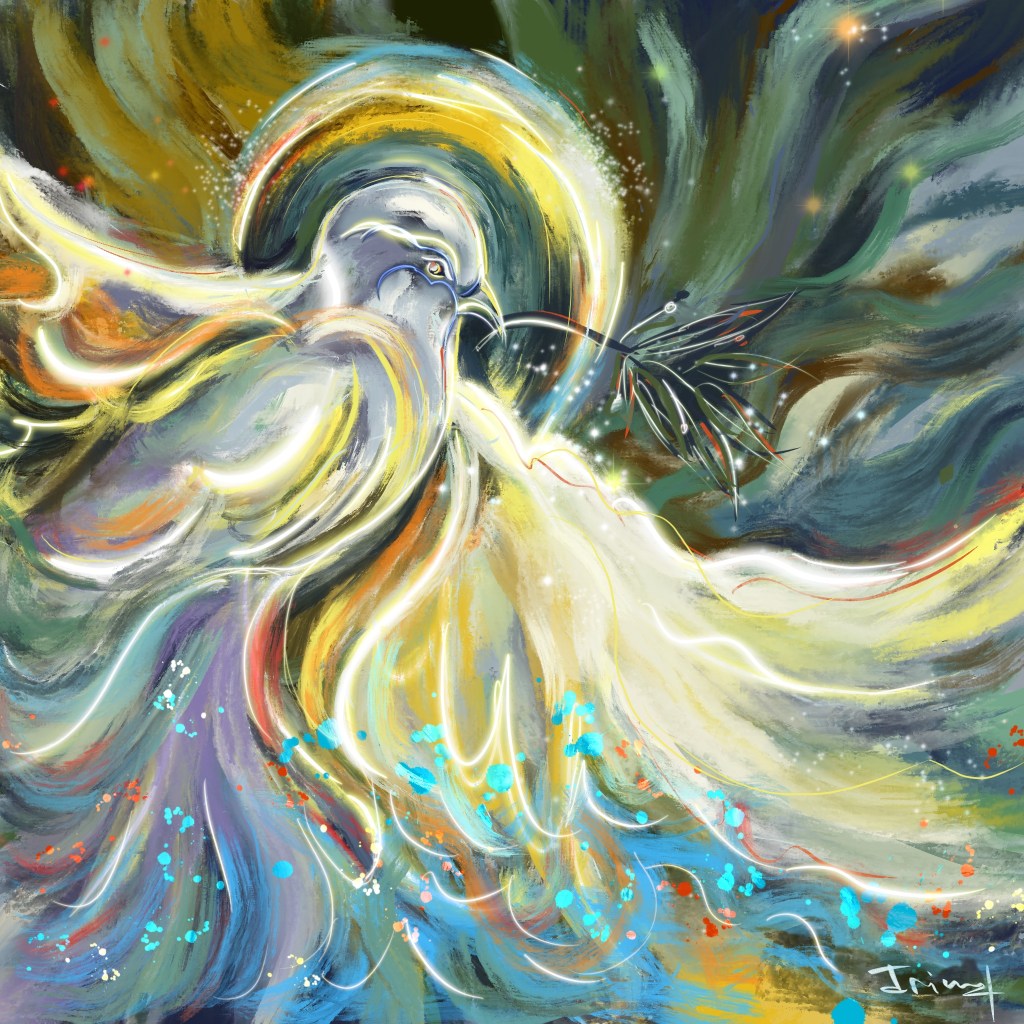
Can you spot three doves in this image: the main one, plus the two that I created quite unintentionally; perhaps, as a subconscious allusion to the Trinity?
Our Gospel readings for both this week and next make deliberate use of animal imagery. This week, in Matthew’s account of the Baptism of Jesus, the focus is on the dove as an embodiment of the Holy Spirit. Next week, in John’s Gospel, we will hear Jesus named as “the lamb of God.” This pairing stood out to me because the subject of scriptural animal imagery has long been close to my heart. I have always loved pets, found restoration in nature, and at one point researched the benefits of human–animal interactions for people living with complex chronic conditions. Once I began to study theology, I returned to this theme in my papers on the role of animals in religious imagination.
Animal imagery is also a frequent subject in my art. And when I was ordained, the first church I served commissioned an Orthodox icon of Creation for me as a gift. The iconographer filled it with real-life animals, and also included a mythic sea creature that looks both dragon-like and joyful at the same time.
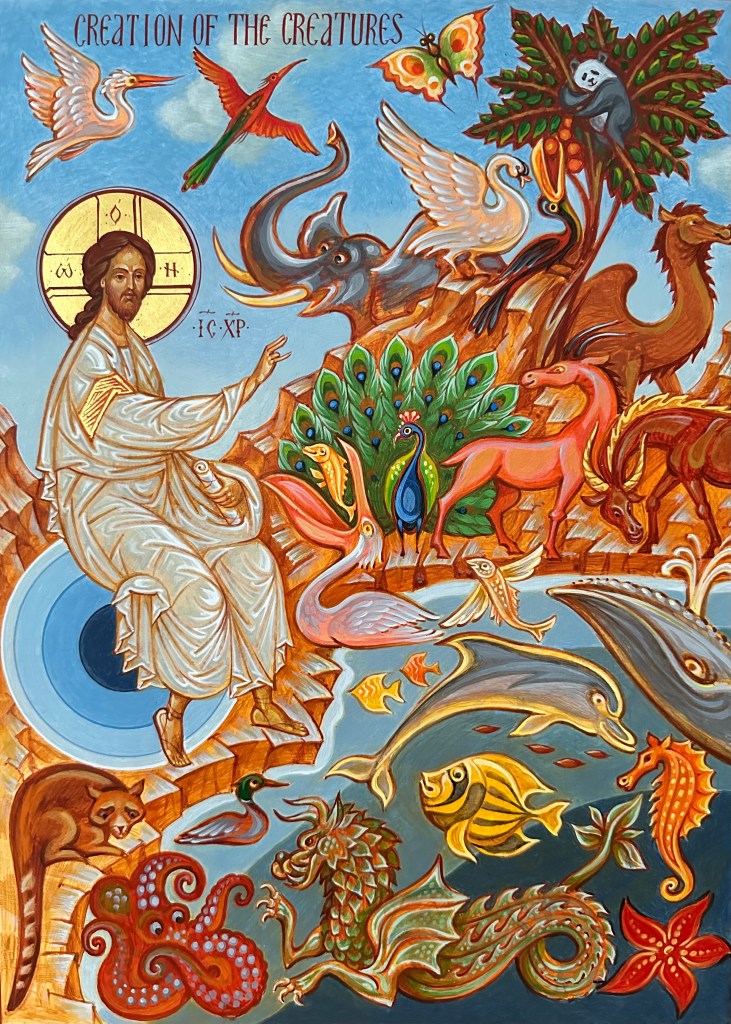
To me, that image has remained a visual reminder that God is often recognised in what is familiar and beautiful, yet always exceeds what is comfortable, controllable, or easily explained. God is, of course, known most fully through human form—first in Jesus, and now, mysteriously, in each of us. But the use of animal imagery may have been a way for scriptural authors to resist shrinking God to our own proportions, and to reassert that we are made in God’s image, not God in ours. And each of us, in turn, is infinitely more than the superficial image we project to others based on our societal roles, dress styles, ethnicity, culture, relationships, etc.
So like all other ancient cultures, biblical authors used animals as proxies for strength and vulnerability, wisdom and danger, intimacy and power. At the same time, there is a strong prohibition in Exodus against worshipping God in embodied forms (which itself suggests that such practices did, in fact, exist in Israel as they did in the neighbouring cultures). Consequently, in compliance with the second commandment and in contrast to many ancient religions, Scripture never represents God as an animal. Instead, natural imagery represents God’s energies: protective, redemptive, life-giving, etc.
As attributed to Martin Luther, “God writes the Gospel not in the Bible alone, but also on trees, and in the flowers and clouds and stars” and“All creatures are merely veils under which God hides Himself”. Another way to name this is a sacrament – an object or practice that makes a spiritual reality present in a form we can encounter: like bread and wine, water and oil, rock and fire, wind and light, and even the spoken word. In doing so, these elements never cease to be what they are, nor do they contain God. Rather, they carry meaning that exceeds themselves. In this sense, the presence of animals in Scripture is sacramental, not merely metaphorical.
At the far end of that spectrum stands the Leviathan portrayed on my icon, embodying God’s mystery, untameability, and even playfulness. But there is also the lion, bear, serpent, eagle, lamb, donkey… but never the warhorse or domineering bull. On the contrary, Jesus himself uses primarily maternal and defenceless images in saying to Jerusalem, “I desired to gather your children together as a hen gathers her brood under her wings,” and to his disciples, to be “gentle as doves” – as the dove that appears at his baptism!
Later, at Pentecost, the Spirit will appear as wind, fire, and sudden understanding, but it is the dove that remains lodged in our imagination as the image of companionship and peace. Descending, hovering, resting, crossing the chasm between the heavens and earth, the dove certainly deepens the telling of the baptismal story, which would otherwise be rather plain: Jesus simply joins the line like everyone else who comes seeking ritual washing and immersion—familiar practices in Jewish life, associated with preparation for religious and communal participation. The only person surprised by this was John the Baptist; but then again, he had the kind of prophetic intuition that others did not possess.
It is worth noting that Matthew, writing for a predominantly Jewish audience, searches the Scriptures for deep patterns to help make sense of the story of Jesus. His Gospel presents Jesus partly as Moses, and partly as Israel as a whole: surviving a death threat as an infant and going into exile, entering the wilderness and ascending a mountain to teach, and passing through the waters of the Jordan at the very place where tradition holds that Israel crossed into the promised land. To this audience, the dove would not have felt random, but marked a threshold between chaos and possibility, judgment and renewal. For those who remembered the Spirit hovering like a bird over the waters at Creation, and the dove returning to Noah with an olive branch after the flood, the baptismal dove would be an unmistakable symbol of a fresh start.
And a fresh start is exactly what lies at the heart of the baptismal story. Jesus steps into the river to meet people where they already are: in water that dissolves regret and hope, shame and longing, failure and resolve. Many of us know what it is like to step into situations already shaped by other people’s stories—families, workplaces, institutions, even churches. In that sense, Jesus “has to” be baptised; not because he is confused about who he is, or repentant, but because Incarnation means that God fully shares the human condition. The water does not cleanse Jesus; rather, by entering it, Jesus cleanses the river as a proxy for all future baptismal waters ever to be used. Once again, Jesus acts as Emmanuel—God with us—as Matthew names him in the infancy narrative and as is echoed again at the end of the Gospel, when the risen Christ promises to be with his followers always. The baptism stands between those bookends and shows how far and deep that “with us” extends.
In fact, God’s “with us”-ness extends as deep as our hearts, since in two of the four Gospels, the descent of the Spirit upon Jesus is an unambiguously interior experience. Luke may be read either way, and John takes a different perspective altogether, but in Matthew and Mark, it is only Jesus who sees the Spirit as a dove, as if to say: “you will be sustained; God is with you in your calling, even when the road ahead is hard”. Only afterward does the voice from heaven speak publicly, naming him as the beloved Son; and it is only after Jesus immerses himself in the river that the dove appears. To me, this suggests that Jesus does not wait for God’s assurance in order to act; rather, having made the choice, he finds peace within himself.
This association of the dove with peace has been powerfully reinforced in the modern imagination by Pablo Picasso.
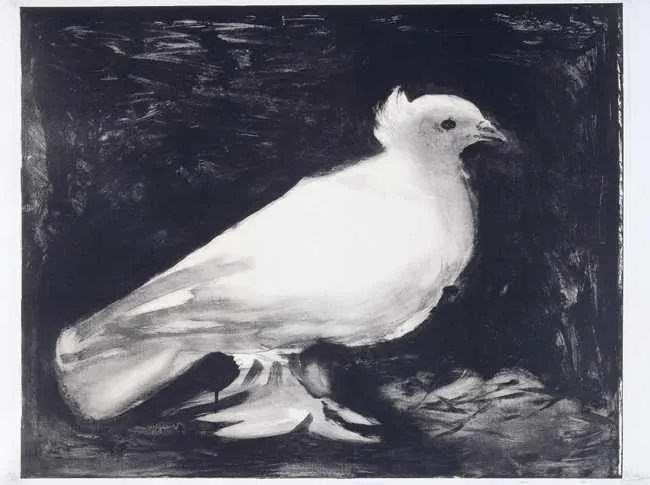
But, when Picasso drew his now-famous dove, also known as “La Colombe,” in 1949, he was not trying to create a universal symbol! He was simply drawing a bird he knew well—one he had grown up with, kept, bred, loved, and even used as a name for his daughter, Paloma. Yet the world that was weary of war and desperately longed for peace instantly took to it, and the image acquired meaning far beyond the artist’s intention. Something similar happened with baptism.
What began as a fairly ordinary Jewish ritual became the one practice that every Christian tradition, except for the Salvation Army and Quakers, retains. And what was once an Old Testament allusion to a hovering bird and returning dove becomes, at the Jordan, a sign of God’s interior, indwelling presence. So the sacramentality of baptism and of animal imagery is doing the same theological work here by giving us language for peace and belonging. How often do we struggle to find these! That’s why we might so readily take to church rituals and sacred practises as accessible symbols of God’s presence with us.
However, could it be that we are looking for peace and belonging only in ‘special’ places, or waiting for someone else—politicians, neighbours, parents, teachers, priests, even God—to create them for us, when in fact we may be the ones who need to take the first step towards the reality we long to make new? As an example, Picasso did not only create the new symbol of peace, but he actively promoted peace and donated many of his works to peace organizations, contributing to their efforts to prevent future conflict.
This week, the dove teaches us that God’s presence rests and works with us from within our hearts and daily lives, rather than conquers or blesses us from a distance. Next week, we will turn to Jesus’ seemingly contradictory titles “Lamb of God” and “Lion of Judah,” which will invite us to consider what it means for strength to take the form of self-giving love.
For now, let’s remember that the dove who finds a place to rest is yet another way in which the gospels say, Emmanuel.
PS:
For the children’s message, I will bring out a small balancing dove—one of those toys that can rest on the tip of a finger or the edge of a surface without falling.
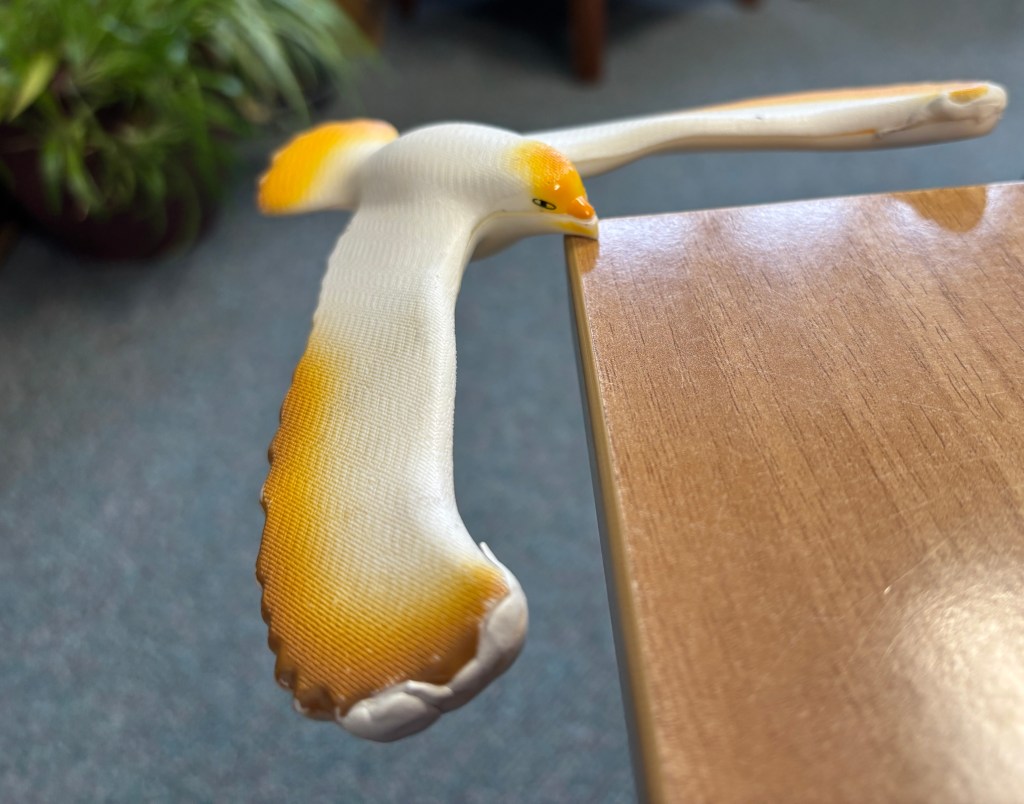
With the help of this dove, I wanted to show the children that the Spirit of God does not require a wide or perfect place to alight and find rest, only the tiniest point where balance can be found. To me, this represents the youngest, weakest, or most imperfect person, or even a momentary, fleeting flash of insight and trust that every single person will experience from time to time. What is more, the dove can keep resting even when the surface itself is a little unsteady; on a moving finger, for example. In that way, it mirrors the Spirit, who works with us, imperfect as we are, as we navigate the wobbly, uneven surfaces of our lives.
This was my plan. However, when I went to look for the toy, I discovered that recently the dove had been taken apart by a curious child who wanted to understand how it worked! That curiosity was not a failure; it was a form of attention, a genuine desire to know. But with the tiny weights removed from the tips of its wings, the dove could no longer rest at all, because something essential was missing. Well, I have managed to put it back together using playdough. Adding just enough, evenly on both sides, they toy could balance again. And as I was doing so, I found myself thinking that this, too, might serve as an analogy.
Human curiosity, tinkering, desire to know how things work—even when it breaks something—is not evil. It is, in many ways, the human story from the beginning, echoed in the first humans’ search for understanding in the Garden, which led to the loss of a peace that was real but also infantile. And yet God fills in the gaps, repairs what is broken or lost in the process of wanting to know, and says: this is still worth holding together. The Spirit does not wait for perfection and stillness, rests even when things are a little wobbly, and never recoils from what has been disturbed. Balance, after all, is not the absence of movement or disruption, but the patient work of restoration, using materials that are humble, soft, and forgiving. The Spirit rests, repairs, completes, gives understanding, and stays.
 Irina's Art
Leave a Reply