
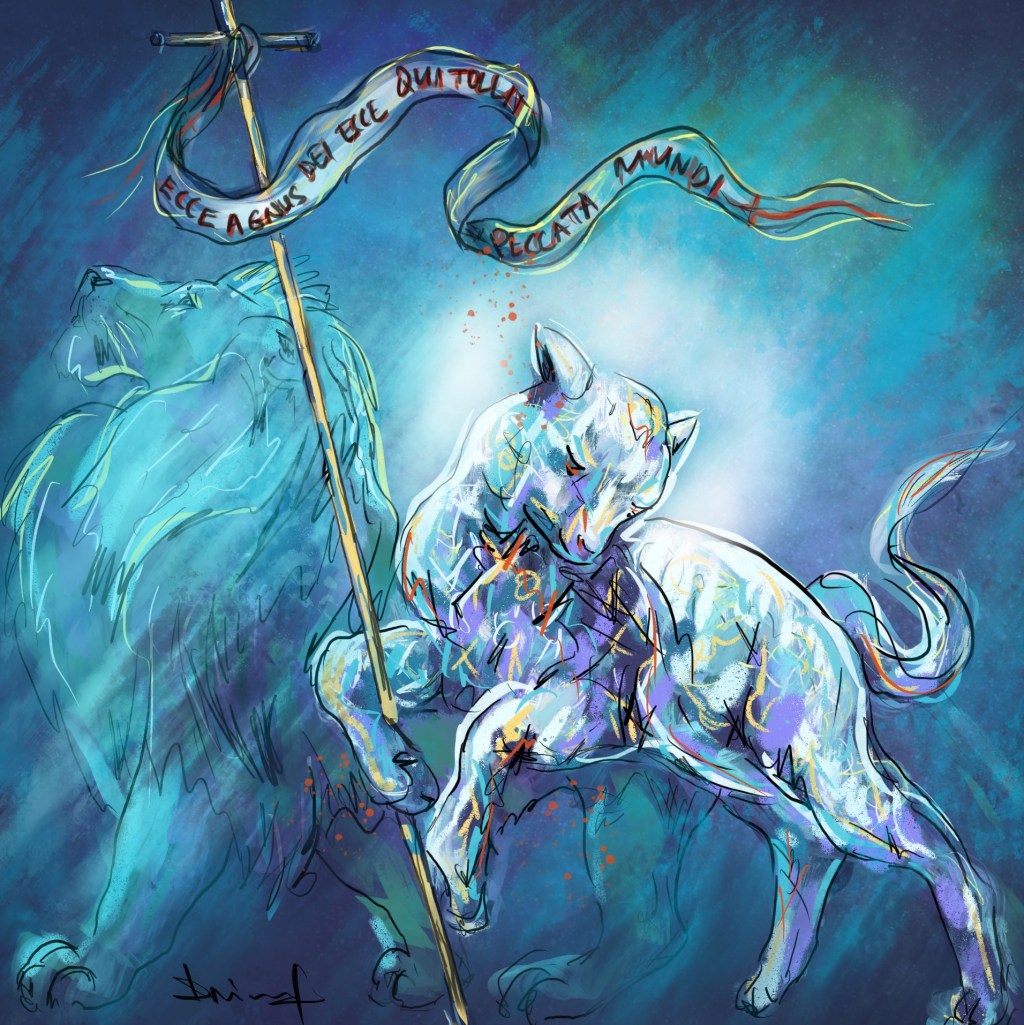
“Ecce Agnus Dei. Ecce qui tollit peccata mundi”—“Behold the Lamb of God. Behold the one who takes away the sin of the world”. Read on to find out why the lion is also present in the background.
In Matthew and Mark’s Gospels, at Jesus’ baptism, the Spirit of God descends upon Jesus as a private vision of a dove. In John’s Gospel, written later, John the Baptist speaks of the dove as though he himself saw it. Yet he also experiences an interior revelation similar to the one Jesus receives in the synoptic baptismal accounts. When John calls Jesus “the Lamb of God” for the first time, it sounds like an insight forming in his mind in real time—much like Jesus seeing the dove. This moment helps explain John’s hesitation to baptize Jesus, preserved in the other Gospels. The second time John uses these words, however, he introduces Jesus to his future disciples, echoing the public declaration that followed Jesus’ personal insight in the baptismal scene.
Together with the images of the mother hen (Mt. 23:37; Lk 13:34) and the lion (Rev 5:5), the dove and the lamb teach us the theology of God’s presence and care, and his mutually deepening qualities of gentleness and strength1. In the first book of the Bible, Jacob blesses his son Judah—and through him all his descendants—as “a lion’s cub,” declaring that “the sceptre shall not depart from Judah” (Gen. 49:9–10), meaning that all Israel’s rightful rulers, including Jesus, would come from this tribe. In the final book of the Bible, its author (another John!) hears that this Lion of Judah has indeed triumphed; yet when he looks, he sees not a lion, but a slain lamb (Rev 5:6).
The lion who conquers as a lamb redefines power without abandoning it, exercises authority through self-giving rather than coercion, and assures us that love willing to be wounded is neither wasted nor fragile. But the lamb is likely far more familiar to us than the lion because it appears in every Eucharistic service. And yet, I have heard countless people say that although they do notice the phrase “the Lamb of God” in the liturgy, they have never understood its origin. By contrast, the original audience of John the Baptist would have readily recognized the image and its theological weight, closely associated in ancient Israel with sacrifice (as, to an extent, was the dove as well).
The connection between the sacrificial lamb and Jesus lies in the Passover story, in which the people of Israel fled from Egypt after consuming a hasty meal of lamb and bread that never had time to rise. Passover was never about appeasing God, but about God setting God’s people free. The lamb’s blood, applied to the doorposts, marked Jewish households as included by God in the story of liberation, signified by their firstborn sons remaining alive while the firstborn of Egypt died. These lambs were not sin offerings killed to satisfy God’s anger; they were signs of protection. God did not need the lambs to die, but the people needed a tangible reassurance of safety and belonging that they literally internalized (i.e., not only killed and took its blood, but also ate!). For this reason, the meal of lamb remained central to the observance of Passover for generations.
Jesus’ own final meal with his friends took place at Passover, or on the night before. Why do the Last Supper narratives not mention any lamb on the table? Because when Jesus points to the bread and wine and says, “This is my body… this is my blood,” he figuratively becomes the lamb himself and confirms John the Baptist’s proclamation. As Paul later writes, “Christ our Passover has been sacrificed for us” (1 Cor. 5:7). Neither the Gospels nor Paul offer a mechanistic theory of how salvation works, but both name Jesus as the sign of belonging, through whom we understand ourselves to be free.
Another Old Testament story featuring a lamb is Isaac’s near escape from becoming a victim of child sacrifice—a story often read as though God desired Isaac’s death and then settled for less. However, Abraham lived in a world where people regularly tried to secure divine favour by offering what was most precious—an instinct that still moves people today to pray, in moments of desperation, “I’ll give you anything if only…” So I think Abraham simply acted according to the logic he knew. He believed that God wanted this and imagined God’s words to that effect, but God interrupted him. The ram caught in the thicket was not a substitute for God’s initial demand; it was God’s refusal to honour faulty spiritual logic! It is as if God says, “What are you thinking? I never wanted your child to die, nor do I need you to prove your faith through murder.”
In the same vein, I do not believe that God wanted people to kill Jesus any more than God wanted Abraham to kill Isaac. But humans turn to violence whenever fear, power, and self-interest converge. In Isaac’s story, God halted violence he never endorsed. Likewise, in Jesus’ story, God does not demand violence—but neither does God halt it. Instead, God enters into it and refuses to mirror it.
The groundwork for this reorientation is evident in today’s psalm: “In sacrifice and offering you take no pleasure… and so I said, ‘Behold, I come’” (Ps. 40:6–8). God does not desire bloodshed, but calls forth presence. “Behold, I come” can be heard both as the human response to God and as God’s own intent to become God-with-us—an echo John picks up when he “beholds” Jesus the Lamb as the sign of God’s coming.
My own convictions regarding atonement align with well-established strands of theology, though not always with the most familiar ones. Many people reject Christianity because of the idea that God would purposefully kill an innocent, powerless person in order to be appeased, collect a debt, inflict vicarious punishment, or—even worse—for the sake of symbolism alone. What is often not realized is that these are only some interpretations of the cross, developed largely in the medieval period and shaped by feudal notions of honour and satisfaction. They are not the earliest or the only approaches. The earliest understanding of Jesus’ death is Christus Victor, in which Christ enters the depths of suffering and death to break their power from within, triumphing over them in a mystical, even cosmic way—much like the lion-lamb of Revelation. Other interpretations followed: Christ as the lover who wins the beloved through self-giving love; Christ as moral exemplar; Christ as the one who exposes violence as incompatible with God’s reign. A lamb cannot overpower a wolf, but it can tell the truth about the wolf, so to speak. As such, Jesus’ death acknowledges the reality of a world in which bad things happen to good people, but his resurrection insists that violence does not have the final word. Non-retaliation and self-giving are the powers that ultimately heal and restore our relationships with God and with one another.
Notwithstanding the variety of atonement theories, the lamb has remained central to Christian worship and art. In Western religious painting, Jesus as the Passover Lamb often carries a banner inscribed Ecce Agnus Dei—“Behold the Lamb of God.” Sometimes the inscription continues with qui tollit peccata mundi, “who takes away the sins of the world,” as in John the Baptist’s proclamation. At other times, it shifts to qui tollis peccata mundi, “you who take away the sins of the world,” addressing Christ directly. From the seventh century onward, the image was discouraged in art so as not to detract from Christ’s full humanity, but it became deeply embedded in worship instead.
In the Latin Mass, the Lamb appears twice: first as a plea addressed to Christ—“you who take away the sin… grant us peace”—and then, at the elevation of the broken bread, as a proclamation to the people: “Behold the Lamb of God who takes away the sin.” In the Anglican service, similarly, the Lamb of God appears twice: in the Gloria and at Communion. In the older rite, both instances used the syntax of proclamation; in the modern rite, both address Christ directly, as we will do in today’s service. The only moment in the new rite when the wording becomes descriptive rather than addressed is on Maundy Thursday, when we proclaim: “This is the day that Christ the Lamb of God gave himself into the hands of those who would slay him.”
Across history, the liturgy has moved between you and he, between prayer and proclamation, just as the Gospel moves between interior insight and public witness. The dove teaches us that God may arrive as a personal insight or as a word that helps us understand another, while the lamb and the lion call us to emulate nonviolent strength. With the image of a lamb, John’s Gospel opens by telling us who Jesus is, and then closes by showing what that identity creates, for after the resurrection Jesus asks Peter three times, “Feed my lambs.”2
The Lamb of God does not only take away sin; he forms a community shaped by care. Beholding him does not require that we solve the mystery of salvation, but that we begin to glimpse what humanity has long struggled to articulate. Those who recognize Jesus in themselves and in others are not sent to conquer or control, but to tend, to feed, and to guard what is vulnerable. Love proves itself not in sacrifice demanded, but in responsibility entrusted. Thanks be to God.
- A related artistic parallel can be found in William Blake’s paired poems The Lamb and The Tyger, which deliberately hold gentleness and terror, innocence and power, side by side. This contrast is taken up musically by John Tavener in his 1980s settings of both texts, where stillness and intensity continually echo one another. In The Tyger, Tavener explicitly quotes the melodic line from The Lamb at the poem’s central question—“Did he who made the Lamb make thee?”—underscoring the unsettling claim that the same creator brings forth both the vulnerable and the fearsome, the lamb and the tiger, Christ and the forces that test him. ↩︎
- CS Lewis’s scene in “The Voyage of the Dawn Treader” describing the breakfast prepared by the Lamb for the children is directly modeled on Jesus’ post-resurrection appearance to the disciples on the shore of the Sea of Tiberias. There, he is not surrounded by glory or spectacle. Instead, he prepares breakfast: bread and fish over a charcoal fire. This quiet scene echoes earlier meals—feeding the crowds, the Last Supper in which Jesus’ body is symbolically linked to the lamb as well as the bread, and wine—and brings the story of the lamb full circle. The risen Christ does not demand sacrifice; he offers nourishment. He meets his friends not in triumph, but in tenderness. The Lamb who was slain now feeds his people. Belonging, once again, is restored through presence and shared food. Here is this beautiful passage from “The Voyage” (part of the “Chronicles of Narnia” series):
[The children] saw a wonder ahead… a long, tall wave – a wave endlessly fixed in one place as you may often see at the edge of a waterfall… now they could look at the rising sun and see it clearly and see things beyond it… a range of mountains… warm and green and full of forests and waterfalls … As the sun rose the sight of those mountains outside the world faded away. The wave remained but there was only blue sky behind it.
The children got out of the boat and waded… At last they were on dry sand, and then on grass… between them and the foot of the sky there was something so white on the green grass that even with their eagles’ eyes they could hardly look at it. They came on and saw that it was a Lamb.
“Come and have breakfast,” said the Lamb in its sweet milky voice.
Then they noticed for the first time that there was a fire lit on the grass and fish roasting on it. They sat down and ate the fish, hungry now for the first time for many days. And it was the most delicious food they had ever tasted.
“Please, Lamb,” said Lucy, “is this the way to Aslan’s country?”
“There is a way into my country from all the worlds,” said the Lamb; but as he spoke his snowy white flushed into tawny gold and his size changed and he was Aslan himself, towering above them and scattering light from his mane.
– C. S. Lewis, The Voyage of the Dawn Treader (Chapter 16)
↩︎
 Irina's Art
Leave a Reply