
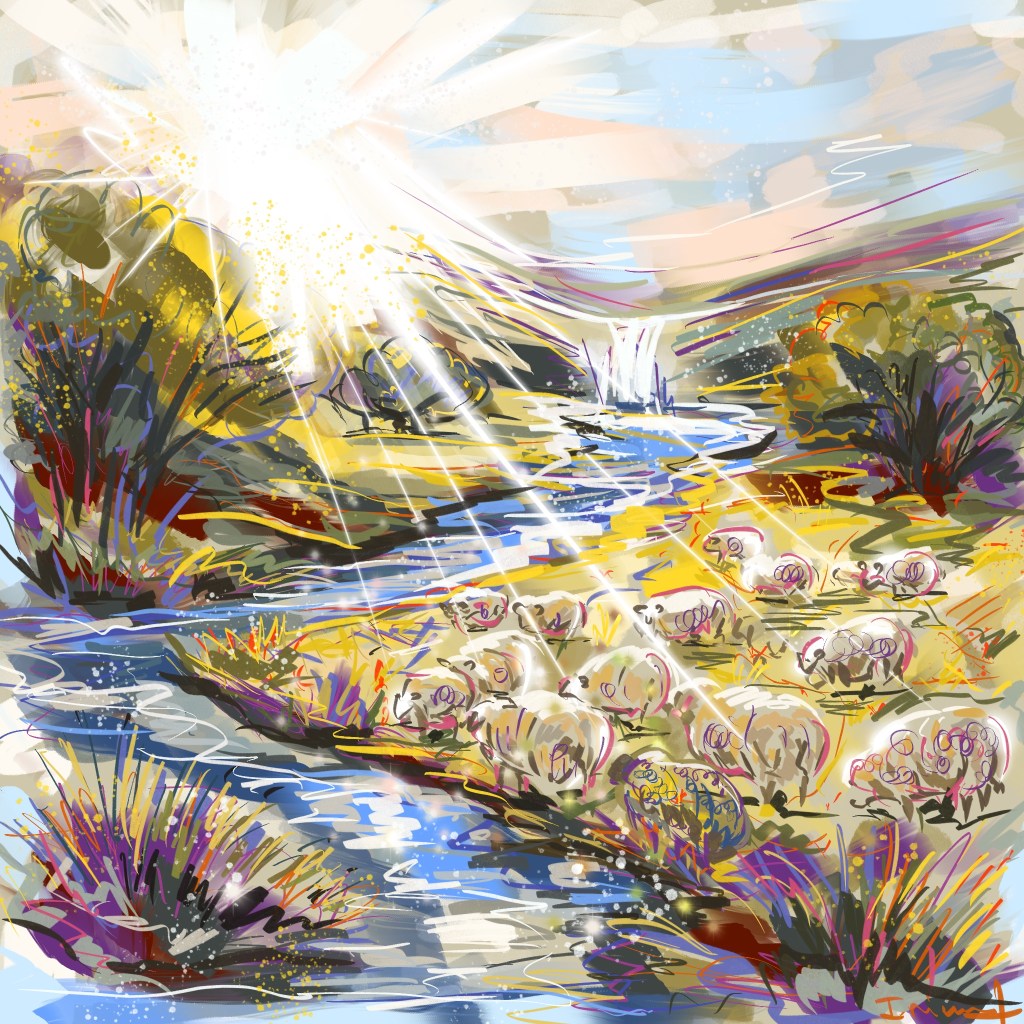
The illustration envisions the world of Psalm 23 appointed for this weekend 1, while the blog post is based on the gospel: click here to read John 9, “Jesus Heals a Man Born Blind”.
The main character in John 9 is a blind man. Given that a fair number of people in our congregation live with limited or declining sight, or no vision at all, it seems to me that the best place to begin our reflection is by acknowledging that biblical language about blindness can be complicated and carries ableist assumptions. In Scripture, restored sight is often used not only as a physical healing but also as a metaphor for spiritual awareness, thereby equating physical blindness with spiritual lack. It also reflects the belief that a divine being would rather fix disabilities than transform the environments and attitudes that make living with disability difficult. We have inherited this worldview, and for centuries expressed the concept of moral awakening through the language of regaining sight – even in the word insight, related to “inner sight.”
Literature often employs the same imagery. In Blindness (1995), José Saramago imagined, decades before COVID, a world struck by a mysterious epidemic. In this disturbing and difficult to read novel, the new virus causes everyone to lose their sight except for one person, who witnesses the collapse of the entire social order. In The Last Battle, C. S. Lewis tells of a group of dwarves who stand in the beauty of Narnia, yet they literally cannot see it. Determined not to be fooled, they insist that the beautiful scenery that lies before them is in fact a dark, dingy stable. Earlier still, John Newton wrote Amazing Grace, which we will sing today. In its famous line, “I once was blind, but now I see,” Newton describes the moment when he finally recognized the horror of the slave trade and his own need for grace.
To soften the ableism in this kind of language, it is worth remembering that throughout history, people living with real blindness expressed deep wisdom. For example, George Matheson, the author of the hymn O Love That Wilt Not Let Me Go, lost his sight as a university student and completed his studies with the help of his sister. On the evening of her wedding, while reflecting on his former fiancée’s decision to leave him because of his blindness, he wrote that hymn in a sudden burst of inspiration. In this prayerful text, he did not ask for vision; and of course, as a blind person, he did not imagine the renewed awareness of the “love that will not let him go” as restored sight. Instead he spoke of yielding his “flickering torch”—perhaps the intermittent moments of limited vision he might have experienced—to the greater light of God to guide his way.
Likewise, the healing of the blind man in John 9 is not only about the restoration of sight. It is also a story about the growth of a voice, about objectification giving way to agency, and about whose testimony counts. These themes appeared in last week’s story about the Samaritan woman and run throughout John’s Gospel. At the beginning of the story others interpret the man’s birth and life, his suffering, and his body. He is talked about rather than talked with. His situation becomes a theological case study. The opening question, “Who sinned, this man or his parents?” reflects assumptions common in antiquity, when many believed disability was punishment for sin, and later historical tendencies to blame mothers’ behaviour during pregnancy for congenital conditions, whether medically justified or not. Even today many parents ask themselves this question when a child is born with medical challenges. I certainly have, even though the physical difficulties with which my children were born are very minor.
Other questions follow. Is it lawful to heal on the Sabbath? Could Jesus perform such a healing if he were a sinner like everyone else? The chapter unfolds almost like a courtroom drama: witnesses are called, testimony is examined, evidence is debated, and competing interpretations are argued. Gradually, however, the narrative shifts. With each round of questioning the man’s answers grow longer and more confident. In fact, it is the repeated questioning that helps him find his voice. At first he refers to Jesus simply by name. Later he ventures a stronger interpretation: “He is a prophet.” Eventually he challenges the authorities, declaring that if Jesus were not from God he could do nothing. He even taunts them: “Do you also want to become his disciples?” And by the end, the story is told almost entirely in his voice. In literary terms the man moves from a passive object to an active witness. The one whose life was interpreted by others begins to interpret events himself, and the testimony of lived experience begins to carry greater weight than the assertions of those whose power had previously defined the truth. The irony of the story is that the man who began in darkness gradually sees more clearly, while those who insist they already see remain in darkness.
The miracle is therefore multi-layered. It involves restored sight, the growth of a voice, dignity replacing objectification, and the marginalized man’s testimony becoming central. In a sense it is a story of new creation. The reference to Jesus making mud from the earth mixed with his own saliva may be disgusting to modern readers. Yet the ancients often associated bodily substances with life force, and the earth echoes the dust from which God forms the first human in Genesis. As such, the man’s body, once treated as cursed, became the site of divine creative action. This reminds us that we, too, always have the opportunity to begin anew, regardless of how “defective” we see our life circumstances or decisions that led to them. After washing in the Pool of Siloam – the name that means “sent” – the man’s entry into a new life resembles baptism. Yet the cost of that new creation is expulsion from the community. In this respect the narrative mirrors the experience of the community that preserved and told this story.
The group we now call the Johannine community, which gave us the Gospel and three epistles attributed to John, appears to have emerged from a conflict that caused their own expulsion from a synagogue community. Rooted in Jewish tradition, they came to articulate a distinctive understanding of Jesus in continuity with their faith, which created tensions between them and their original community. These are reflected in Jesus’ numerous confrontations with the Pharisees found in John’s Gospel, including the one connected with this healing of the blind man. (Unfortunately, these passages have also contributed to the subsequent development of Christian antisemitism.) Yet neither the Johannine believers nor the blind man initially sought to become reformers. Their growing understanding simply shed light on truths others preferred not to see. As the author of the letter to the Ephesians wrote, “You were once darkness, but now you are light.” Not you are in the light, or have seen the light, but you are light.
History offers many similar examples of people expelled from their communities for illuminating truths about the systems in which they lived that others preferred to keep in the shadows. Anne Hutchinson, for instance, was banished from Massachusetts in 1637 even though she believed she was only deepening Puritan teachings. Martin Luther likewise began as a Catholic monk who hoped to reform the church he loved, not create a new one. These stories remind us that communities sometimes respond to new ideas not by changing but by removing the person whose transformation exposes the need for change. In that sense such individuals become a kind of light by which others might see. Yet what that light reveals is not always welcome, and truth can be costly. Dietrich Bonhoeffer wrote (1937), “When Christ calls a man, he bids him come and die.” What he meant was that recognizing the truth may require giving up our entire worldview and, with it, surrendering security and acceptance we previously enjoyed.
Throughout history, various institutions have controlled the interpretation of truth. During COVID, people around the world navigated competing explanations offered by governments, scientists, and the media. In times of war or in societies drifting toward authoritarianism, narratives are shaped by propaganda, sometimes appealing to a mythical past so the nation may be made “great again,” even when the meaning of that greatness remains unclear. The Church reinforced the societal assumptions that served its human leaders’ purposes. Today, the volume of manipulated or misleading information circulating online makes it increasingly difficult to distinguish trustworthy reporting from fake news. Critical thinking skills are therefore necessary, yet they can easily turn into skepticism, cynicism, and denial, causing us to close ourselves off from what is true, much like the dwarves in Narnia who couldn’t see its beauty.
I began by saying that the language of sight and blindness is complicated and can carry ableist assumptions. Yet it is fair to say that all of us, like the formerly blind man, begin each search for truth with limited understanding. We initiate many such searches every day: when we process what we hear in the news, recount history, decide on daily living practices that keep us physically and mentally healthy, reflect on theology, and make daily living decisions based on the values grounded in that theology. Discussing our experiences with people we trust, and reflecting on them in light of both scripture and history, deepens our thoughts and strengthens our voices. May we have the humility to keep learning, the courage to speak truthfully, and the grace to walk together.
- Psalm 23 will be read this weekend alongside the Old Testament reading, in which the prophet Samuel chooses David—a shepherd boy—as Israel’s future king. This reading itself echoes the theme of sight and understanding from John 9 in its assertion that “The LORD does not see as mortals see; they look on the outward appearance, but the LORD looks on the heart.” (1 Samuel 16:7) ↩︎


 Irina's Art
Leave a Reply