
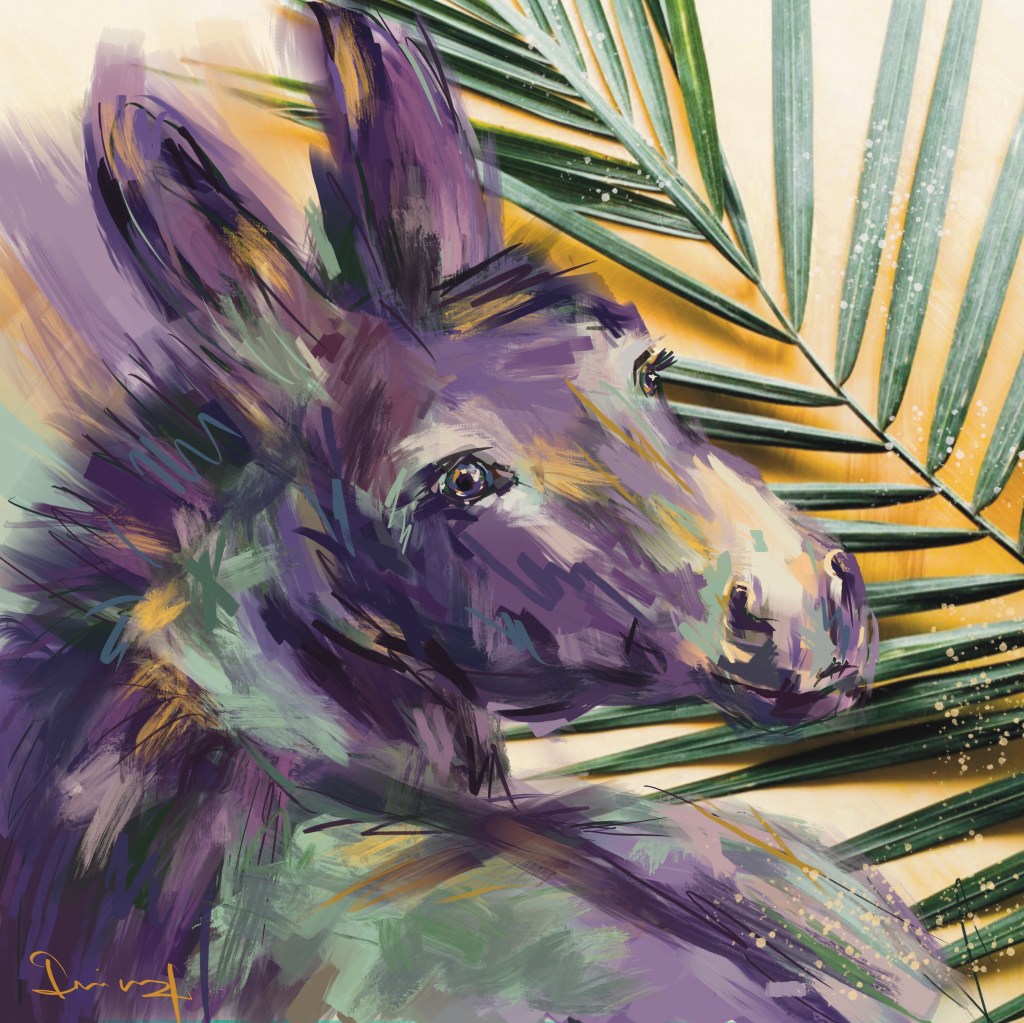
On the last Sunday of Lent, also known as Palm Sunday, we read not one but two Gospel passages. The first is read at the start of the liturgy, just before we embark on the procession with the palms, and it tells of Jesus’ so-called triumphal entry into Jerusalem. Click here to read Matthew’s account that we will hear this year. The second gospel is read in its typical place in the order of service, but the narrative is much longer than usual. It reviews Jesus’ trial and death, and gives us a glimpse of Good Friday.
Last week, I visited my children’s school to give a presentation on Holy Week. It is an interdenominational Christian school, so I am free to present religious content but remain sensitive to the variety of traditions represented in the student body. On this occasion, as is often the case when Easter is approaching, I found myself running out of time to complete my slides. Hurried and less attentive than I usually am, I downloaded the last image that I needed, without looking too closely at it or checking its source, and pasted it on one of the slides. After the presentation, one of the Grade 10 students approached me, saying,
“Rev. Dubinski, you’re always very intentional about choosing artwork to illustrate your slides, so I was wondering if you knew that one of the images you used was created by a priest who is currently being tried for allegedly abusing at least thirty women over the past decades. His artworks used to be all over the place, but they have now been removed from the Vatican. And his work is of questionable artistic value to begin with, not only because it parodies a Byzantine style, but also because there is just never any light in the eyes.”
I admitted my lack of research on this occasion, as well as my unfamiliarity with the Catholic context in which she was clearly well versed and up to date. I thanked her, and I told her that this story would one day make its way into a homily. It turns out that it came in handy sooner rather than later, because it touches on several aspects of Palm Sunday that spoke to me this year.
Both the Gospel story that tells of Jesus’ entrance into Jerusalem for the last Passover celebration of his life, and the service that begins our Holy Week, are so rich in symbolism that there are many directions in which one could go, as I have done over the years. We could reflect on the donkey Jesus rode as a symbol of Christ himself, who came in peace and humility, echoing the prophecy of Zechariah 9:9. We could explore the palm branches as layered symbols within the Mediterranean world: peace and victory for the Greeks, funeral imagery for the Egyptians, and freedom and national identity in the Jewish celebration of annual feasts. We could consider the diversity of the crowd, in which children, disciples, religious authorities, soldiers, worshippers, and bystanders each represent something within us, all present at once. And we could trace the crowd’s shouts back to Psalm 118, arising from a liturgical tradition of processions and praise, and from a longing for salvation – the word that lies at the root of both the cry Hoshianna (Hosanna) and the name Jehoshua (Jesus). Yet this year, that small exchange with the student has led me to reflect on the following three symbols: the wisdom of the children, the fickleness of the crowd, and the request to give to the Lord.
The children’s presence in the Palm Sunday story is highlighted by the hymn with which we circled the church this morning: “All glory, laud, and honour to you, Redeemer, King, to whom the lips of children made sweet hosannas ring”. It is the children who remain with Jesus and continue to cry out in praise even as the mood begins to change. For shortly after this triumphant entry, Jesus enters the temple and overturns the moneychangers’ tables, creating a scene of disruption and displaying anger that tends to surprise us. Yet throughout this episode, the children continued shouting in the Temple courts, “Hosanna to the Son of David” (Matthew 21:14). Well, children live with emotional intensity on a daily basis. They know what it is like to be “hangry,” as Jesus is said to have been when he cursed the fig tree on route to the Temple and then moved on to his outburst (Mark 11:12; in Matthew the sequence is reversed); as some scholars suggest, simply looking to convert his coins into smaller change in order to buy food. Children know that strong feelings and questionable actions based on them do not fully define a person. Their wisdom is grounded in an ability to see through outward appearances and beyond them. And so it is “out of the mouths of infants and nursing babies”, as Jesus quotes Psalm 8:2 in Matthew 21:16, that we sometimes hear the words that alert us to what we may skip over in a hurry.
In my own story, too, it was a student who noticed what I had missed. She saw not only the ethical implications, or at least the ambiguity, of the image I had chosen, but also its artistic shortcomings. She reminded me that children are attentive, perceptive, and discerning. Adults bear a great responsibility in what we present to the young people in our lives and how we say it. Often enough, children do notice pieces of information we assume to be beyond their years. And of course, we also have much to learn from what they see from their fresh perspectives. This student even helped me with my own portraiture practice by reminding me that the eyes matter, and that light—or its absence—is essential!
At the same time, precisely because children move so freely between their emotions, they also embody the tension we enact in this liturgy: the movement from “Hosanna” in the opening procession, to “Crucify him!” said by the entire congregation as part of the Passion Gospel reading. Anyone who has spent time with teenagers knows the experience of hearing “love you” and “hate you” said in the same breath. Yet in the Gospel, it is the adults who first welcome Jesus into Jerusalem with shouts of praise, only to call for his crucifixion shortly thereafter. Don’t we all tend to elevate leaders, artists, and public figures, and promptly cast them down when the tide turns against them? And don’t we all praise and betray God within the same day?
The artist to whom the student drew my attention is now disgraced; in his case, and in contrast to Jesus, it may have been rightly so (there is no verdict on this yet). But he created works that inspired worship in countless individuals. He engaged in acts of creativity that, at their best, reflect the image of God as Creator, in whose image we are made. And yet, according to those who have spoken out, he may have also caused profound harm, even possibly as the alleged victims were helping him to install his work. This is an extreme example, of course; but the capacity to create beauty and to inflict harm co-exist in every life. We all move between generosity and self-interest, between compassion and indifference. Each of us is capable of reflecting the image of God and, at the same time, contributing to the brokenness of the world.
Likewise, the gifts and resources we offer to the world can arise either from selfish ambition or from a sincere desire to provide for others what is life-giving, when we discern that “the Lord needs it” (Matthew 21:3, Luke 19:31). The artist in my story clearly possessed remarkable skill, a capacity that at times God used, through these artworks, to draw people toward prayer. Yet questions have been raised as to whether the artist was given numerous large-scale commissions in prominent churches because he was a cleric and a member of a religious order, or on the basis of his artistic merit. And, of course, as already noted, that same life devoted to ministry and art also contained actions that betrayed and wounded others. This makes me think that gifts alone are not enough; they must be applied within a framework of integrity, humility, and accountability. It is then that the Lord actually needs them, as opposed to could use them.
But honestly, the readiness with which the donkey owners in the Gospels comply with the Lord’s request is rather striking. In Matthew’s account, Jesus instructs his disciples to take not one but two donkeys—the mother and her colt—and, if questioned, to say simply that the Lord needs them. If someone were to say to us today, “The Lord needs your car” – or your artistic skills, talents, time, money, patience, expertise, etc. – would we respond in the same way? It is hard enough to give to specific people and causes, but I find that a request made “for the Lord,” or even “for the church,” can be more difficult to honour because it is so much more abstract. We want to know where our resources are going, and what the recipients will do with our gifts; and I think there is no fault in that.
But what did those villagers understand about Jesus, or about their own possessions, that made such trust possible? How can we learn the same? What does the Lord need from us today? Perhaps time, attention, resources, creativity; or willingness to act more intentionally and examine more closely the sources and influences with which we engage. Or listening to those whom we might assume know less, and doing the job right even when it is for people we assume to be too young or too old, or too few in number to appreciate it fully.
Palm Sunday places before us a series of images and voices, including children who see clearly, crowds that shift unpredictably, animals lent without hesitation. These are not merely allegorical elements of an ancient story but invitations to examine the patterns within our own lives, and to consider what it might mean, here and now, to respond when we hear the words: “The Lord has need of us.” May we recognize what has been entrusted to us, and offer it with integrity, humility, and care.
 Irina's Art
Leave a Reply