
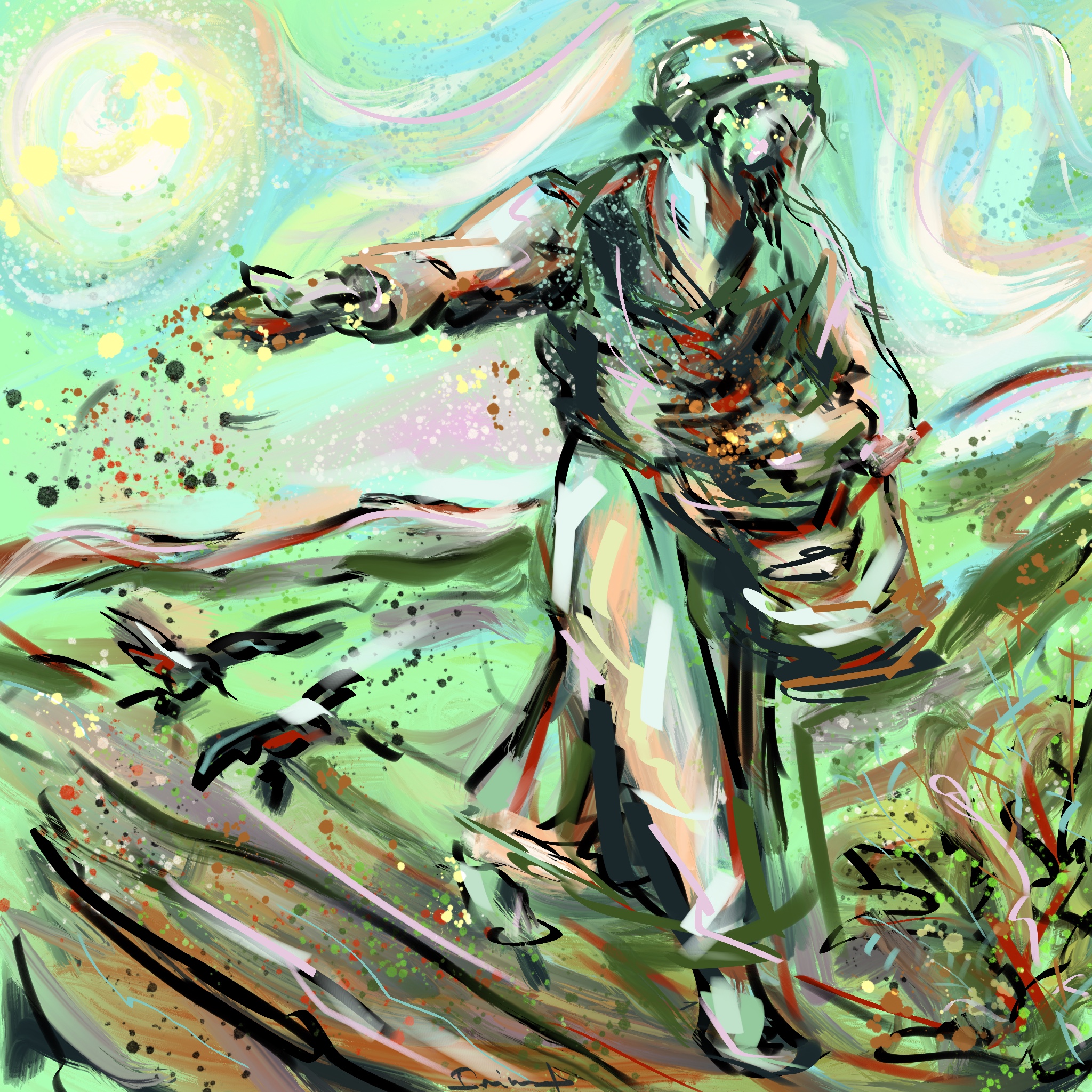

In this image, the Sower stands at the far right, sowing the seeds in the wake of his passing, suggesting that we often recognize what has been planted in us only afterwards, through reflection on what we have lived. His outstretched arm and the arc of seeds carry the movement away from the figure, so that the painting centres not on the sower as an individual, but on grace moving outward through the generous act of giving. The seeds become almost indistinguishable from light, leaving open whether they are grains of wheat or the Word of God being scattered.
Over time, Jesus came to be understood through many identities: a holy man who felt so close to God as to call him Father, rabbi and healer, ascetic and prophet, and even a proto-Marxist and proto-feminist! Yet these various facets of who he appeared to be were all rooted in one, historically specific religious affiliation: the apocalyptic stream of Judaism, at the heart of which was the conviction that the present world was in the grip of such extensive evil that God would have to end it all and start again.
Jesus prophesied the imminent advent of the so-called Son of Man, whom God would send to defeat the forces of evil and usher in the renewed world order, called the Kingdom of God (or of heaven). In the Synoptic Gospels, Jesus spoke about this person, perhaps a manifestation of God, as distinct from himself, but in John’s Gospel, he went as far as to call himself by this title. And in all four Gospels, Jesus called on people not to become too attached to the present world, because it would not last, but to learn to live ethically so as to be ready for the future reality.
So when Jesus told parables about wheat and weeds or seed sown on different kinds of ground (read the text here), he was describing the kind of control that the “evil one” or “the enemy” exerts over the world. However, the interpretations that Jesus provided for his own parables also reveal that he really did mean that there were groups of people who would be ready for the coming of the Son of Man, and would make it into the Kingdom, and others who would not be ready and would thus be excluded. There is no way to hide the reality that Jesus was not as inclusive as we wish him to be—or perhaps the author of Matthew, the Gospel most concerned with the Jewishness of Jesus, thought to highlight this by making Jesus’ teachings appear somewhat unnuanced.
In Jesus’ belief system, how would people become ready for the advent of the Kingdom of God? By hearing and heeding the Word of God: the Law, the Jewish scriptures. In the sower parables, the seed is the word of God. In Isaiah 55, God’s word is the rain that waters the seed. In the Psalms, the Law is many things, from lamps to honey. Jesus neither invented the Law nor wilfully disobeyed it. Some Pharisees accused him of doing so, but they themselves debated how the Law should best be kept, and so there were some with whom Jesus’ understanding aligned and others who condemned Jesus’ interpretation. Yet Jesus himself repeatedly taught faithfulness to the heart of the Law, already summarized in Leviticus and Deuteronomy as “love God and neighbour,” which became “love one another as I have loved you” in John’s Gospel.
I believe that when we read these parables today, however, we may apply them more broadly. These images can still apply to our responses to God, but not only to what we read in scripture, but also to what we hear implicitly through others, discern through events around us, receive less consciously through nature and art, or encounter mystically. In one way or another, we are all trying to grow some kind of fruit, and I think this involves at least two universal tasks. The first is discerning an overarching purpose for our lives; the second is learning to become content with our destiny, even while continuing to pursue our goals.
My own reading of these parables is therefore that they need not describe different categories of people but rather different parts of ourselves, or different seasons of life. There are not four kinds of hearts—the hard, the shallow, the distracted, and the spiritually fruitful. And most certainly, there are not only two kinds of people—the deserving and undeserving, wicked and righteous, saved and condemned, destined for heaven or hell. The human heart is complicated, and I do not believe anybody is dispensable to God, not even through their own failure to pay attention or their conscious resistance to grace. Wheat and weeds can grow together within a single human life. The sower keeps sowing extravagantly and is remarkably patient with what grows.
They are extraordinarily rich analogies that remain intelligible even to those of us who are largely urban dwellers. Many people still like to grow things; there is simply something deeply satisfying about being productive and creative while participating in the natural world, and even those who do not garden delight in watching things grow. In the parable of the four types of ground, Jesus describes seeds that fall on a path, on rocky ground, among thorns, and on good soil. What makes soil “good” depends partly on what you want to grow. My beloved roses prefer good drainage and slightly acidic soil, but other plants thrive in wetter conditions and alkaline soil. Each of us is all of those soils at different times in our lives, fostering different types of plants. Parts of our psyche are fertile; parts are hardened. Some growth is shallow; some is choked in its early stages by competing demands; and sometimes we are so depleted that nothing new seems able to take root. In a community where we accompany one another through illness, aging, and care, we know how profoundly both chronic pain and caregiving can alter the soil of our hearts – yet there is always something growing.
While we cannot always control the season of life, we can tend the soil and remove some of the stones by choosing not to participate in cruelty, echo gossip, judge others, or allow cynicism to harden us. Still, like the animals that feed on seeds and shoots, the fear of the unknown, propaganda, manipulation, and advertising can all snatch away newly forming convictions. In my garden, it is not so much birds eating seed as squirrels digging up tulip bulbs in autumn and groundhogs devouring budding zucchini flowers in spring. You have to plant bulbs so that it looks as though nothing ever happened, then sprinkle a deterrent such as blood/bone meal over the evidence—though what deters a rodent may now attract a dog, who loves both bones and digging! This may be a new parable in itself, signifying that the habits we develop to protect ourselves from one danger can leave us vulnerable to another.
The parable of the wheat and the weeds, on the other hand, evokes yet another familiar gardening problem: early growth can be deceptive. In early spring, everything emerges looking more or less the same, whether it was intentionally planted or arrived on the wind. Dormant plants still look quite dead, while lush, vigorous, and impressive growth may turn out to be invasive. Interestingly, many weeds have weaker roots, so when you are uncertain, you can test them by pulling gently. There is a brief window of time when you can finally tell what is what, but if you miss it, the weeds soon shoot up much faster than the plants you actually want. All the roots become intertwined, and by pulling too aggressively, one can damage the intentionally cultivated plants.
But what, after all, is a weed? I consider daylilies weeds because they are nearly indestructible, take over everything, and I do not particularly like their appearance (I grow them anyway!). Goldenrod, on the other hand, is a conventional weed, but I like it and keep it. Perhaps, ultimately, what makes a weed a weed is that you do not appreciate it, yet it takes off despite your attempts to curb its spread, monopolizing light and nutrients and preventing rain from reaching what you do want. Likewise, the weeds growing alongside the good qualities in our lives are not always dramatic moral failures. Few destructive patterns begin with a true love of evil. Sometimes they are simply unproductive habits of attention and ways of living that grow unnoticed; in other cases, something good becomes distorted by fear, scarcity, ego, or isolation, or grows out of proportion. Thus, the desire for excellence becomes perfectionism; prudence becomes anxiety; genuine vocation fosters guilt when rest is needed. Altruism conceals a need for control or indispensability. Love becomes possessiveness, confidence becomes arrogance, justice becomes cruelty, and connectivity becomes codependence. In my understanding, this is what sin is: not evil as a separate entity or mysterious external force that causes us to misbehave and be selfish, but the distortion of good intention.
And so the understandable question is whether we should rush to pull out the tares that seem to have sprung up overnight. Our culture encourages self-diagnosis and the presentation of a curated image of the self, which has the potential to result in a kind of spiritual over-weeding. Yet the parable suggests something more merciful and realistic: until the harvest, wheat and weeds coexist, for in gathering the weeds we may uproot the wheat along with them. Some forms of self-correction become so harsh that they damage tenderness, joy, spontaneity, and hope. As such, someone determined never to fail again may become incapable of creativity, risk, or future learning. A person trying to uproot every trace of vulnerability may uproot compassion with it, while someone determined to eliminate all dependence may also damage the capacity for intimacy.
If harmful behaviour often emerges from wounded or overextended versions of good impulses, then hating ourselves is not the key to transformation and repentance. The goal is not the annihilation of desire, passion, ambition, and longing, but their integration. Perhaps this is why spiritual maturity produces gentleness. People who have examined themselves truthfully and with self-compassion become slower to divide humanity neatly into categories of good and bad because they have discovered that such impulses already coexist within themselves. As Psalm 139 reminds us, God already knows the whole field of the human heart and still holds us within a presence from which we cannot be separated. We can rest in this grace and extend it to others.
The two parables, then, describe related aspects of interior life. The parable of the sower asks what makes us receptive or resistant, what allows something good to take root, and what snatches it away or chokes it before it matures. The parable of the wheat and the tares asks what happens once good qualities and distorted versions of those same qualities become intertwined, and how we learn to discern between them without harshness. And perhaps the greatest miracle is that the Sower eternally keeps scattering seed generously, even where it seems wasteful, while the Gardener is ever patient before deciding what must finally be removed. Our call is to tend the ground we have been given—to examine our lives, repent, cultivate qualities that help us fulfil our purpose and become more content, and make ourselves more receptive to God’s word—but to do so with humility and patience, recognizing that human growth is organic. However our hearts may change with the seasons, God’s love is patient enough to wait for us to bloom again. The hope of these parables is not that the field begins pure, but that, despite everything mixed within it, fruit and beauty still grow.

Leave a Reply