
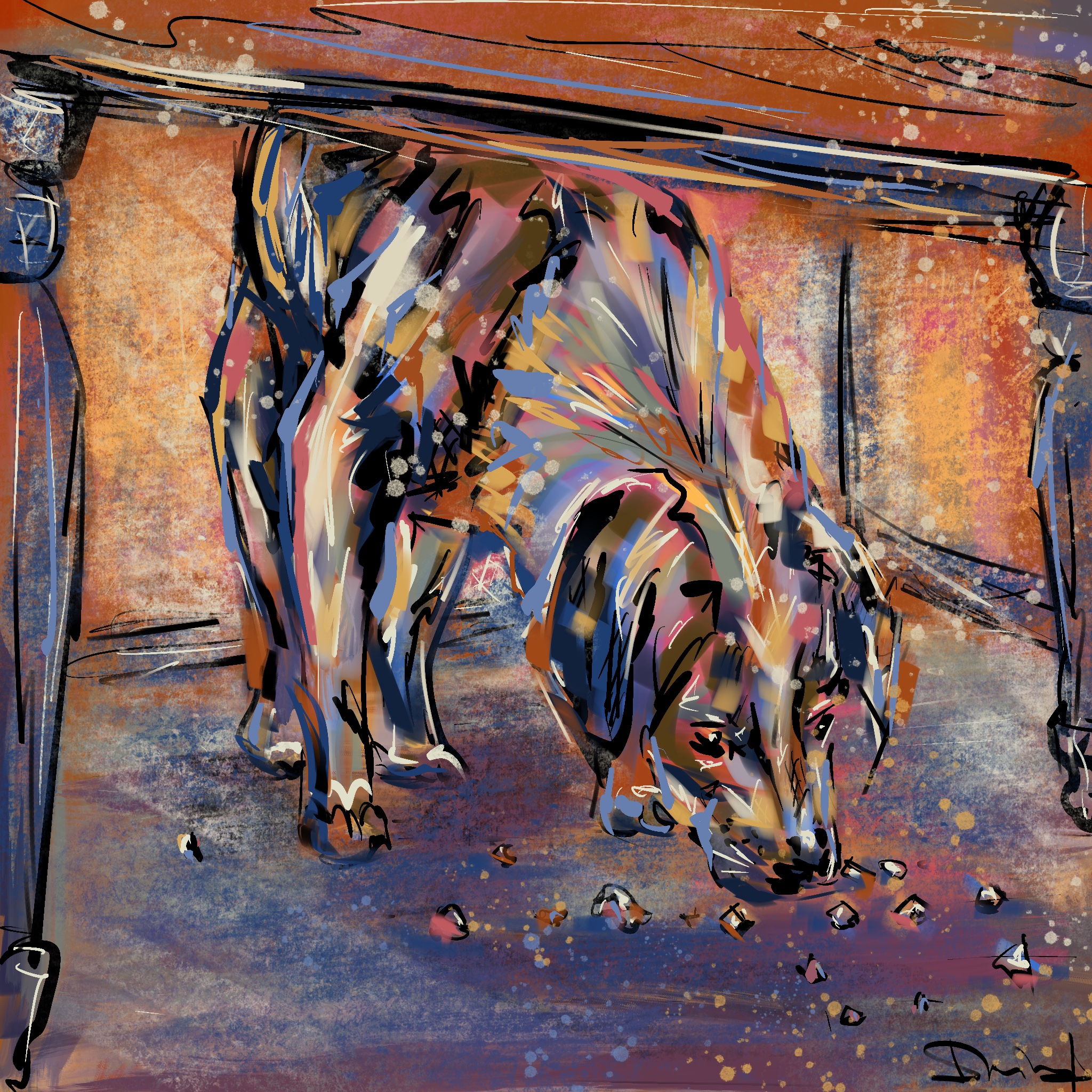

“Even the dogs eat the [children’s] crumbs that fall from their master’s table.” (Matthew 15:27; Mark 7:28)
Today’s Gospel story hardly sounds as though it comes from the life of Jesus. A woman whose ethnicity is identified as Canaanite in Matthew (read the text here) and Syrophoenician in Mark (read the text here) has learned that the famous Jewish healer has entered her region and begs him to heal her suffering daughter. Uncharacteristically, he refuses to help her because she is a foreigner and calls her a derogatory word, saying: “It is not fair to take the children’s food and throw it to the dogs.” We have all experienced rejection, but it stings so much more when it is based on a characteristic over which we have no control, such as ethnicity, gender, social status, or disability. And it is one thing to ask for something for oneself and quite another to beg on behalf of a child. So why not heal the child immediately? Why invoke the distinction between Israel and those outside it?
One interpretation is that Jesus deliberately subjected the woman to this exchange in order to teach his disciples. That interpretation has never worked for me because it just seems too cold and calculating to belong in the story of Jesus. At the other end of the spectrum is the argument that Jesus was not insulting her at all because he used the milder of two available words for a dog, referring to a domestic rather than a feral animal. Indeed, there is archaeological evidence that dogs were valued as domestic companions, and even a modern Canaan Dog breed apparently descended from ancient dogs of the region, so perhaps the image was less offensive than we imagine it was. Yet dogs in the ancient Middle East did carry negative associations, just as they still do in some areas today. And even if Jesus’ word choice was gentler, the metaphor still remains hierarchical: “the children are fed first” implies that some ethnic groups are more deserving of blessing than others.
I believe that to take the theology of the Incarnation seriously is to say that Jesus’ mind developed within a particular culture, history, and religion. He must have known that those listening to him held shared assumptions about insiders and outsiders, purity and danger, respectable and suspect people, and that his reputation as a religious teacher depended on his answer. The stakes were high. Yet, like everyone else in the process of forming a worldview, Jesus was discerning which of his inherited assumptions to affirm, which to revise, and which he was only beginning to recognize. Perhaps this woman contributed to this celebrated rabbi’s articulation of a more developed theology, and it is to his credit that he allowed himself to gain insight from an outsider. But how does she manage to turn the encounter to her benefit?
Other characters asked Jesus questions either to help them understand him, or to challenge him. This woman comes up with a statement; one through which she both “thinks out loud” herself and challenges him. Prior to this, she had already figured out that she could appeal to God through a person whom she understood to be endowed with extraordinary power, and that his God would hear her even as an outsider. So she approaches Jesus using the language of his own people, calling him “Son of David.” Precisely what she initially understands by that title cannot be known, but she proceeds to combine her original notion with Jesus’ metaphor to form a new insight: “Even the dogs eat the crumbs under their masters’ tables.” As in, “Yes, Lord, and if your metaphor is true, then notice what else follows from it.” Her genius is that she does not reject the derogatory image Jesus gives her; she accepts his metaphor provisionally, then uses its own logic against the conclusion he draws from it. If she is to be placed beneath the table, then even there she remains within reach of grace. She dares to express the hope that the blessing given to Israel need not entail the abandonment of everyone else.
More than just winning an argument, she draws out an implication of Jesus’ own proclamation: the God whose reign he announces cannot be confined within the categories, systems, or hierarchies of the human world. And it works: Jesus changes his mind. What is more, as Matthew and Mark construct their narratives, this becomes a pivotal moment in his ministry, after which it begins to include the outsiders. This is reflected, for example, in the second set of feeding miracles that shortly follows this story in both Gospels, which scholars have interpreted as the feeding of a Gentile crowd based on the numerical symbolism we considered two weeks ago (read the sermon here).
But what sort of prejudice was keeping Jesus from helping her? What had created such a wall that he could not summon his usual compassion? The source of his animosity lies in the relationship between his people and those known as the Canaanites. On the one hand, ancient Canaanite religious practices did include traditions that biblical writers associated with child sacrifice and other practices profoundly abhorrent to Israelite Law centred on loving God and neighbour. Yet the biblical story also depicts Israel repeatedly falling into precisely the practices it condemns, through intermarriage, cultural exchange, and coexistence in the land. The Israelites therefore blamed the Canaanites for leading them into idolatry, much as generations of men absolved themselves of infidelity and exploitation by blaming women for “seducing” them.
As for the resulting conflict, to me, the destruction of entire peoples as Israel entered the land it understood God to have promised to them is not that different from other times in history when religious conviction resulted in genocidal violence. Whenever one group comes to regard itself as uniquely worthy because of a special relationship with God, it tends to resort to dehumanizing language as one of the mechanisms by which those perceived as less worthy can be displaced, enslaved, assaulted, or killed without troubling the conscience of their persecutors. And when an entire population is reduced to a less-than-human category through the systemic use of derogatory language – dogs, vermin, unclean, parasites, devils, lebensunwertes leben (“life unworthy of life”), untermensch (“subhuman”), etc. – then genocidal intent truly takes hold.
We may associate such thinking with a safely distant past, such as the conquests of biblical times or the horrors of the mid-twentieth century; yet several examples committed before the eyes of the whole world are disturbingly contemporary. Only a little more than a decade ago, ISIS carried out a genocide against the Yazidis of Iraq, killing men and teenage boys and enslaving women and children. Some were held in households whose daily lives looked normal. The horror of that detail is precisely its ordinariness: a system had taught average people that those they exploited in every way within their own homes were a category to whom moral obligations did not apply. Another example is today’s Gaza, where a UN Independent International Commission of Inquiry has concluded that Israeli authorities harboured genocidal intent. Of course, this is a much more complicated context because Israel rejects that conclusion and argues that its objective has been defeating Hamas rather than destroying Palestinians as a group.
Indeed, in some political events it is much more difficult to infer legally the intent behind mass destruction, deprivation, and displacement than in others. Regardless, in this case, UN bodies have consistently documented the effects as especially devastating for children. But a child does not understand why someone has decided that she belongs to the wrong people! She knows hunger, fear, pain, loss of family, the desire to go home, and perhaps some awareness that the pets of those who oppress her people are fed better than she is. That is what makes the absent daughter in today’s Gospel so poignant. She bears no responsibility for generations of religious and territorial conflict or the practices attributed to her ancestors. Her mother’s heroism is that she boldly forces a powerful person to encounter her daughter as an individual rather than as a category. Whatever her ethnicity signified within Jesus’ inherited imagination, she flung his derogatory language and its logic back at him, compelling him to recognize her daughter as fully human; as any child of God, worthy of compassion.
Anglicans have grappled with the theological question of human worth as most Christians do, and in fact, have preserved the image from this Gospel story in one of the most memorable prayers of the older Eucharistic tradition, which includes the following phrase:
“We are not worthy so much as to gather up the crumbs under thy Table. But thou art the same Lord, whose property is always to have mercy.”
The “Prayer of Humble Access” (read full text here) is said in unison immediately before receiving Communion, after the Eucharistic Prayer and the Lord’s Prayer. Composed by Thomas Cranmer in 1548, it is one of the earliest original English prayers distinctive to the Anglican tradition. It remains beloved by many of us for its extraordinary rhythm, familiarity, theological density, and scriptural echoes. Yet many others recoil from its language of unworthiness.
But Christian theology makes an extraordinarily elevated claim about human worth: we bear the image of God. However we understand that concept, it implies that capacities we associate with divine life, such as reason, creativity, relationship, morality, ethics, and self-giving love, are reflected within each of us. So each person’s worth is immense but not self-generated. Perhaps what Cranmer was trying to express in language that went too far, was not that God finds us contemptible and graciously tolerates us anyway, but that our worth is real because it rests upon a generosity of the Creator prior to anything we could earn. Mercy is not God’s reluctant concession but a defining aspect of his nature.
It seems to me that the prayer contains the same theological kernel as the woman’s answer to Jesus, as well as the stories of the feeding of the multitudes, which, as I mentioned, mark the beginning of Jesus’ ministry among the Gentiles. In each case, there is the recurring question of who is entitled to eat and whether there will be enough food. The woman’s answer anticipates the deeper logic of the Eucharist: grace and mercy cannot be exhausted or even diminished by being shared. Even a crumb will suffice for the moment because it comes from an inexhaustible source. Another person’s inclusion does not require my exclusion. My worth is not diminished by my recognition of another person’s worth because it rests in the God who creates and sustains, in whose image we are made, and whose property is always to have mercy.
What I find hopeful about this disturbing story is that nobody remains stuck where they began. The outsider becomes a theologian, the rabbi changes his mind, and a child who bears no responsibility for the history that had set the stage for this encounter is made well. So no, I cannot imagine Jesus deliberately humiliating the woman for educational purposes. And if even his understanding could be developed through such an exchange, then surely none of our present assumptions are beyond revision. We are born into societies, families, religious traditions, political systems, and economic arrangements we did not construct, but all of us face the work of discerning what injustices we tolerate only because they are ordinary.
Which individuals do we reduce to categories, what words do we call them, and with what implications?
Likewise, genuine faith will always have room to grow beyond the system given to us by parents, societies, and institutions. Through learning, prayer, experience, questions, and even what feels like negotiating with God, we make our faith more genuinely our own, even if the process forces us to become more comfortable with ambiguity than our inherited faith allows.
In which ways has your faith evolved and opened up over time, and because of whose influence?
I think the bottom line is that like this woman, we do not need to understand everything about God in order to know that we all deserve compassion and are called to practice it. Like Jesus, may we remain curious about how God might expand our ministry beyond the scope of our imagination. What matters is our willingness to remain in conversation: with God, with Scripture, and with people, especially those whose stories unsettle our inherited categories.

Leave a Reply