
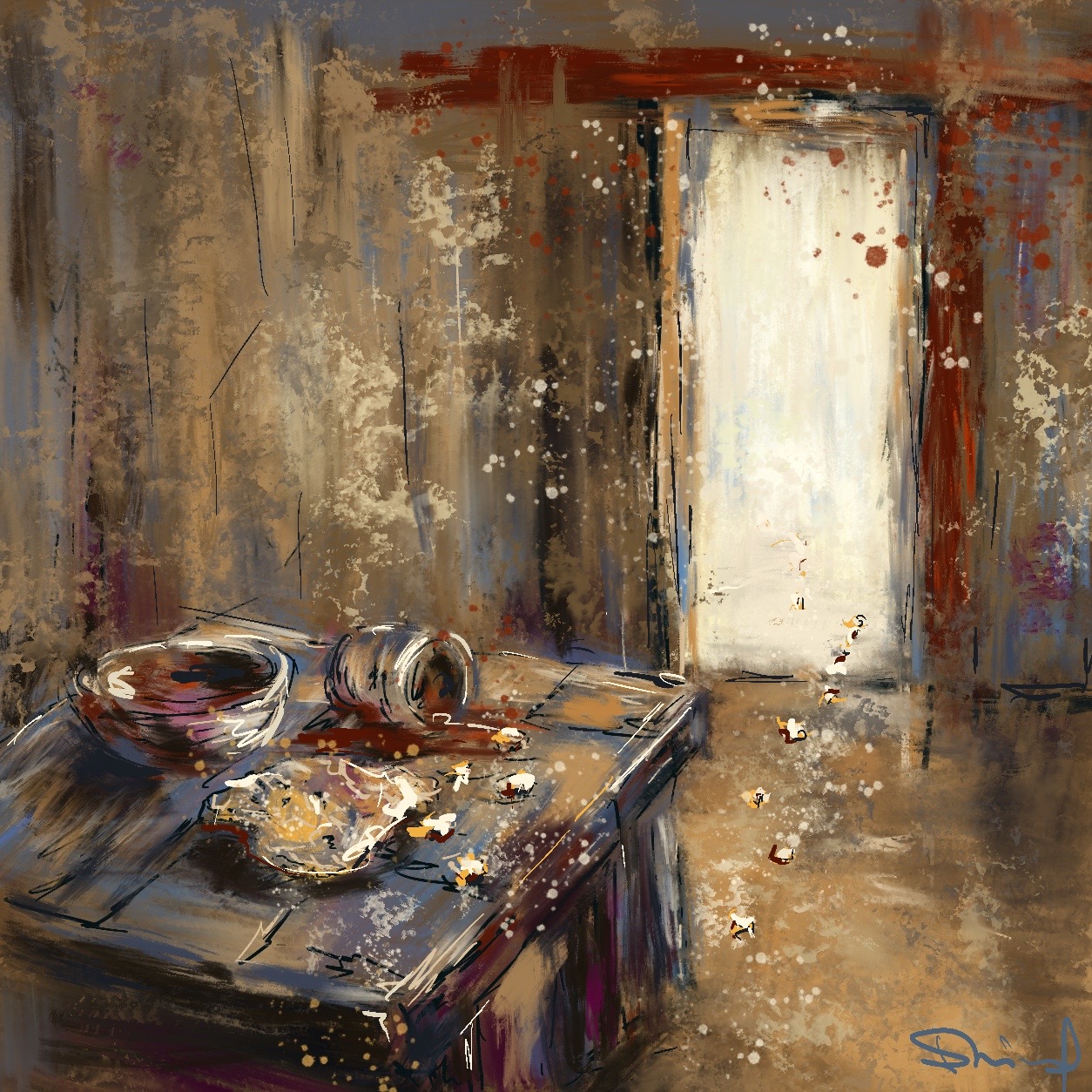

The Passover story is most familiar to us as the context for the Eucharistic prayers, the symbolism of Jesus’ title, “Lamb of God,” and the Maundy Thursday liturgy, when we remember Jesus gathering with his friends for their final supper together. Today, for once, the Passover itself is the subject of our reading from Exodus 12 (click here for full text), which recounted the details of the night on which Moses led his people out of Egypt and back towards Canaan, the territory encompassing modern-day Israel and parts of the Levant, including Lebanon, Jordan, and Syria. Their ancestor Abraham had once settled there, believing that God had called him to move from Mesopotamia, but his great-grandsons and their families eventually had to relocate to Egypt because of a famine. This worked well for a while as one of the twelve brothers, Joseph, was already in Egypt when the famine began and had developed extraordinary influence at court. But two to three hundred years later, the Pharaoh of the time looked upon this rapidly growing population and saw a threat.
Traditional calculations have placed the number of Israelites in Egypt at the time of the Exodus at two or three million, approaching Egypt’s own presumed population of three or four million. Exodus refers to six hundred thousand Israelite men, whereas the Egyptian army may have numbered no more than twenty-five thousand. These figures may not be historically precise, and even if Pharaoh’s concern that the Israelites might eventually outnumber the Egyptians had some numerical basis, his claim that they would necessarily side with Egypt’s enemies in a conflict lacked evidence. Nevertheless, that fear set in motion a series of escalating measures against them, beginning with forced labour and culminating in the killing of their newborn babies.
Their future leader, Moses, survived only because an Egyptian princess rescued and raised him. His older brother Aaron, who later became his spokesperson and Israel’s first high priest, had been born before the Pharaoh’s decree against the newborns, and was therefore raised safely at home. When Moses was forty, which Exodus does not mention but the New Testament book Acts does, he visited his people. After killing an Egyptian who was attacking one of them, Moses had to flee to Midian, where he protected his future wife Zipporah and her sisters from aggressive shepherds. After forty years of tending her father’s sheep, Moses heard God speaking from the burning bush. So it was at the age of eighty that he returned to Egypt and demanded of the Pharaoh to “Let my people go.” Pharaoh repeatedly refused, and a succession of plagues followed, each exposing the powerlessness of Egypt’s deities. After nine of these, the conflict reached its culmination: the people who had suffered the state-sanctioned murder of their own children were delivered through a night when Egyptian families experienced that same horror.
Before that night, each Israelite household was instructed to slaughter a lamb and put some of its blood upon the doorposts as a sign of God’s promise of protection over their households. The lambs were not killed only for the sake of using their blood, but became the meal that energized the people for the wilderness journey. As the meat was roasted, the families too small to consume an entire lamb joined their neighbours, and nothing was wasted. Alongside it, they ate bread that had no time to rise because they had to leave immediately, and bitter herbs that echoed the bitterness of slavery.
Where in our church service do we refer to these slaughtered lambs? It is after we break the bread symbolizing Jesus’ body, broken by death near the time of Passover many centuries later. Matthew, Mark, and Luke present the Last Supper as a Passover meal, but John places the meal before Passover, so that Jesus died at the same time as the lambs did. Yet none of the Gospels mentions a lamb upon the table. Instead, as Jesus takes bread and wine and says, “This is my body. This is my blood,” figuratively, he becomes that lamb. Therefore, we say or sing the Agnus Dei: “Lamb of God, who takes away the sin of the world, have mercy on us,” reflecting the title given to Jesus by John the Baptist and Paul’s words, “Christ our Passover has been sacrificed for us.”
John and Paul use the image of the Passover lamb to interpret Jesus’ death as the means of our spiritual liberation, which, in my opinion, extends the theological logic beyond the meaning of the original Passover lamb. It was not a propitiatory sacrifice intended to appease an angry God. It was not a sin offering or a substitute punished in the people’s place. Passover was not about persuading God to become merciful. It began with God’s mercy and reflected his promise of safety and freedom, freely given. What looks like a sacrifice was simply participation in this saving action made tangible by giving the people something they could do, touch, mark upon their homes, and literally take into themselves.
That distinction matters to me when I reflect upon the lamb as a symbol of Jesus. I do not believe that God intentionally caused Jesus to be born and live only so that, some thirty years later, he could be killed to appease God’s anger. I do not believe that God required the punishment of an innocent person before becoming willing to forgive the guilty. Such theologies of satisfaction have roots in the medieval world and were shaped by its concepts of debt, violated honour, and the satisfaction owed to a powerful ruler; and penal substitution theories developed during the Reformation. These interpretations have remained influential, but they are neither the earliest Christian explanations of the cross nor the only ones available to us today. Therefore, I do not believe that God sacrificed Jesus. Human beings did. Jesus was killed because fear, power, violence, and self-interest converged around him, just as they had once converged around the Hebrew babies. As has happened throughout history and still happens now, God neither demanded the violence nor prevented it. But Jesus’ non-retaliation reveals another kind of power, one available to human beings and not only to God: power that creates freedom without producing another victim.
One of the earliest Christian understandings of this mystery is called Christus Victor. We may imagine Christ’s victory on a cosmic scale, as though a battle took place somewhere far beyond us. But each person is also a cosmos in which God’s victory over evil must take place many times over, and God’s grace makes it possible. My belief is that God wills the salvation of every person, and that divine grace ultimately holds every life and draws all creation into eternal life with God. Whatever “heaven” may finally mean as a place or state of being, our entry into it is not something we purchase through either correct belief or exemplary behaviour. Like Israel’s liberation, it begins in God’s initiative and God’s faithfulness. But yes, it does call for our participation.
Therefore, to me, Jesus is our Passover lamb not because he was killed in our place, but because he shows us what it means to break free and to live without being held in bondage by the forces that so often govern us. We each have our own issues that enslave us spiritually and force us to labour without reward. Therefore, there are many “Egypts” from which we depart over the course of our lives. At times, it may be the excessive attachment to money and possessions. It may be the need to control and dominate, or simply to fit in and receive approval; the fear of losing status or of missing out; the impulse to answer violence with violence and to act upon jealousy, anger and resentment. These states can become ingrained enough to resemble home, even when they prevent us from living freely. Until one day, we recognize that the time has come to eat our last meal in that place with our sandals on and our staffs in our hands.
We have all made a number of decisions that fit into this category. For example, at the start of COVID, I held two part-time jobs. One of them was exacting too high a cost from my mental and physical health and from our family life. Most importantly, I had no agency, voice, or freedom to do what I believed was right in my role. At the time, I did not yet understand the full toll that this situation had been taking upon me, nor could I anticipate the good things that would become possible after I left. It was only when I reconciled myself to giving up half of my income and entered “the wilderness”, so to speak, that I recognized that this Egypt had been costing me more than I knew. Perhaps you, too, can recall an occasion when you left your own Egypt. It may have been difficult, costly, or frightening, but necessary. You may have discovered that you had been in Egypt only once you felt healthier and more fully alive, well after you left.
That does not make it easy to leave the old home behind, however limiting it may have been. The Israelites discovered this in the wilderness, as they repeatedly doubted, complained, fashioned an idol, resisted Moses’ leadership, and asked to return to Egypt. They were not models of perfect faith, and neither were the generations that followed them. The Jewish High Holy Days that are now approaching (Rosh Hashanah on September 11, and Yom Kippur on September 20) call people to examine their lives, but they also remind them that belonging does not depend upon maintaining a flawless record. So does Passover, which has now been observed for millennia following the command God gave on that night: “throughout your generations you shall observe it.”
As one way of keeping this ancient command, the Torah called for pilgrimage to Jerusalem, even if not everyone could undertake it annually. Jesus, too, went to Jerusalem for significant festivals, including the Passover during which he died. Following the final destruction of the Temple in 70 CE, Jewish worship became centred in synagogues, but because the Passover celebration always had the home meal component – Seder, and its liturgical pattern, Haggadah – it remained consistently observed. In a section that I find particularly fascinating, the Haggadah responds to Exodus 12:26-27, “And when your children ask you, ‘What does this ceremony mean to you?’ then tell them…” by imagining four children: the wise one who wants to deepen her understanding; the rebellious one who is sarcastic; the young one who asks only, “What is it?”; and the one who does not yet know what to ask. Nobody is too simple or too difficult, or already knows too much, to engage in the conversation! And a modern Jewish reflection adds a fifth child, absent from the table, to affirm that even one who is disconnected, uninterested, alienated, or unwilling to come is never forgotten or abandoned. The community is encouraged to trust in the possibility of her return.
This offers Christians a powerful image of God’s grace. Everyone belongs before they understand, including those who have not yet come to the table. Explicit faith may help us recognize and participate in the freedom God offers, but it does not create God’s love or limit its reach. As I said, Jesus himself allowed the ancient observances to shape his understanding of repentance and hope, and so at his final Passover meal, he placed his own life within the ancient story of liberation. But as he gave his friends bread and wine, he did not say, “God must be persuaded to save you.” He said, in effect, “God’s saving life is here. Take it into yourselves. Then get ready to leave.”
Now we follow Jesus’ invitation to continue celebrating the Eucharist. Each liturgy is another Passover meal in which we remember that God desires freedom and eternal communion with him for every person. Our participation in that freedom consists largely in learning to live selflessly. This does not mean self-erasure, but becoming less governed by the frightened self that wants to survive and preserve the status quo through rivalry and control. It means releasing resentment, refusing retaliation, sharing our resources, and acting compassionately even when there is no advantage to us. The question is not whether God is willing to save and free us. The question is what we are now ready to leave behind so that we can live as people who are already free.


Leave a Reply