
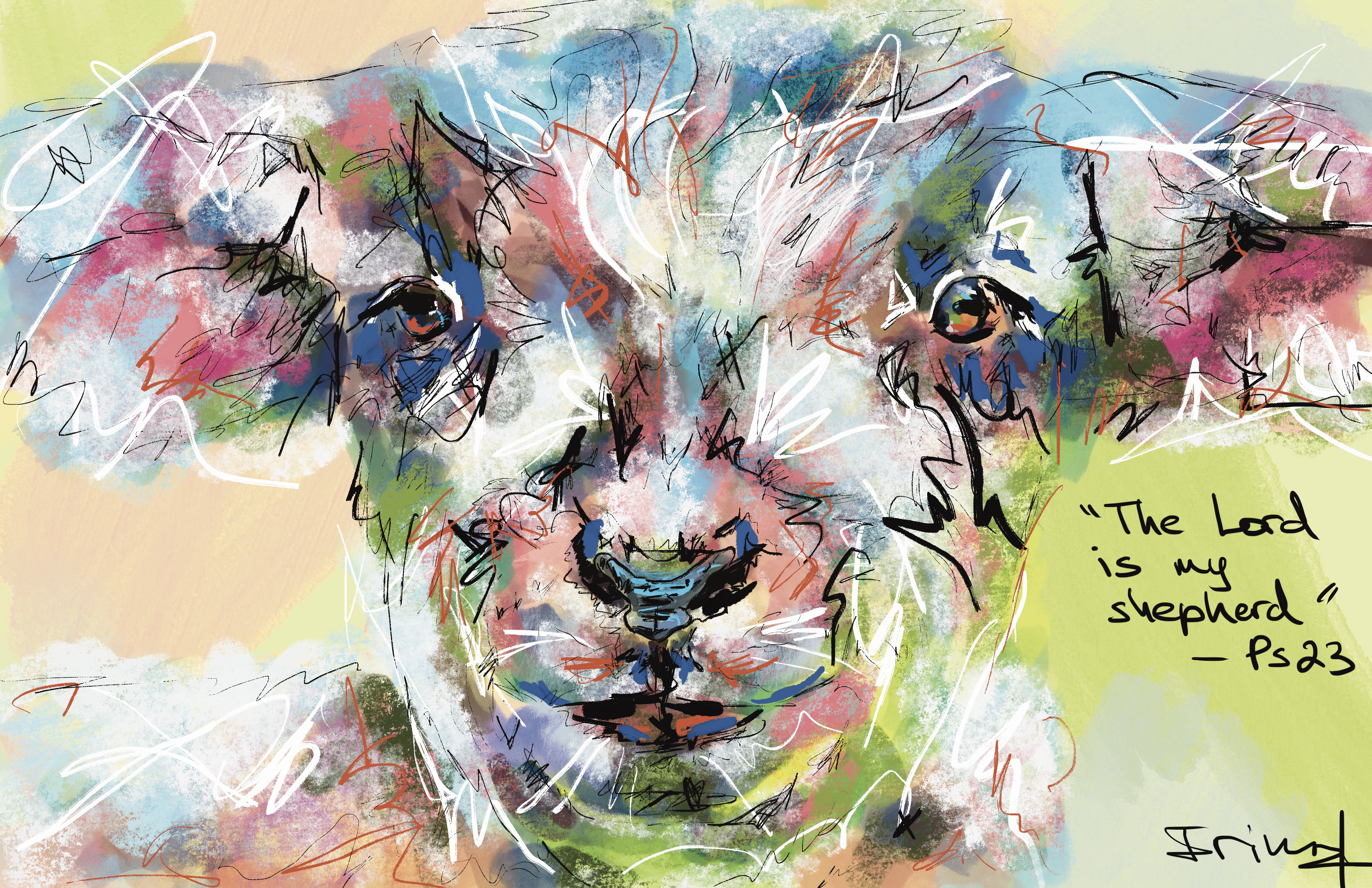

Every year half-way through Eastertide, a number of clergy around the world all face the same challenge: preaching about sheep. It’s hard to find something new to say, while also avoiding a lecture on animal husbandry or creating a sentimental children’s book illustration. There are a few other options, which I tried in the past, but as a surprise to myself, I have never preached on Psalm 23. I have referred to it in more funeral homilies than I can remember; but on Easter 4, I tend to resist it. Are you similarly aware of some passages that make you frustrated, say something you don’t want to hear, or you just don’t want to explore? Why is that? How do you feel about Psalm 23? We hear it at most funerals, and at the start of each Vicar of Dibley episode (if you’re into British sitcoms!). Many people, including non-Christians, know and love it. A few city dwellers might find agrarian references somewhat irrelevant; some might chafe at the unflattering comparison with the sheep, and others dislike the notion of “rod and staff”. None of it was my problem though. It is that I simply don’t see how an animal destined for a fire pit, or a lifetime of making wool and cheese, could represent the object of unconditional love. I don’t see much of a difference between the “hired hands” and the owners – they all avoid material loss.
Because I don’t see what practical value humans have to God, I surmise that his/her love must be unconditional, and as such, to me, God just isn’t a shepherd. And I think that’s okay: I find many other, more relatable “images of God” in the scriptures and elsewhere, and I invite you to explore your own images of God, and their sources. It’s important to recognise our theological assumptions in order to understand resistances to scriptures. And eventually, I did begin to enjoy Psalm 23 simply for its description of what it means to be loved. The limitation of the shepherding analogy is still there, but to me it is also a reminder that while not all human love begins unconditionally, many relationships have the potential to offer it eventually. Like a shepherd might begin to feel emotionally attached to his utilitarian farm animals (complicating things in the long run!), relationships that start out on exclusively practical terms sometimes do lead to genuine affection: friendships grow among business colleagues, arranged marriages become affectionate, connections that are forced become enjoyable, etc. In time, we might acquire unselfish delight in the well-being or existence of another, and the impulse to care and provide emotional affirmation independent of our expectation of gaining something in return. That’s the miracle of love. It can grow through the most surprising connections, because God is love, and s/he exists everywhere.
And regardless of how love starts, it meets the same universal needs. That’s what Psalm 23 names in its 6 short verses that convey the themes of provision, protection, guidance, assurance, companionship, and trust, but leave lots of room for individual interpretations. Do you recognize your needs and desires in this imagery? These are mine: “lying down” refers to safety and relaxation, “green pastures” symbolize energy and personal growth, “quiet waters” is being truly known, attuned to (because they create reflections), “to refresh” means to keep life interesting, “right paths” indicate guidance, “you are with me” in the “darkest valleys” is compassion and reassurance, the “rod and staff” is constructive criticism and reality check, “table” is care, “oil” is healing, “overflowing cup” are those met needs that I didn’t know I had, “dwelling in the house” is belonging, and “forever” reflects stability and permanence with people, and hope for eternal life with God. By listing it like this, I began to notice and appreciate which of my loved ones and/or God provide for which need, and I hope that I give something similar to people around me – probably just one or two things to each person. Are your associations similar to mine? What is it that you lack? What have you recently found and appreciated? Can you describe your relationships with your loved ones and/or God in these terms, and are you aware of how you might meet such needs in other people?
We are wired for love and connection. Christians believe self-giving to be the mechanism by which all become saved, both in eternity and in the moment-by-moment making the current world a better place. I believe that this includes giving up instances of asserting our rights, authority, and the “this is how we alway do it”. Jesus’ own description of “the good shepherd” (Jn 10) is a 40-verse-long explanation of how the religious leaders of his time actually failed to balance their authority rooted in legalism with their responsibility to provide spiritual care, when criticizing his decision to perform a healing on a Sabbath (Jn. 9). Well, we have all been in situations when humans failed us. When we lacked clarity, struggled with decisions, experienced grief or suffering – and nobody could help us. It may, in fact, be the absence or inadequacy of a human connection at an important moment that leads us to say, “My God, my God, why have you forsaken me?” This is from Psalm 22, and I think that by putting “The Lord is my shepherd” next, the editors of the Psalter made God’s reply, “But I haven’t!” No, God does not forsake us – that’s our deepest hope, for which we do find evidence in God’s continual communication of his/her presence with us; both in the fleeting glimpses of the Transcendent and in human connections. The latter are much more often occurring and longer lasting than any mystical awareness we may develop. May we continue to imitate Jesus’ example in becoming “good shepherds” (with all the limitations it entails) and embodying God’s abiding love on earth. Thanks be to God.
Reflection Questions
- Consider the challenges that currently weigh on your mind, or decisions to make and directions that you will need to take in the near future. What practices or habits help you stay connected to the divine presence, and keep you open to receive God’s assurance and guidance when needed?
- Is there one particular image in this psalm’s portrayal of a rural/natural landscape that to you conveys most fully the sense of peace, safety, and fulfillment? As a contemporary urban dweller, do you find it possible to find this imagery comforting or powerful?
- Is there a real place on earth where you felt a strong connection with something greater than yourself? What made it so?

 Irina's Art
Leave a Reply to gregoryludlow Cancel reply