
Much of the world’s literature across all times and cultures explores the power of love over death. Grief is a universal emotion, and even its earliest, legendary depictions still resonate with us. Andromache mourns Hector as greatly as Achilles grieves for Patroclus (“The Iliad”), David – for Jonathan (2 Sam 1:26) and Gilgamesh – for Enkidu (2000 BC). Grief drives Isis into the underworld in search of Osiris, and Orpheus – of Eurydice. Indigenous myths across continents feature love so powerful as to affect the natural world even after the lovers’ death, and in the Western works, it is often only in death that love does become fulfilled. Think of Romeo and Juliet, Siegfried and Odette, Tristan and Isolde, the spirits of Wuthering Heights, or more recently, Noah and Allie in “The Notebook.” This movie (2004) and book (1996) portrays the struggle of an elderly man to stay connected to his wife despite her Alzheimer’s disease. In the final moment of lucidity, she asked, “do you think our love could take us away, together”? It seems that it could, as the following morning, they are both found dead, together in one bed. Dramatic and sentimental? Sure; but how many of you, like Noah, lost your loved ones to the shadows of their memories, or like Gilgamesh – to terminal illness; how many lived through grief as powerful as Andromache’s or unfulfilled longing as frustrating as Don Quixote’s or Aurelio Buendia’s? Based on these experiences, can we say, “love is as strong as death” ?
The line sounds like it could be from a popular song, but comes from the Bible – Song of Solomon (8:6), which is quite unlike any scripture. It joined the OT canon late, in the 2 century CE, and mainly because of its references to Solomon. In 3:6-10, it describes his wedding similarly to Ps 45, and his lover is called The Shulamite, either as a play on his name or to indicate a sense of ownership. Tradition calls the book “of Solomon”, together with a few other scriptures of the wisdom genre, though most likely, it was written centuries later. And as it never mentions heaven, God, or the Golden Rule, it really does seem to be “just” a love song, even if it is the greatest of them all, as its other names suggest (“of Songs” or “of Canticles”). It reads almost as an anthology that connects poems in the ancient style of Mesopotamia and Greece, snippets of Egyptian wedding songs, fragments of dialogue, accounts of dreams and trysts, sensual allusions, and exotic comparisons of the beloved’s features with places and animals. Once it did join the canon, believers began to interpret this all as a reference to God’s love – for Israel, as the Jews do, reciting it on Passover; for an individual soul, as did early Christians, and for the Church, as of the Middle Ages. Be this as it may, to me, the book is stunning in its own right.
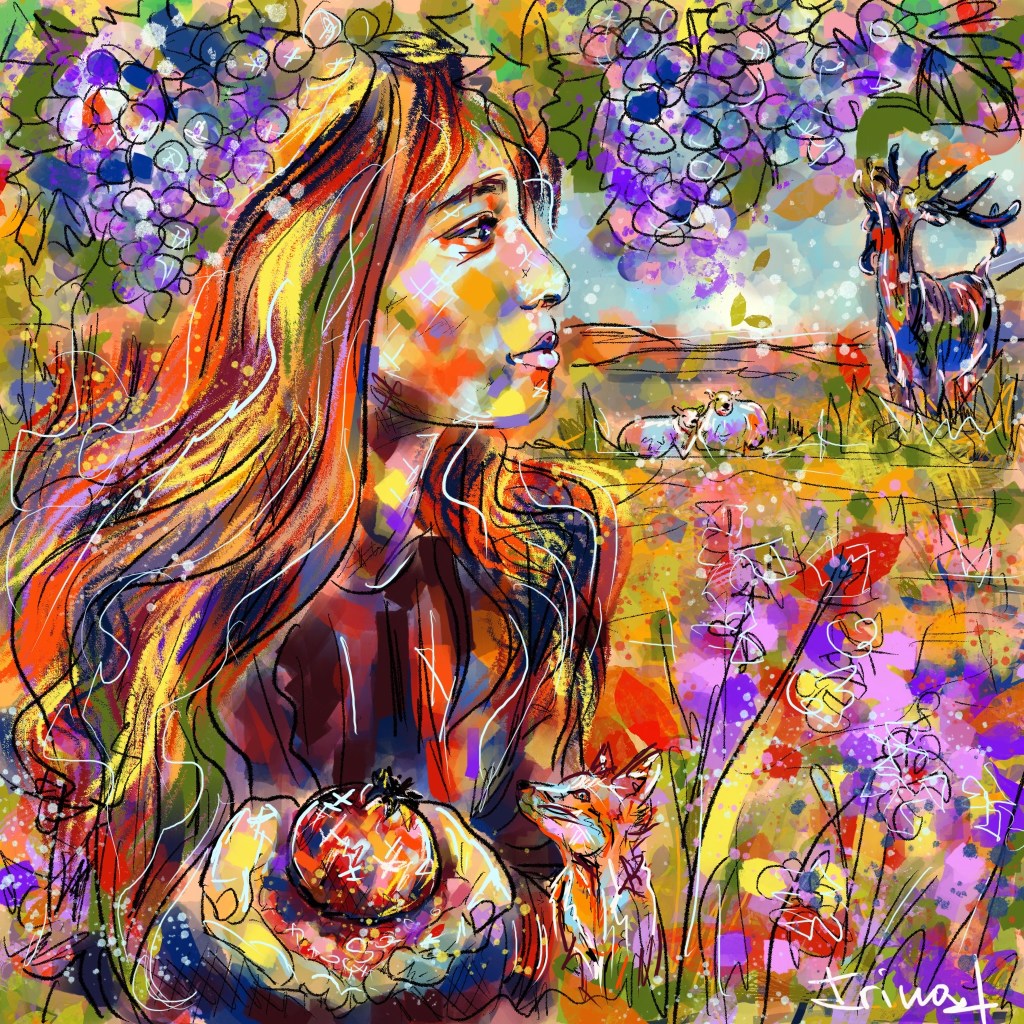
It has a shimmering, dreamlike quality and many gorgeous lines: “Sustain me with raisins; refresh me with apples, for I am sick with love” (2:5), “Let us rise early and go to the vineyards, to see if the grapevines have budded, if the blossoms have opened, if the pomegranates have bloomed (7:12), “I am my beloved’s, and my beloved’s mine” ( 2:16)... I believe that like all of the best literature, it is not about being in love, but on the quest for love. I also think there is little distinction in our experience of human and divine love. God is love, and so we live into his image as children, siblings, parents, friends, and lovers through all kinds of love, of which none is less noble than another, including physical desire. Just as today’s gospel asserts that no food is unclean, so were the medieval mystics quite unashamed to see their union with God as a type of intimacy. This may seem strange to those of us who are used to praying to God by presenting a list of requests; if so, have a look at Bernini’s “Ecstasy of Santa Teresa” that shows her pierced with the spear of divine love, or consider reading her books and poems, some of which portrays God not only as a lover, but even a hunter! Or another famous poem, “La Noche Oscura de Alma”, in which San Juan de La Cruz describes the soul’s search for God as a parallel to The Shulamite’s desperate quest for her lover, fulfilled once “my face I laid on my beloved, everything stopped, and I abandoned myself, leaving all my cares forgotten among the lilies.”
There’s a good reason why, for centuries, this beautiful little text that hardly belongs in the biblical canon has inspired so many great mystics and “casual” believers. I think it’s because through its exotic and sensual language, it conveys the most universal longing of all – to love and be loved, belong and connect, and to do so forever. Is “love as strong as death”? Or stronger? Our faith and hope insists that it is, by God’s design and by his grace. Can you hear God’s invitation as he “stands behind our wall, gazing in at the windows, looking through the lattice” (2:9) and says, “Arise, my love, my fair one, and come away, for now the winter is past, the rain is over and gone. The flowers appear on the earth; the time of singing has come” (2:10-13)? Would you invite him, like the Shulamite, to “come into his garden, and eat its choice fruits” (4:16)?
It’s not always easy to see God through the lattice of this world. Life’s big and little challenges keep coming back, like those pesky little foxes about which The Shulamite complained that they dug up her vineyard (2:15). Sometimes, our quest seems futile, and our prayers fail to produce the consolation and intimacy for which we long. But, let us not lose hope – “let us arise and go into the vineyard”! Life is full of lilies, grapes, and pomegranates; that is, the instances of God’s self-revelation to us, and the moments when we, in turn, successfully imitate his self-giving and forgiveness. May our prayers be less about requesting, and more about loving and feeling loved. Amen.
Question to Consider
How do you understand the line from the Song of Songs, “Love is as strong as death”? One of the alternate readings for this line is “Love is stronger than death”—what difference does this make?

 Irina's Art
Leave a Reply