
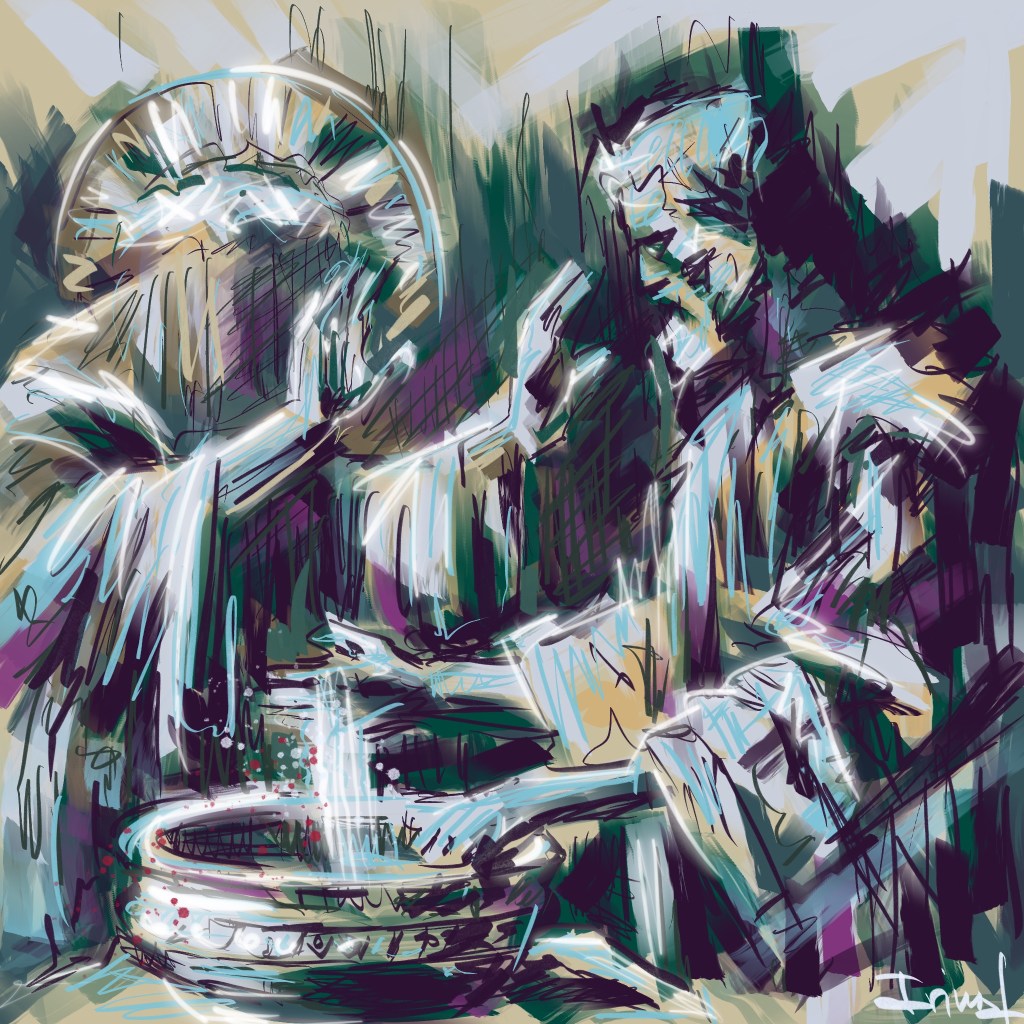
This drawing is part of my Lenten series representing the Stations of the Cross. ‘Station One: Jesus is Condemned to Death’ depicts what I believe was Jesus’ final temptation, a moment for which he had been prepared through his time of discernment in the desert.
In January, we celebrated the Baptism of the Lord, and reflected on the event that marked the beginning of Christ’s public ministry. But before he performed miracles or preached, he first spent 40 days in the wilderness, preparing to face both the power entrusted to him and the trials ahead. Many of us mark Lent by giving up small comforts to align ourselves with Christ’s desert asceticism and his suffering on the cross. But another essential aspect of Lent is self-reflection. This season is an opportunity to contemplate who we are and why we are here, preparing us for both future abundance, so that we do not forget God as the giver of all gifts, and future hardship, when we might be tempted to accuse God of having forsaken us.
For the voice that spoke to Jesus in the desert is the same deceitful voice we all hear at times. It distorts what is good, misrepresents God’s activity, and urges us to prioritize ourselves over others. Dostoevsky called it “the spirit of self-destruction and non-being” (“The Brothers Karamazov”, 5.5.10). Its personifications appear in all world mythologies and include Lucifer, Loki, Hades, Voland, Mephistopheles, Screwtape… Perhaps attributing our temptations to a diabolical force—an evil being whispering in our ear or sitting on one shoulder—has been just another way to shift the blame from ourselves. Or more simply, it is a way that cultures around the world acknowledge how tangible the impulse to do wrong can feel.
Dostoevsky, along with C.S. Lewis, George MacDonald, and a few others, saw Jesus’ temptations as variations of a single offer: to make the world better by taking away our freedom. To provide endless bread, ensuring every desire is met; to send angels to cushion every fall, making life safe; to impose a rule that spares us from hard choices—all at the cost of our free will. Of course, we still wait for a savior who would do such a thing. That’s because God’s intention for the Incarnation was not to override our choices but to model self-giving. For at its core, every sin is only a distortion of something good. Under pressure, persistence becomes stubbornness, appreciation turns to envy, perceptiveness to judgment, intensity to anger, and so on. To fall into temptation means to act too quickly, base decisions on emotions and habits, and choose the path of least resistance. The antidote is to emulate Jesus’ stance of self-giving.
So, if for God, temptation meant fixing the world at the expense of freeing it, then for us, it means behaving as though we don’t have a will and to blame others for our mistakes – just as Adam blamed Eve, who in turn blamed the Snake. Yet despite their common theme, I believe Jesus’ temptations are distinct, and mirror struggles that shape our world today as much as they did in Jesus’ time.
The first, turning stones into bread, speaks to the lure of convenience. We live in a world of instant food, same-day delivery, fast internet, rapid travel, and medications for every discomfort. We are conditioned to prefer instant gratification, but Jesus reminds us that not everything nourishing or meaningful can be immediate or effortless. The second, ruling over the world, is about control. We wish to shape reality to our will, secure outcomes, master uncertainty, and we worship productivity, business, and fitness. Yet Jesus refuses dominion and trusts God alone. The third, throwing himself from the temple’s pinnacle, is about self-image. In our world, success is measured in likes, accolades, and visibility. But Jesus rejects spectacle, standing firm in the quiet confidence of his identity.
The evil spirit offered Jesus a path that promised fulfillment but distorted what it meant to be both truly God—one who enables free will in reflection of his own image—and truly human—one who finds meaning in process, vulnerability, and authenticity. As such, the point of Lent is not to test our willpower, but to notice these patterns and choose differently. When do we prioritize speed over substance? When does our need for control overcome our trust in God or in others? When do we seek recognition at the expense of authenticity? What miracles do we expect, and which ones do we overlook? How often do we mistake our needs for our rights?
When our stones refuse to turn into bread, when we hit rock bottom on the way down from the temple, when everything we desire feels out of reach, each of us responds in our own ways. Some grow apathetic; others become resentful, angry, impatient, or envious. But the strategies to overcome each of these diverse responses are the same—the ones Christ himself modeled in the wilderness. It was through prayer and remembering scripture that he steadied himself. Let’s help each other to incorporate these same tools into our daily lives—with God’s help.
Questions to Consider
1. Lent is often framed as a time of self-denial, but how might it
also be a time of recalibration—a season for reassessing what truly
matters?
2. How do you see the archetypal temptations—to turn stones into bread, to rule the world, and to jump off the temple—playing out in contemporary life? Did my reframing of these as convenience, control, and image resonate with you?
3. In what ways have you experienced the pressures to prioritize speed and convenience, to stay constantly busy and productive (or simply keep your head above water!), or to seek recognition—sometimes at the expense of process, growth, and deeper fulfillment?
P.S.
“Pause a little, leave behind the unrest and commotion that fill the soul with bitter feelings which never get us anywhere… Pause from this compulsion to a fast-paced life that scatters, divides and ultimately destroys time with family, with friends, with children, with grandparents… time as a gift” — Pope Francis (2018)

 Irina's Art
Leave a Reply