
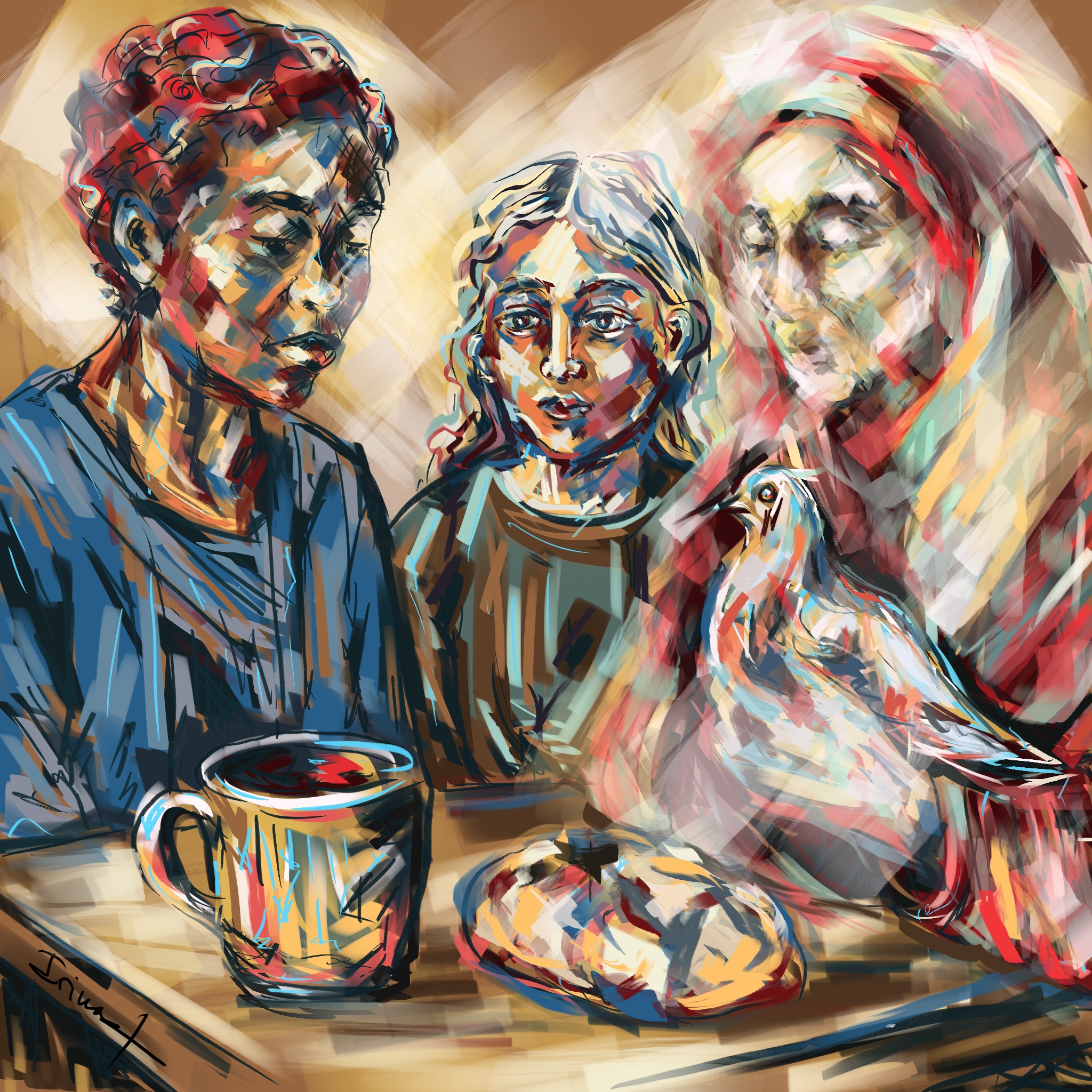

“At the Table”
Three figures gather around bread, cup, and dove—a visual meditation on both the Trinity and the Church. The older woman, loosely rendered and surrounded by a haze, gestures toward the Holy Spirit: present, nurturing, and elusive. The adult figure, contemplative and grounded, evokes the Creator’s abiding presence, unconstrained by gender. Only the child meets the viewer’s gaze—intentionally so, for it is through the Incarnation that God interfaces with the material world. In this child, the Word becomes flesh and looks back at us. Unlike traditional icons of the Holy Trinity, this work leaves no empty space at the table for the viewer—for the diversity of persons already seated there is indended to represent each of us.
Marking the end of the Easter cycle, Pentecost Sunday commemorates the appearance of the Holy Spirit to the first followers of Jesus, gathered together in Jerusalem. There, they began to preach to a crowd of Jews who had traveled to Judea for Shavuot—the festival of the grain harvest celebrated fifty days after Passover. Pentecost is simply the name used by Greek-speaking Jews for Shavuot, derived from the word for “fiftieth.” Observant Jews still celebrate this feast around the world, sometimes coinciding with the Christian date, and sometimes not, because the dates for Easter and Passover are calculated independently. This year, Shavuot was already observed last weekend.
The number fifty holds deep significance in Jewish—and later Christian—mysticism, symbolizing eternity and divine fulfillment, pointing beyond the temporal and material. Christians now count fifty days after Easter and draw a theological parallel: just as Passover marks Israel’s exodus from slavery in Egypt, so Easter marks spiritual liberation; and just as Shavuot commemorates the first fruits of the harvest in the land of presumed freedom, Pentecost marks the first fruits of the disciples’ relationship with Jesus—their first shared experience of the Spirit. This moment is both foundational for the Church and the enduring source of its unity through the centuries.
In the story from Acts, this first “fruit of the harvest” manifested not only in fire and wind, but in mutual understanding. The pilgrims gathered for Shavuot spoke diverse native languages of the Jewish diaspora, yet each was able to understand the Galilean, Aramaic-speaking followers of Jesus. As such, while the Passover-to-Shavuot movement mirrors that of Easter-to-Pentecost, Pentecost is also a reversal of a much older narrative – that of the Tower of Babel, which we sometimes read as the Old Testament text for Pentecost. For example, in the Byzantine tradition, Pentecost is the first time the faithful kneel again since Easter to offer thanksgiving to God for “reversing the chaos of Babel.”
The Tower of Babel appears in Genesis 11 as a curious, fragmentary tale in which humanity, still united under one language, seeks to build a tower that reaches the heavens—a monument to human ambition and control. But God, seeing that this project would lead them away from true communion with one another and with the divine, confuses their speech and scatters them. Versions of this myth are found in many cultures. A beautiful contemporary take can be found in Ted Chiang’s science-fantasy novelette Tower of Babylon (1990), reprinted in Stories of Your Life and Others (2002).
The story does serve as a warning against pride and the illusion that we can build our way to heaven, or to spiritual freedom, by our own strength. Beyond that, I’m not sure whether the Babel story is about pride or fear, or a kind of coming-of-age; perhaps all of the above, as the stories of Eden and the Flood also are. These ancient tales reflect a deep grappling with the question of how we, humans came to be rational beings, capable of both intentional love and intentionally inflicting harm. The motive for building the tower is not entirely clear, nor does it align with what we know from historical linguistics. It even contradicts Genesis 10, which portrays a post-Noahic world of diverse nations and languages descended from the sole survivors of the Flood—Noah’s sons Shem, Ham, and Japheth, and their wives. One thing is certain: without communication, there can be no collaboration.
And even more certain is this: the chaos, misunderstanding, and alienation we experience in this world are not God’s doing, but our own. The Spirit, by contrast, helps us overcome disorder and directs our energy toward what is good, true, and life-giving. So yes, God does allow us to resume the age-old project of building something that unites heaven and earth—that is, the Church. But unlike the old tower, the Church is built as wide as it is tall. The good news of Pentecost is that the Spirit enables us to comprehend and communicate, allowing us to be united without erasing our differences.
Jesus told his followers shortly before his death: “[God will] give you another Advocate… the Spirit of truth [who] will teach you everything, and remind you of all that I have said to you” (John 14:26). Who is this Advocate, the most elusive of the three Persons of the Trinity—often imagined as feminine, shimmering, dynamic, fiery, flowing, breath-giving, elusive, and nourishing, the one whose “sighs are too deep for words” (Romans 8:26)? Many have tried to render her in writing, painting, music, and prayer, but no one has seen her fully—not in this life. What we do see, feel, and act upon are her manifestations: reconciliation, unity, mutual understanding, peace, creativity, and reverence for beauty. These take place in our hearts, yet ripple outward and touch others.
Indeed, Pentecost represents the Spirit as no longer external—a cloud in the wilderness or upon the mountain-top, or a burning bush unconsumed by fire—but as fire that comes to rest on people, touching their very hearts. This fire—or breath, wind, water, light, voice—enlivens us here on earth, both individually and communally, both in worship and in relationship. Taken together, these testify to the Spirit’s ongoing work in the world, even when that work resists easy definition in 21st-century terms.
We encounter the Spirit in the stillness of prayer, in the tear shed on Good Friday, in a set of worn prayer beads, a faded prayer book, a mysterious icon, a lovingly polished communion vessel, and in the mystery of shared bread and wine. And the Spirit touches our relationships too, by helping us “speak” in languages of love. Gary Chapman’s Five Love Languages framework, which includes words of affirmation, acts of service, receiving gifts, quality time, and physical touch, is perhaps overly simplified, but it helps us understand how people give and receive love. While we all appreciate each of these to some degree, most of us have one or two that speak to us most deeply. When we learn to speak love in the language another person understands, our relationships grow in strength and depth. As such, true communication is not just about speaking, but about connection in ordinary, daily life.
So where Babel scattered, Pentecost gathers. At Babel, people learned to fear difference, and at Pentecost, the Spirit spoke in every language so that all could receive love in a way they understood. Where language once divided, the Spirit now bridges. Pentecost reveals that God’s message of love is not reserved for one tribe, one tongue, or one culture—it is spoken in every language, for every heart, and heard best when it is offered in the language of love that each person can understand. Thanks be to God.
Questions to Consider
1. Where do you see the Spirit at work today, in the church or elsewhere, drawing people together despite cultural, linguistic, or ideological differences?
2. Are there areas in your life where you are still “building towers”—trying to secure identity, meaning, or control?
3. What “tongues” do you need to learn—literal or figurative—in order to become a better listener and bearer of God’s love?
4. How do you most naturally give and receive love—through words, acts, presence, gifts, or touch? How attuned are you to the love languages of those around you?

Leave a Reply