
Just as my homily will ask us to see dignity and belonging beyond society’s standards of “normal,” my illustration also raises questions about how art itself can challenge or reinforce cultural expectations of beauty and disability. I chose to portray “the bent woman” from Luke’s Gospel as disabled and yet still conventionally beautiful — a choice that both resists and risks reinforcing the aesthetic expectations of our culture. In your opinion, does this artwork challenge or perpetuate the cultural assumption that beauty is required for dignity? What changes when disability is portrayed as both real and still within the bounds of attractiveness?
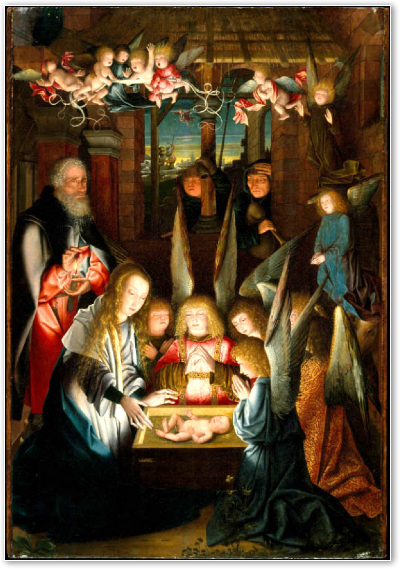
For contrast, here is a remarkable 16th-century Dutch depiction of people with Down syndrome worshipping the Christ child — one of the rare historical works that portrays disability without disguise or correction, placing it directly in the holy scene. Together, how do the two images shape your sense of who belongs at the center of worship and how holiness is embodied?
What does it mean to be “normal”? Our culture tells us that to be normal—that is, “fully human”—is to think rationally, act independently, contribute by doing, achieve professional success, and all the while stay slim, conventionally beautiful, and youthful. There is even a sense that we owe it to society to be healthy, whatever “health” means. Thomas Reynolds, Associate Professor of Theology at Emmanuel College and our invited speaker for Breakaway this year, uses the term “the cult of normalcy” to describe the assumptions we all absorb about what makes life valuable (as members of religious cults internalize and perpetuate shared ideas through continued brainwashing).
Our language betrays these biases whenever we carelessly throw around phrases such as “a lame excuse” or “are you blind?” Even in the church, we speak of “caring for the needy,” as though there are two groups—“us” who are able to help, and “they” who have needs. Scripture is not immune to such assumptions, and religions perpetuated them for centuries. Ancient beliefs equated physical difference with moral character: Zacchaeus’ short stature with small-mindedness or greed, Mary Magdalene’s epilepsy with demonic possession, the woman bent low by kyphosis in today’s reading with unworthiness. Disability was seen either as punishment for sin or as an aesthetic challenge to perfection in a world where tall and straight meant regal and powerful, righteous and divine. Either way, disabled people were excluded from communal worship. And notice: women are rarely the focus of healing stories. Only five women out of twenty-six people healed in the Gospels, and only two out of seven healings on the Sabbath—the bent woman and Peter’s mother-in-law. The Gospels themselves reflect not only ableist but also sexist assumptions many of us hold today.
So when Jesus heals, the Gospel writers are reflecting their world’s expectation: that God’s job was to fix what was “wrong,” and to do so for people who mattered. Today, do we still perpetuate ableist assumptions when we read these miracles? Do we reinforce the idea that disability equals lack of faith, a tragic flaw to pity, a deficiency to remediate, or at best, resilience to admire? Do we still hear these stories and wonder why we are not “healed,” and what is wrong with us—or with God—that the cultural ideals of wellness are not always granted to us in response to our prayers?
But the truth is, none of us is permanently in the “abled” category. Every one of us carries vulnerability—seen or unseen, temporary or permanent—and every one of us knows and loves people whose lives defy the cult of normalcy. People are disabled by society’s imagination of normal, often more than by their conditions themselves. Diagnosis and labeling open the door for treatment, yes, but they also shift attention toward changing the person instead of changing the environment. If scooters or robot suits (like those worn in action movies!) were the norm, mobility impairment would not be a disability. The acceptance of glasses has already turned many visual impairments into a reason to acquire a fashion accessory. If ASL were the majority language, deafness would not be seen as lack. If stores were not designed as temples of consumerism creating sensory overload, people with autism would not be labeled disruptive.
Disability is not a defect in bodies but a barrier created by environments and attitudes—and those barriers weigh on us all in different ways at different times. For example, Moses stuttered. Paul likely lived with epilepsy or scoliosis. Isaiah tells us the Messiah would be marred and without beauty. God has always spoken through unruly and overlooked bodies. Redemption is not remediation or rehabilitation, but being recognized as holy. That is exactly what Jesus gave the woman in today’s story.
For eighteen years this woman could see little more than the dirt at her feet. Still, she came to synagogue, despite being pushed aside as spiritually inadequate. How many of us, if we were in her place, would blame God and give up religion altogether? But Jesus’ first act is not even to heal her body; it is to see her. He calls her forward into the center—where women did not normally sit—speaks to her directly, touches her, and proclaims her free. She stands tall, lifts her gaze, and praises God.
Immediately, the synagogue leader tries to take that away. He does not speak to her or even to Jesus, but to the crowd: “Wrong day! How dare she! How dare he!” Jealousy cloaked in principle. How often do we do the same? But Jesus refuses that game. He names her a daughter of Abraham, he forgoes his customary “your faith has made you well,” and he appeals to compassion as an antidote to jealousy. In doing so, he asserts that she belongs—not because she was “fixed,” not because she became useful or worthy, but because she always was.
And as in all seven Sabbath healings of Jesus, this moment illustrates the true meaning of Sabbath—not legalism but relationship. Jesus prayed everywhere—on mountains and in deserts, and in the midst of a raging storm—but he also kept the Sabbath in synagogues. Community worship mattered to him. This commandment is not simply about ceasing from labor but about recognizing God’s presence among us, together. Sacraments such as Eucharist and baptism can only exist in community. And what Jesus’ healings show is that disabled people—visibly and invisibly, permanently and temporarily, to a lesser or greater degree—are essential members of Christ’s body, without whom the Church is not complete.
So the miracle here is not only the straightening of the woman’s spine but also her dignity and her restoration to the status of a full member of the community—in her belonging. Too often we confuse inclusion with belonging, or hope that one automatically results in the other. The best way I have heard it described is this: inclusion simply means being present, but belonging means being missed when you are absent. And also too often we emphasize what people should do in imitation of Jesus’ love—serving, giving, volunteering. Yet the ministry of being is sacred too. I guarantee that each of us will find at times that this is the only ministry open to us that day; and for some, it is the main ministry they will ever offer.
This reframes care. Of course, alleviating suffering and limitation through treatment is necessary wherever possible; but so is the removal of barriers to participation—ramps and main-floor washrooms, better sound and livestreaming. We have done quite a bit around here, and there is still more to improve. But there is one thing we can all do: to recognize that care is not charity but reciprocity. Nobody needs care all the time, everybody will need it at some point, and everybody has something to give—including the gift of presence.
So what does this mean for us as a congregation? It means asking: what disables our members today—visibly or invisibly? Who is present but not belonging? And if it is you who feels overlooked, unheard, unseen, or unable to participate fully in the life of this parish—please know this: you are not alone. Consider speaking with me or another member of this community whom you trust. Together we will try to discern your gifts, remove barriers, or simply learn to value your presence more fully and recognize what we are missing. I was about to say “our blind spots” and caught myself—in line with what I said earlier about language!
Because the bent woman is not “them.” She is all of us—sooner or later, or even now. Her story reminds us that vulnerability is not flaw, that compassion is greater than jealousy, that Sabbath is not about perfection but about communion. So may we learn to see people with all kinds of disabilities as Jesus saw: not looking away politely, not rushing to infantilize with unwanted help, not even admiring their resilience, but recognizing dignity, calling people into the center, and making space where barriers once stood. May we learn to belong to one another, so that when anyone is absent, they are missed.


 Irina's Art
Leave a Reply to dalewjscott Cancel reply