

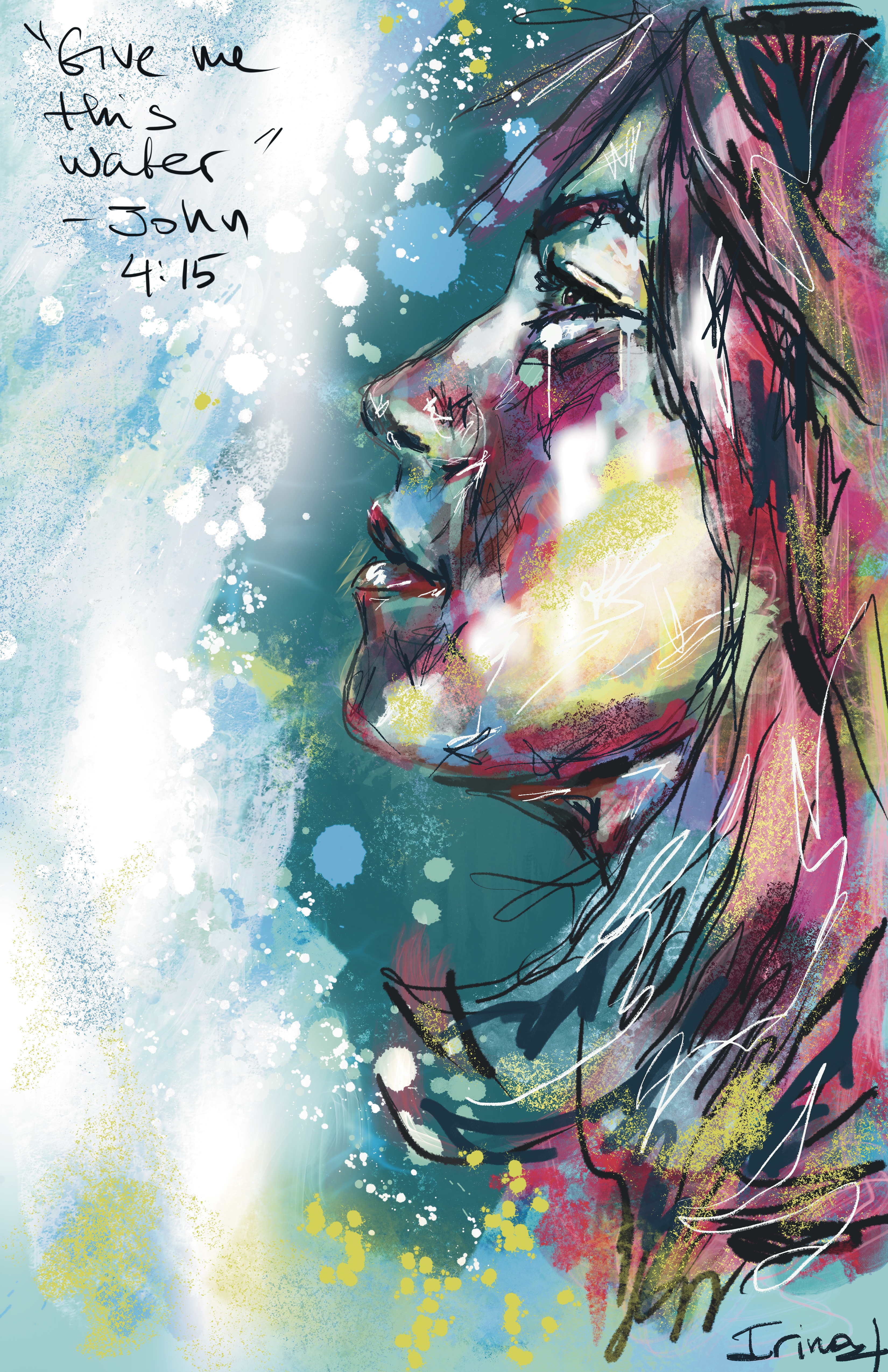
Click here to read John 4:5-42
This Sunday is International Women’s Day, and fittingly, the Gospel centres on a woman. In fact, it preserves the longest recorded one-on-one conversation between Jesus and any individual in the Gospels! Jesus meets the Samaritan woman at a well, which in Scripture often functions as a liminal space between past and future, grief and possibility, encounter and transformation. Many biblical love stories begin at wells—Rebekah and Isaac, Jacob and Rachel, Moses and Zipporah—and while the meeting in John 4:5–42 does not result in a literal romance, early Christian writers often interpreted it as symbolizing the love story unfolding between Christ and the Church. The conversation flows in two movements: first the revelation of the “living water” as the saving love of God, and then the revelation of Jesus as the embodiment of that love.
The Samaritan woman is the first person in John’s Gospel to whom Jesus clearly declares his identity as the Messiah. John places this conversation deliberately after Jesus’ nighttime discussion with Nicodemus. The contrast is striking: a respected religious leader, the learned insider, comes to Jesus secretly by night and struggles to understand him, while a marginalized woman meets him in broad daylight, recognizes who Jesus is, and becomes a witness to her village. Jesus’ close followers struggle to grasp who he is, whereas this outsider becomes, in effect, the first apostle—one who is “sent” to tell others about him (from the Greek apo, “away from,” and stellō, “to send”). The disciples go into the village to obtain literal food; she goes into the village to provide spiritual nourishment. The disciples bring bread to Jesus; she brings people to him. As a result, in the Eastern Catholic and Orthodox traditions this woman is venerated as a saint under the Greek name Photine, meaning “the luminous one.”
Why then does this woman so often appear in sermons and commentaries as one of the “bad girls of the Bible”—a cautionary tale of a morally suspect woman who slinks to the well at noon out of shame, avoiding the respectable women of the village? Why do we tend to hear her voice as defensive and cynical rather than curious, and Jesus’ voice as exposing and correcting rather than compassionate? The Gospel itself does not accuse her of immorality or specify her tone. John simply tells us that she has had five husbands and now lives with a man who is not her husband.
It is of course this detail—something that would rarely count against a man—that shaped the way the passage has been read. This double standard remains familiar in modern legal contexts, where victims of sexual violence may still be questioned about their romantic history, as though it could justify or invalidate a crime committed against them. It is the same logic that contributed to the collapse of the high-profile case against the International Monetary Fund chief Dominique Strauss-Kahn in 2011, when prosecutors cited “credibility issues” concerning the complainant Nafissatou Diallo.
Yet until the second half of the twentieth century, a woman did not accumulate husbands at will but survived through attachment to households headed by men. Multiple marriages could reflect the practice of levirate marriage where a woman was compelled to marry the brothers of a deceased husband; or infertility, abandonment, illness, and, inevitably, economic necessity. The Pharisees’ repeated attempts to entrap Jesus with questions about divorce and remarriage suggest that such situations were common and complicated. Even the detail about the hour of the day may not mean what we assume, as noon is not necessarily the harshest hour in every season.
This leads me to think that while modern readers became accustomed to seeing this woman as immoral, her contemporaries may not have looked at her situation that way. In fact, if she had truly been regarded as disgraced, it is hard to imagine an entire community responding so readily to her message. A disreputable woman would not typically function as a credible witness in the ancient Middle East, where honor and reputation mattered enormously, as they still do. Yet the text tells us that many believed in Jesus first because of her testimony—in Greek, martyria—before inviting him to stay with them and eventually believing because of his own words.
Yes, it is the line, “Go call your husband” that we tend to hear as a trap. But in the social context of the time, inviting a household head into the conversation would have been expected. Following her response, Jesus shows that he already understands her complicated situation—not to shame her but to assure her that nothing about her life disqualifies her from receiving the living water he offers. If Jesus were exposing her sin, we would expect language of repentance and absolution, perhaps something like “Go and sin no more.” Instead, the conversation moves directly into theology.
John’s Gospel is also a deeply symbolic text that uses historical details to construct spiritual meaning. Some scholars suggest that the five husbands may not refer to the woman’s marital history at all but to the religious history of her people. As the woman herself notes, Jews and Samaritans share ancestry through Jacob. Yet after the Assyrian conquest of the northern part of what originated as one kingdom of Israel, 700 years before Jesus’ time, the region later called Samaria became home to several foreign populations who brought their own gods with them (2 Kings 17). Over time, five such groups and their religious traditions became associated with the region. In that light, Jesus’ statement about five husbands may symbolically reflect the spiritual history of Samaria itself—a people whose religious identity had become fragmented and was still in flux (i.e., no current husband). The conversation therefore naturally turns to the question of true worship “in spirit and in truth.”
Once we recognize how we may have misheard her story—both by reconsidering the literal reading and by acknowledging the possible symbolic one—we begin to hear the conversation differently. The sarcasm we imagined in the woman’s voice fades, and the accusation we assumed in Jesus’ voice softens. This is precisely the aim of feminist scriptural interpretation: to ask which biblical voices, of any gender, may have been diminished through the centuries, and to listen for them again more carefully. I therefore read this woman’s situation not as promiscuous but precarious. In a society where a woman’s security depended on childbearing and physical labor, her repeated displacement from household to household might suggest chronic illness, infertility, or disability. Her marginalization would then have been multifaceted: a Jewish man might dismiss her as a Samaritan, and a Samaritan man might dismiss her as a woman; men might regard her as worthless because she is unmarriageable, and women — because she is poor.
This is what feminist theory calls intersectionality—the recognition that different forms of vulnerability do not simply add together but interact to produce a distinct experience of marginalization. Whether the five husbands describe her personal history or the spiritual history of Samaria itself, Jesus models how we might meet a person whom society has set aside. He does not treat her as a category or as the sum of her identities, but as a person—as a theologian whose questions deserve respect. He listens, speaks, and reveals himself in the longest dialogue preserved in the Gospels. She emerges in the text as a thoughtful interlocutor and ultimately as a preacher—the first evangelist.
Jesus does not heal this woman by offering her a new husband or restoring her health or fertility. He heals her by recognizing who she is—“He told me everything I have ever done!”—and by entrusting her with the revelation of who he is. Like the rock Moses struck in the desert that released water for the thirsty people, her heart becomes a wellspring of life because Christ fills it with purpose. Notably, the one who offers living water begins by saying, “Give me a drink.” In doing so, he restores her dignity through recognizing their mutual dependence.
But what did she long to be healed from?
The same struggles we live with today: social instability, illness and poverty, the exhaustion of the rat race, and the lack of fulfillment. We all long to be free of these, yet modern life intensifies them in ways that often fall disproportionately on women. Women are expected to succeed professionally while still bearing primary responsibility at home. In the public sphere, women are described as “hysterical,” “shrill,” or “unstable,” and our appearance and emotional temperament are judged as though these traits determine our professional capacity in ways that those of men are not. For example, people once mailed New Zealand’s Prime Minister Jacinda Ardern newspaper clippings of cartoon dog-food advertisements exaggerating large teeth, with notes claiming that hers were worse. Her predecessor Helen Clark was greeted with banners declaring, “You’re so ugly.” In a digital age, public humiliation has become even easier. Reputations can be dismantled by a single social media post, bodies scrutinized against endlessly curated images, and even neutral photographs manipulated by AI to shame or exploit.
Closer to home, clergywomen are often criticized for clothing, hairstyle, age, or demeanor—thank goodness for vestments. As women in public life, we are often forced to see ourselves through the eyes of others: be confident but not intimidating, authentic but not oversharing, attractive but not provocative, accomplished but not threatening. Beyond the psychological strain created by these double standards, women also continue to suffer disproportionate rates of intimate-partner violence. In Canada, intimate-partner homicide still accounts for roughly one in five police-reported homicides, and women comprise about 75–80 percent of the victims.
And just as in the biblical story we read today, whenever multiple layers of vulnerability intersect, the experience becomes even more complex. Age is one such facet, reflected in the archetypal image of the witch in folklore, or in the book Face: One Square Foot of Skin (2021), in which Justine Bateman describes the experience of watching one’s face change and sensing society withdrawing its gaze. Race and poverty add their own layers. As I mentioned earlier, Nafissatou Diallo—a Guinean immigrant asylum seeker whose partner laundered money through her bank account—was no match for the legal machinery that dismissed her case against the IMF chief. One cannot help wondering whether the press would have been so quick to portray a white middle-class complainant as a sex worker.
Oppression is intersectional, and labels and assumptions cause immense suffering. They distract us from recognizing the dignity and calling of the person before us—and within ourselves. The good news is that just as the woman reached deep into the well to draw water for Jesus, by connecting with the depth of our own experiences of injustice, stigmatization, and misunderstanding, we too may discover the living water—love that persists even in the presence of injustice and pain—and draw it up so that we may share it with one another. Whenever we name one another’s suffering without moralizing, spiritualizing, or erasing it, we reaffirm each person’s worth as someone called to carry God’s message into the world. And when we truly strive to see others for who they are—as the intersection of many vulnerabilities and gifts, without contempt—that is when the living water begins to flow, nourishing even the driest places of this world. Thanks be to God.

 Irina's Art
Leave a Reply to dalewjscott Cancel reply