
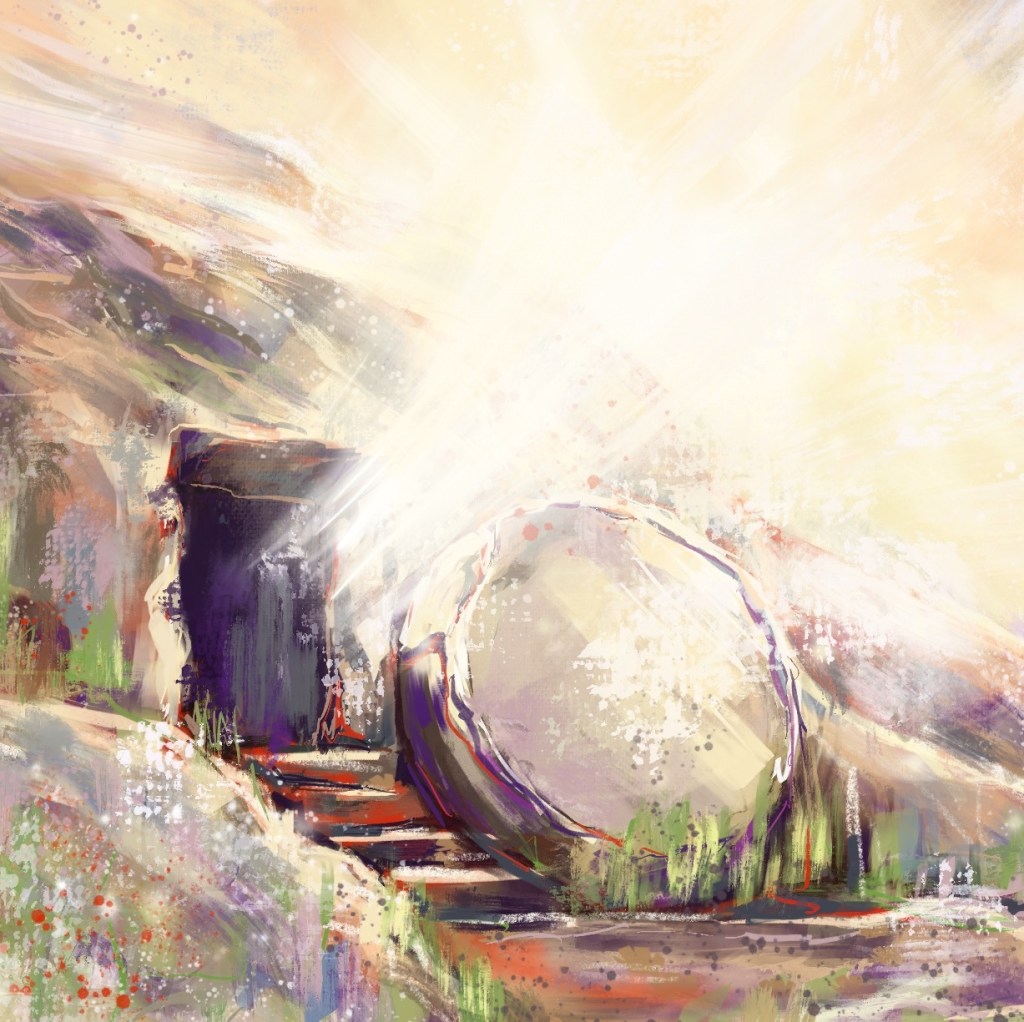
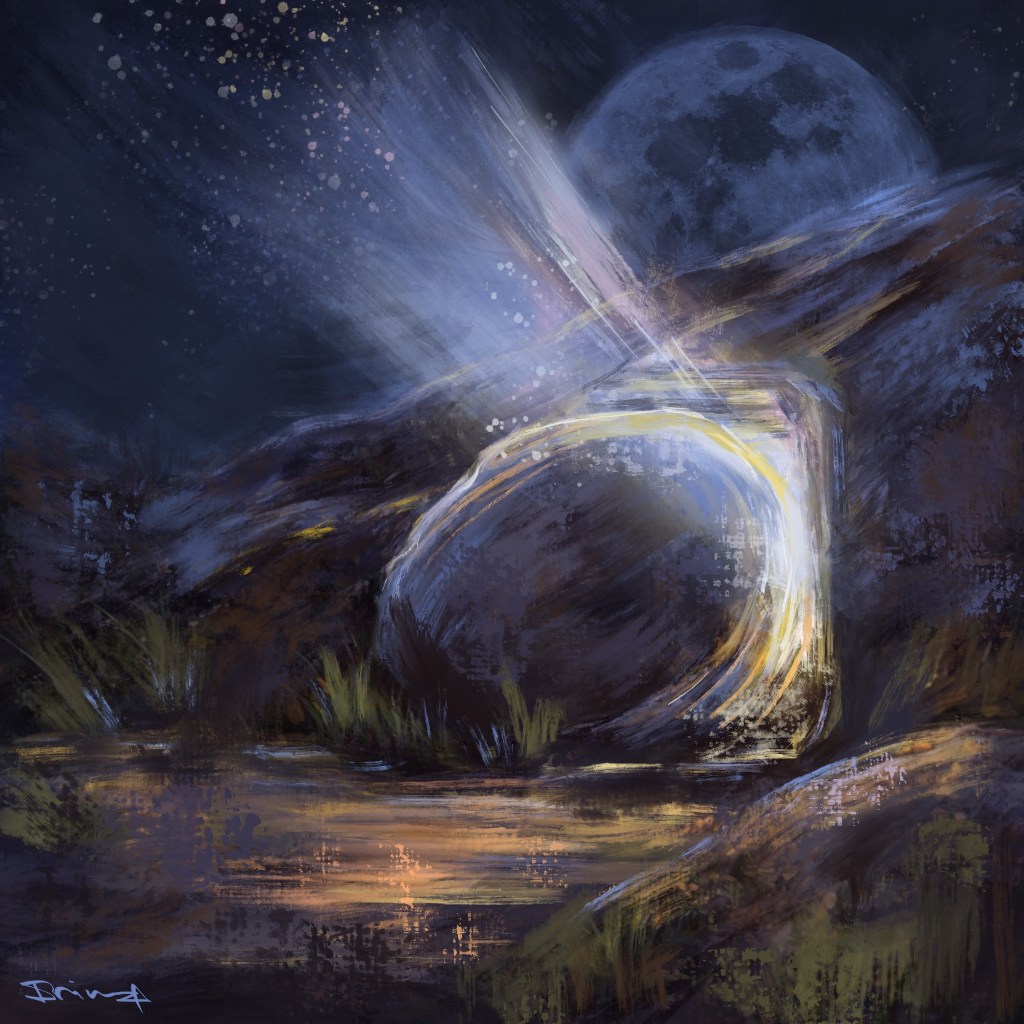
If you were to paint or sculpt the moment of the Resurrection, or make a film about it, how would you do it? What are some representations you have seen that moved you? I have to think about this whenever I select an image and a poem for the Easter bulletin, and an object for the children’s message. And each of the Gospel writers faced a similar artistic and theological task: to communicate an impossible reality that cannot even be pinned to a specific moment in time. Every Gospel conveys what has become the quintessential imagery of the resurrection in Western art: the empty tomb, with one or two messengers telling a small group of women that Jesus is not there; or, in John’s telling, Mary Magdalene encountering Jesus in the garden. In Byzantine art, the Anastasis (i.e., “standing up again”) icon imagines what takes place the night before, when Jesus descends into the underworld, rescues Adam and Eve, and joins their hands in a gesture that echoes wedding imagery as a symbol of renewed relationships.
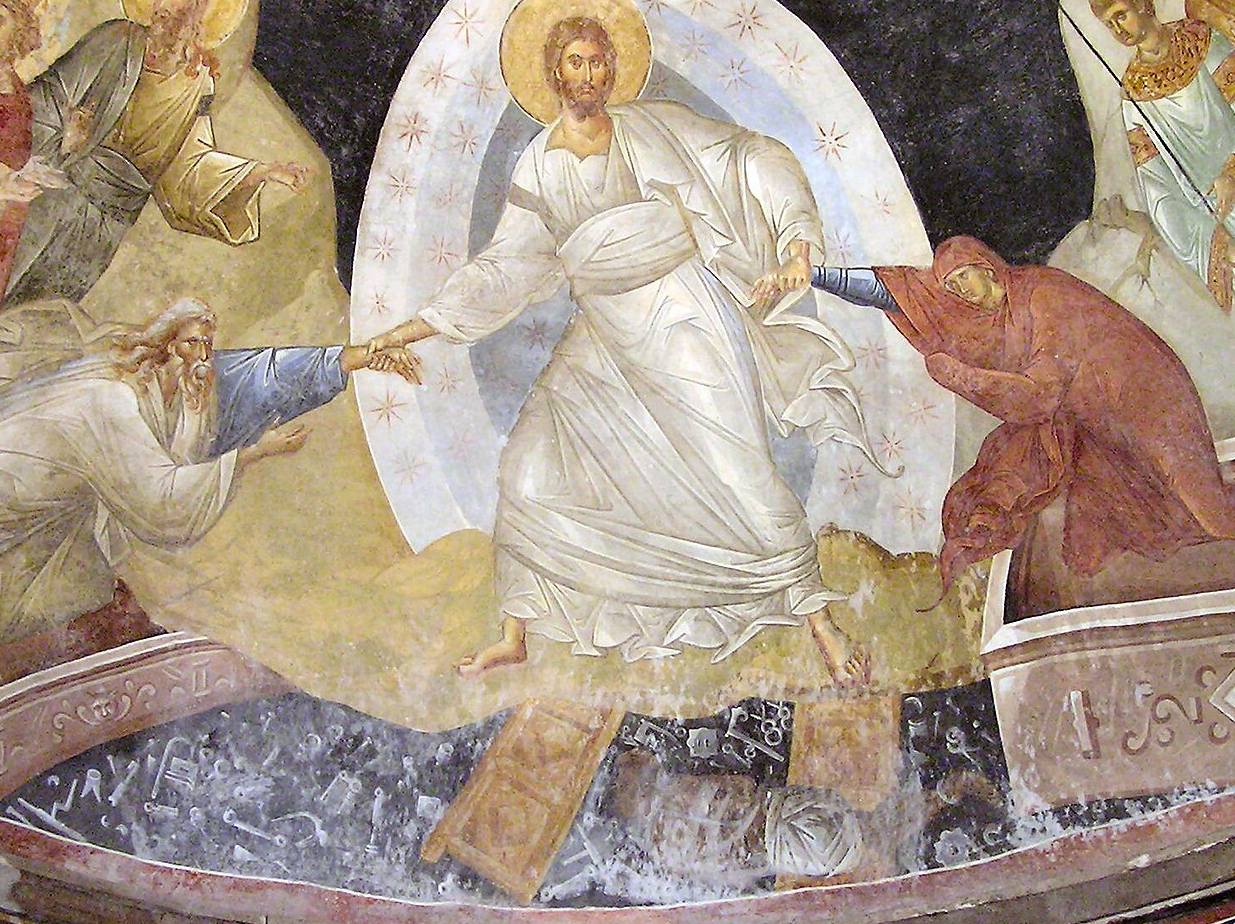
And still, the empty tomb, the words spoken by the angels or by Jesus himself, and the vision of the Harrowing of Hell, for all their power, are not the moment of resurrection, but only its consequence. I wish I could tell you, “This is how it happened.”
At least Matthew’s account, which we read today, indicates that there was an earthquake, in contrast to the other evangelists who begin with the tomb already open. This helps a little, yet even here it is not clear whether the earthquake itself loosened the stone, or whether the angel’s action of moving it caused the earth to tremble. This lack of clarity unsettles us. We tend to think of science as a collection of facts known, if not by us, then by experts. We imagine that we understand natural phenomena simply by applying specialized language, as though naming something were the same as explaining it. Theology, too, often names rather than explains. Yet while we are willing to take quite a bit on trust in science, when it comes to faith, we hesitate to do so.
The truth is that both the natural and the spiritual realms invite us into partial knowing. In nature, we understand the mechanics of earthquakes, yet we cannot say exactly what sets one off. We understand the processes of conception and labour, but not what initiates them. In medicine, the same substances can heal and harm, and the same mechanisms can create life and destroy it. Both maturation and terminal disease involve the division of cells, yet we cannot answer why this cell, this body, at this time. We know that light and sound travel in waves, but not exactly how the brain receives and transforms these stimuli.
Beyond what is accessible through science lie further realities that defy probability. Life is full of such inexplicable events: documented accounts of children who carry memories of other people’s lives (e.g., James Leininger who remembered being a WWII pilot), twins whose lives unfold in uncannily parallel ways (e.g., Jim Twins), or fiction that anticipates events that occur long after it is written (e.g., Titan and Titanic). Yet we do not need to prove or elevate these mysteries for their own sake. The women at the tomb were told to move on promptly: “Go to Galilee. There you will meet him.”
For Jesus, the place where new life began was not the cross, but the tomb. For us, it is neither the cross nor the tomb, but what this scripture calls Galilee: a place, a moment, or a person in whose presence we become aware of a reality larger than ourselves. Like the women, we have often already been there before we are sent back. We can recognize the presence of God there, even though we only partially understand it. This is not to say that it is easy. It is precisely the experience of not knowing and not controlling that generates fear, most of all the fear of mortality.
We know neither how long we have, nor what lies beyond. I have known two people who glimpsed something of that threshold through near-death experiences. One returned with a deep sense of peace and lived with that gift until she died at well over a hundred years old. The other, still young now, returned with heightened fear, more acutely aware of life’s fragility and of the question of whether there will be enough time to live meaningfully, to become who she senses she is meant to be. Knowing, it seems, does not always resolve our fears.
That is why I suspect that even if the Passion and resurrection narrative did offer us a technical explanation, it would not necessarily resolve what troubles us. As it stands, it does not tell us by what mechanism life after death becomes possible, or even by what theological logic the death and suffering of Christ secure eternal life. I believe that the Cross is not a transaction that satisfies a demand for punishment or pays a debt owed, but a revelation of how God responds to the worst evil humans can do. Christ does not respond to harm with more harm, or to betrayal with revenge. When people abandon him, mock him, and put him to death, he does not pass that pain on to others. He holds evil, and it stops with him. The resurrection is, in effect, the ancient expression of a truth we still recognize: that love is never wasted and cannot be defeated.
Through love, the cycle of evil is broken in Christ, and we are called to do the same. Each time we interrupt anger with patience or meet indifference with care, we create a small space where something new can grow. These are small resurrections, moments in which life begins again in the very place where it might have ended, and through which we participate in drawing the world closer to what God intends it to be. The New Life is not simply a reversal of death, but the vindication of a non-retaliative, self-giving way of being as the way in which we meet God in the Galilees of our lives.
And this God is not abstract, but encountered in ordinary, tangible relationships. I was reminded of this again and again over Holy Week. When someone makes sure that a gluten-free hot cross bun is set aside for Good Friday so that no one is left out; when a person with limited vision is guided to venerate the cross with dignity; when people are not left alone in hospitals despite the busyness of the season; when names are spoken in prayer, and musicians are sponsored as a gift to the community; time and skill are offered in the church and beyond—these gestures may not seem dramatic, yet their effects on others are very real. What moves people, again and again, is love, and we certainly recognize it when we see it.
This is part of the mystery that Easter invites us to trust: that the love we see in these concrete acts is the same presence we sometimes feel within us, or glimpse as a mystery in daily life. It is there when we say we were “saved by an angel,” experience déjà vu, or seemingly sense another’s thoughts; when a sudden peace settles upon us, clarity appears where there was none before, or when we feel drawn toward something good that we did not plan. Again, we can describe what happens, but not how; and it begins in hidden ways. In my children’s message, I will draw a parallel between this and a seed placed in the dark, left unseen until something begins to break open; and the magical house Casita in Disney’s Encanto, which was rebuilt slowly after its demise, through many hands, until it became alive again.
Perhaps, then, the invitation of Easter is not to solve the mystery, but to step into it as the disciples and women walked into the open tomb, or into the garden surrounding it. To notice where our own Galilee might be. To pay attention to the places in our lives where anxiety begins to lessen. To loosen, even slightly, our need to have everything explained. Because this may be how the stone that separates us from the full awareness of God’s presence begins to roll away, gathering momentum from that first imperceptible shift.
And that is the hope into which we are invited today.
Christ is risen. Alleluia.

 Irina's Art
Leave a Reply to Anonymous Cancel reply