
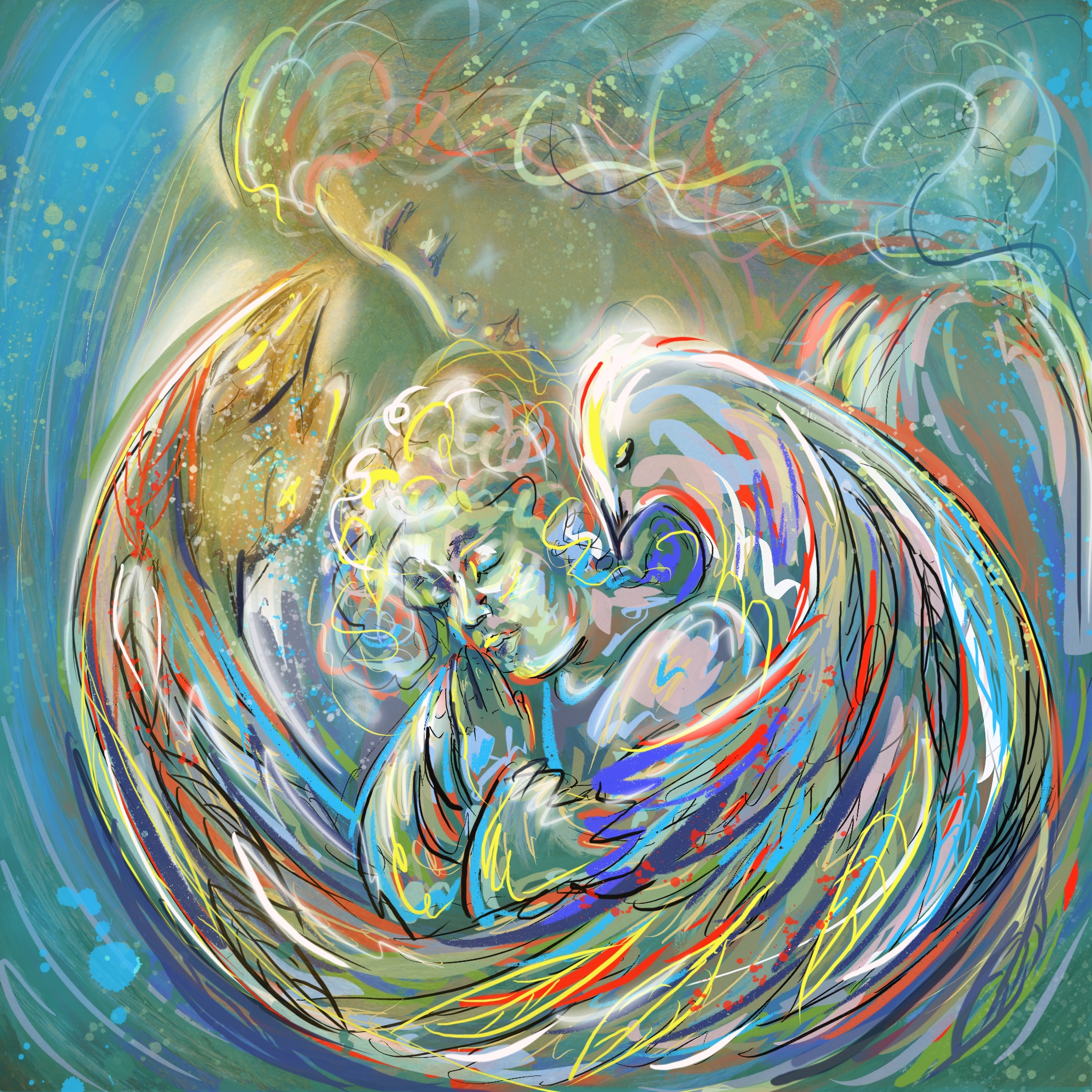

In John 14, Jesus assures the anxious hearts of his disciples that they will never be abandoned because God will send them the Holy Spirit. They already knew that the Spirit of God hovered over the world at Creation, spoke through the prophets, and descended as a dove at Jesus’ baptism. Later, in confirmation of these very promises, S/he will appear to them at Pentecost.
Here, however, Jesus speaks of the Spirit in a particularly personal way, calling it the Advocate, in Greek, Paraclete. The term, historically used for a legal advocate or helper in court, from para- (“beside”) and kalein (“to call”), literally means “one called to be alongside another.” As such, Jesus presents the Spirit not as a theological concept, but as a presence: tangible, guiding, and comforting. However, as it is likened to a person arguing a case in court, it carries none of the soft or sentimental connotations we sometimes attribute to it. Indeed, the same Spirit who descends gently “as a dove” also arrives at Pentecost with fire and violent wind. We heard both dimensions invoked in the words the Bishop prayed over Jonathan at his ordination last Sunday:
“Holy Spirit, gentle as a dove, living, burning as fire, empower your servant…”
Sacraments such as ordination, baptism, and confirmation explicitly invoke the Spirit to indwell and transform the person in a liturgical and ecclesial context. Yet we also understand the Spirit to be active within daily life: in insight, conviction, creativity, and courage; in the pull to act compassionately when it would be easier not to do so; or in situations for which we feel simultaneously unprepared and strangely equipped. I will share one such experience from my own ministry in a few moments, and I also think the situation in which Paul ends up on the Areopagus in today’s reading from Acts 17:16-34 is in the same category (click here to read the passage).
When Paul arrived in Athens, it took only a few conversations in the marketplace before he was pressed into public debate. Preaching unfamiliar deities in Athens was illegal, yet the Athenians delighted in debating new ideas from a philosophical standpoint, often in the place called the Areopagus (aka Mars Hill): a rocky outcropping northwest of the city that had previously functioned as the homicide court.
Before heading to the Areopagus, Paul had already noticed many outdoor altars bearing the inscription “to an unknown god.” These altars were remnants of a crisis six centuries earlier, when Athens had been devastated by plague. After exhausting sacrifices to the gods of their pantheon, the Athenians turned to the Cretan poet-prophet Epimenides. His instruction was to follow the sheep at dawn and build an altar wherever they lay down to rest rather than graze, which would have been unusual behaviour for sheep in the morning. The city thus became dotted with altars “to an unknown god”, later uncovered by modern-day archaeologists, and the plague subsided.
Paul recognized in these altars a witness to a time when the Athenians had reached beyond certainty and found that help came to meet them, and he interpreted that moment through their literary tradition (Acts 17:28). From Epimenides, that same prophet who advised the Athenians to watch the sheep, he quoted:
“They fashioned a tomb for you [Zeus]… but you are not dead: you live and abide forever, for in you we live and move and have our being”.
And from the third-century Stoic poet Aratus, he cited,
“For every street, every marketplace is full of Zeus. Even the sea and the harbour are full of this deity. Everyone is indebted to Zeus, for we too are his offspring.”
These quotations, only the latter portions of which appear in the biblical text, referred to Zeus as the chief “known” Greek deity. Paul used them to challenge the Epicurean and Stoic philosophers gathered on the Areopagus, as both philosophical schools acknowledged a supreme divine reality that existed even above Zeus, but they considered such a being too exalted for direct involvement in human affairs. Paul explained to them that such a God was not confined to temples or a specific deity within their system of beliefs; yet he was not at all distant, but present “in street and marketplace.” Furthermore, all people — not merely mythological heroes — are his children.
This language of belonging resonates with Jesus’ promise: “I will not leave you as orphans” (John 14:18). An orphan is a person who is unprotected, unguided, and left without belonging or a place within a larger story. Paul was speaking to a city that had once felt “orphaned” – abandoned and uncertain whether any god still cared for it. Into that memory he proclaimed a different truth: the God you do not yet fully know has already been seeking you and cares for you as a parent might.
The means by which that belonging becomes tangible is the presence of the Holy Spirit. Yet this presence not only comforts; it also summons us to use our skills. To deliver a speech like this, Paul had to draw on the knowledge amassed over years of studying both Jewish and Greek philosophy and poetry. Yet his remarkable ability to utilize that learning at precisely the right moment seems borne of the Spirit. He could have avoided the speech or approached it with hostility or superiority. Instead, he entered the moment with courage, compassion, and intellectual generosity. Then the right words, from among those he had long held in his mind, came to him.
Likewise, whenever we preach or offer spiritual care, we draw both on what we have diligently learned and on the inspiration of the Spirit. What is more, the Spirit often compels us into encounters we would not otherwise choose. Sometimes this means speaking; at other times it means listening when a stranger unexpectedly begins unburdening their grief, confusion, and difficulties at the least convenient moments — for me, most often in the grocery store while rushing off to collect children from school.
But the most dramatic encounter yet happened while running near the cottage in Muskoka. That day, I found myself on a quiet road some distance from where I was staying. The area was deserted, and the cottages faced the lake, away from the road. I felt entirely alone — until I encountered an older woman standing in the middle of the road, clad in pajamas, and crying. Before I had thought it through, I found myself stopping to ask if she was alright, as we sometimes do when somebody clearly isn’t.
She was not okay. In the course of our conversation, the woman disclosed that she was contemplating ending her life, burdened by profound guilt over something she had done many years earlier, which she never named. The situation was pastorally and practically complex. Once I had satisfied myself that she had no immediate means of harming herself, myself, or others, and that she was not entirely alone at the cottage, I tried to help her reflect on what still gave her life meaning and, especially, belonging. (Had the situation appeared more dangerous, I would have withdrawn and called 911.) Eventually, I identified myself as a minister and expressed my conviction that God forgives everyone.
She asked me for absolution. I gave it. Nothing dramatic happened; there were no revelations, tears, or visible transformation. Yet there was an unmistakable sense of emotional settling and peace.
Only after I left her standing there did another awareness begin to emerge. I had been alone, on an isolated road, with a distressed and unstable stranger! The rationality of the moment gave way to a visceral awareness of vulnerability, and I ran home much faster than I had run out. Yet what has remained with me over the years is not really the fear, but the layered quality of the encounter itself. There was the impulse to stop that was more of a pull than a decision. The request for absolution that was outside the church, without vestments or liturgy. And the “right words” that I somehow managed to draw on.
“In him we live and move and have our being.”
“I will not leave you as orphans.”
That day, on a quiet country road, neither of us was as alone as it first appeared. The Athenians, with their altars to the unknown God, marked places where they sensed the divine presence, however vaguely. Likewise, certain moments in our own lives become sites of encounter, at times beyond our comprehension. Perhaps today or tomorrow we will encounter someone for whom the “gods” of medicine, beauty, youth, success, wealth, or self-reliance have failed, just as the gods of the Greek pantheon failed to relieve Athens of the plague. May we then offer words that unite wisdom with compassion, perhaps in the same way many of our biological and spiritual mothers, whom we honour this weekend, often manage to do. And may we also learn to recognize moments when God intervenes for us: unexpected, unbidden, unnoticed.
In his Areopagus speech, Paul says that “God overlooks [literally, “winks at”] the times of human ignorance” (Acts 17:30). Yet we are called to reflect upon our lives, discern God’s activity within them, deepen our understanding of vocation and meaning, and cultivate the wisdom that allows us, when the moment comes, to become a Paraclete for another: an advocate, comforter, helper, and companion along the way; as always, with God’s help.
Leave a Reply