
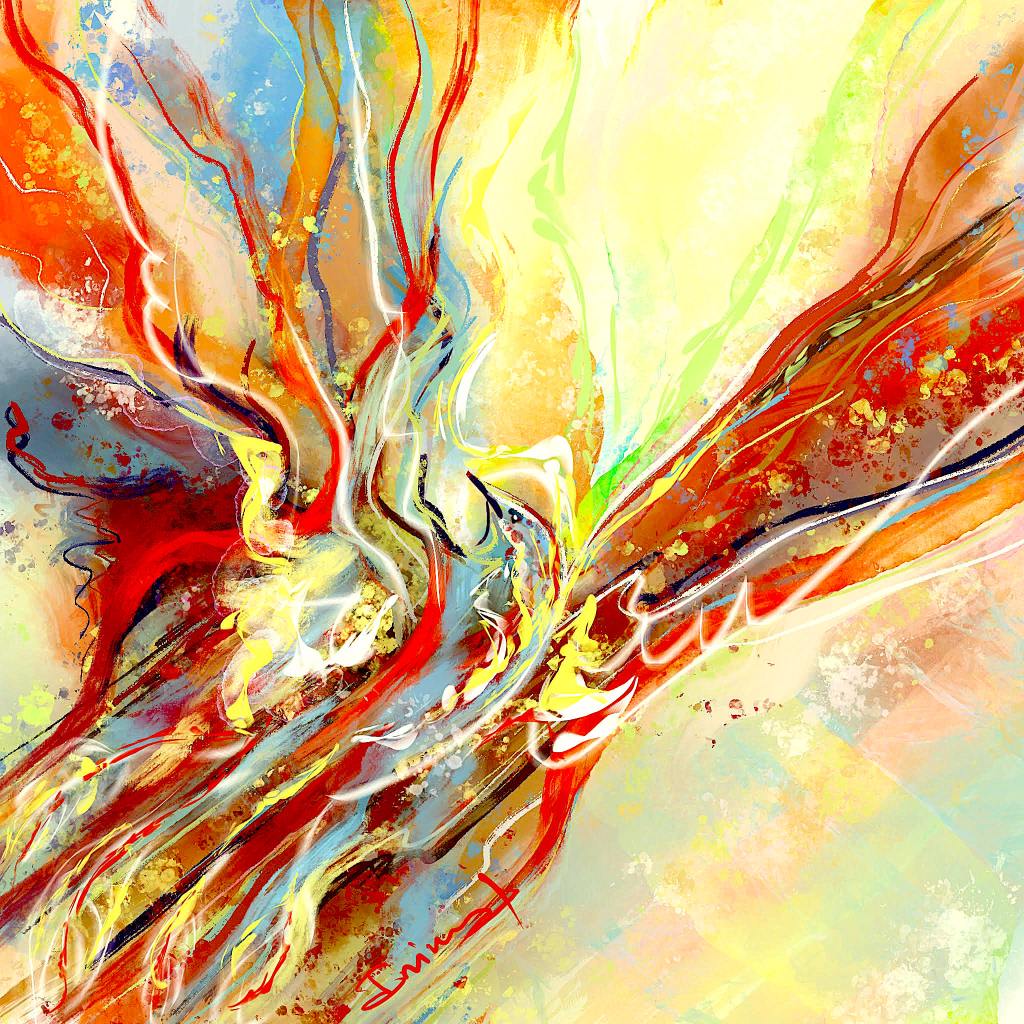
Acts 2 (click here to read the full text) describes the appearance of the Holy Spirit to the apostles gathered in Jerusalem for the Shavuot feast, fifty days after Passover. Ten days earlier, they had witnessed Jesus’ Ascension, but nobody knew who the Advocate he promised in his place would be (John 14:16), or how long they would have to wait for this presence to arrive. In our own lives, we also experience such liminal periods. Many of us remember being suspended between hope and fear before the birth of a child, career changes, new stages of education, transitions into retirement or assisted living, and some may encounter this again in new ways through palliative care and final stages of life.
Originally, Pentecost was simply the Greek name for Shavuot, derived from the word for “fifty” to reflect its timing following Passover. Today, however, we use it specifically for the Christian observance commemorating the events of Acts 2. We still place it fifty days after Easter, since the first Easter took place during Passover. This year, for example, Pentecost (May 24) falls close to Shavuot (May 21–23), because Western Easter itself fell during the eight days of Passover.
Beyond establishing the timing of the Christian feast, however, the theological progression of the Jewish feasts is also carried over to the Christian ones. Passover celebrates liberation from slavery; Shavuot celebrates the first fruits of freedom lived out in the new land. Easter frees us from the fear of death; Pentecost reveals the first fruits of life shaped by spiritual freedom. Fear of death so often drives jealousy, possessiveness, and violence because of the human instinct toward self-preservation, but when it begins to loosen its grip, even slightly, as it does through faith, we become more capable of genuine communion, understanding, generosity, courage, and altruism. In Rabbinic Judaism, Shavuot also became associated with the giving of the Ten Commandments to Moses, fitting the same broad movement from bondage to freedom: doing what is right not through fearful and rote obedience, but through self-giving grounded in freedom under grace.
In John 7, the Gospel assigned for Pentecost, Jesus speaks to the crowds during the Feast of Booths, when Israel remembered God sustaining the people with water and manna during their wilderness wandering. He promised then that “rivers of living water” would flow from believers’ hearts (John 7:38). At Pentecost, we see the narrative fulfillment of that promise: no longer temporary provision in the desert, but the abiding and life-giving presence of the Holy Spirit within God’s people.
Acts 2 represents this presence through wind, fire, and the miraculous understanding of foreign languages when the Aramaic-speaking disciples began preaching to crowds of Jews who, like them, had travelled to Jerusalem from many places and spoke many languages. Most notably, Peter delivered a speech beginning with the words of the prophet Joel: “I will pour out my Spirit upon all flesh… and all who call upon the Lord will be saved” (Joel 2:28, 32). He continued with such a long and powerful address that one wonders how an illiterate fisherman became capable of such eloquence, and how readily the quotation came to him despite the uncertainty following the Ascension. In a sense, Peter himself experienced a new, supernatural understanding of what had just taken place.
In my Pentecost homilies, I tend to focus on this gift of understanding, which I interpret, following Orthodox Pentecost prayers, as a reversal of the Tower of Babel narrative (Genesis 11:1–9). This explanation for the existence of many languages, dating back at least to the Sumerian period four thousand years ago, described humanity attempting to ascend to heaven by constructing a tall tower and losing its common language as punishment for pride. At Pentecost, by contrast, God descends from heaven and people begin to understand one another. Our differences remain yet become capable of interpretation through the Spirit, and we are invited once again to participate in building something that unites heaven and earth: not a tower of pride, but the Church, in which, as Paul writes, there is “no Jew or Gentile in Christ” (Galatians 3:28).
This year, however, what struck me anew was that at Pentecost, the Spirit manifested itself not only in people’s minds and hearts, but primarily through natural phenomena: wind and fire, as well as breath, sound, energy, and movement required to speak, hear, and understand. The Spirit is not “owned” by the people, nor is it alien to creation or detached from it, but works within all of it, as it has from The Beginning when it hovered over the waters (Genesis 1:2) and fashioned the universe as its “architect” (Proverbs 8:30–36).
Psalm 104:29–30, appointed for Pentecost, meditates on the Spirit as a life-giving force sustaining all creatures: “When you hide your face, they are dismayed; when you take away their breath, they die and return to their dust. When you send forth your spirit, they are created; and you renew the face of the earth”.
In fact, the Hebrew word ruach means wind, spirit, breath, life-force, and divine presence all at once, because the ancients did not divide the physical and spiritual worlds as sharply as we do. Likewise, nephesh, translated as “soul,”means “living being” or “living self” and refers to the whole creature, including animals, rather than an eternal ghost trapped in a temporary body. Christianity never entirely lost this older biblical understanding of Spirit as life-giving divine breath permeating creation, though at times it was pushed toward a sharper spirit-matter divide than scripture itself suggests.
Christian tradition emerged through continued dialogue between Hebrew belief and Greek philosophy. Early Christianity was shaped especially strongly by Platonic and Neo-Platonic thought, which viewed the material world as a lesser shadow of a higher spiritual reality and dominated the intellectual world of the first centuries through figures such as Augustine of Hippo. Aristotle, by contrast, saw form and substance as inseparably connected. In questions of body and soul, spirit and creation, this was much closer to the holistic Hebrew belief. Christianity was reconnected to this perspective through medieval theologians such as Thomas Aquinas. Some of the philosophical language used to articulate the doctrine of the Trinity — including terms such as essence and person — was also shaped by Aristotle, as was the concept that physical matter can genuinely convey divine grace. Most aspects of incarnational and sacramental theology rest on this foundation.
Gerard Manley Hopkins’s poem God’s Grandeur (written in 1877, published in 1918), which I chose for this week’s leaflet, captures this vision beautifully using the form of a traditional 14-line sonnet:
The world is charged with the grandeur of God.
It will flame out, like shining from shook foil;
It gathers to a greatness, like the ooze of oil
Crushed. Why do men then now not reck his rod?
Generations have trod, have trod, have trod;
And all is seared with trade; bleared, smeared with toil;
And wears man’s smudge and shares man’s smell: the soil
Is bare now, nor can foot feel, being shod.
And for all this, nature is never spent;
There lives the dearest freshness deep down things;
And though the last lights off the black West went
Oh, morning, at the brown brink eastward, springs —
Because the Holy Ghost over the bent
World broods with warm breast and with ah! bright wings.
In keeping with what I outline here, Hopkins believed that God’s presence shimmers through all the world “like shining from shook foil” in sudden bursts of radiance, and lives within it as “the dearest freshness deep down things.” The following line echoes scripture in which humanity is driven westward away from Eden while salvation is imagined as coming from the East, like the rising sun. The Holy Ghost brooding “over the bent / World… with warm breast and with ah! bright wings” recalls both the Spirit hovering over the waters and descending as fire. Divine grandeur is also “like the ooze of oil,” suggesting slow accumulation as opposed to an explosion.
Indeed, the Spirit sometimes works dramatically, like fire and wind, and sometimes almost imperceptibly. But then why does today’s passage from John’s Gospel say that “the Spirit was not yet given, because Jesus was not yet glorified” (John 7:39)? I do not think John meant that the Spirit literally did not exist, because he later wrote that before Ascension and Pentecost, Jesus physically breathed upon the disciples and said, “Receive the Holy Spirit” (John 20:22), in an action recalling the creation of Adam yet occurring before Pentecost.
To me, the narrative of Pentecost is a culmination of a long scriptural arc that reveals a deepened understanding of the relationship that has always existed between humanity and the Spirit. Acts 2 describes flames resting distinctly upon each person, suggesting the new theological insight that built on the scriptural foundation: that the Spirit is not confined to isolated holy figures or sacred places, nor is it an impersonal divine energy or influence, but an animate, personal connection between humanity and God that may be experienced individually as well as communally, and that may bring comfort yet will also demand responsibility.
In light of this, the opening line of Hopkins’ poem, “The world is charged with the grandeur of God,” is especially brilliant because the word “charge” carries two meanings. It suggests that the world is filled with something electric, alive with power and motion, like a battery holding energy. Yet we can also charge someone with a task, and in that sense the world is entrusted with reflecting divine glory and presence. Humanity, in particular, is charged with ensuring that the rest of creation continues to do so. Unfortunately, our greed and restlessness have scarred the earth just as they mar our relationships. “Generations have trod, have trod, have trod” sounds weary and mechanical, like endless marching or machinery. The words “seared,” “bleared,” “smeared,” and “smudged” evoke the image of a grimy window through which glory cannot shine as brightly as it should. For Hopkins, ecological destruction is not primarily a political concern, but evidence of spiritual numbness. We become alienated from nature when we stop noticing the divine presence shimmering through it. Ecological concern, therefore, is not the worship of nature, a political posture, or a public performance of virtue, but a way of honouring the imprint of divine glory within creation and remaining attentive to the Creator’s presence, just as we would in one another.
As such, the world remains charged with divine grandeur, energy, and presence, and also charged to our care. The Spirit has not withdrawn from us or the world, and still hovers over all with warmth and life. Beneath fatigue, violence, cynicism, and societal fragmentation, she draws us more deeply into care for nature and for one another. The Spirit moves through breath and speech, fire and wind, natural beauty and human creativity, acts of courage and understanding, communities gathered across differences, and people who choose generosity over fear. Perhaps the task of the Church is not only to “open the eyes of our hearts” (Ephesians 1:18) to mystical manifestations of the Spirit, or to testify about them to others, but to become, however imperfectly, a people through whom that divine presence becomes visible in ways others can readily understand. May our own little community remain capable of mutual understanding across difference, which the Spirit does not erase but interprets, and may we embrace generosity and reverence toward one another and all creation, all of us bearing divine glory both collectively and individually.

 Irina's Art
Leave a Reply