
If I were to ask you who the most important New Testament character is after Jesus and Paul, whom would you name? How about Abraham? Yes, his story is told in Genesis, but the evangelists refer to him both as part of Jesus’ genealogy and in theological arguments. Paul centres his reasoning for the inclusion of the Gentiles in the Church on Abraham, who already had a relationship with God before Judaism existed. In James, Abraham shows that faith and works belong together, and in Hebrews, he models trusting a promise that he never fully sees fulfilled in his lifetime. So in Lent, for example, we often read about Abraham making a covenant with God as an illustration of the trust and commitment required to cultivate our own faith.
But we rarely hear his entire story told on a Sunday. Once every three summers, as is the case this year, we read several episodes, which are not enough to convey the whole sweep of the narrative that spans Genesis 11:27 to Genesis 25:11. Also, Abraham receives the call, but Sarah shares all its consequences; yet we generally tell the story from his perspective alone. It is remarkable that Sarah gets as much of a voice as she does in such ancient texts, and that she emerges as a complicated figure. So today, I would like to tell as much of the story as possible, and from Sarah’s perspective.
Last Sunday, we spent time with the woman from the synoptic gospels whose physical, social, domestic, emotional, and religious life had been shaped by chronic bleeding. Like her, Sarah lives for most of her life with the absence of a child. Throughout Scripture, at pivotal moments in the story of salvation, there is often a woman who cannot conceive: Sarah, Rebekah, Rachel, Manoah’s wife, Hannah, the Shunammite woman, and Elizabeth. Yet new life appears in each of them as a sign that God is creating a future human beings cannot see. Mary herself, who is not barren, receives the angelic announcement of her miraculous conception that echoes the promise given to Sarah. The difference with Mary, however, is that the first announcement comes to Sarai at the age of sixty-five, and to Abram – at seventy-five.
They live in Mesopotamia, but God promises that Abram’s descendants will become a great nation, through whom all the nations of the earth will be blessed, and that they will inherit the land of Canaan. The pair do initially settle there. At some point, however, famine drives them into Egypt, just as it will later drive Israel itself. Abram becomes afraid that the Egyptians will kill him on account of Sarai’s striking beauty, so, to save himself, he calls her his sister—a half-truth, since she may have been his niece. Sarai bears all the risk as she is taken into Pharaoh’s house. This happens not once, but twice in the story.
They eventually emerge from Egypt, and Abram becomes the chieftain of a nomadic household so large that he and his nephew Lot separate because the land could not support all their animals together. Yet this so-called desert is filled with rival tribes and conflicts over trade routes and grazing grounds. At one point Lot is captured. Abram rescues him with his trained men and, on his way back, encounters the mysterious Melchizedek. This priest and king of the place called Salem, long before Jerusalem, appears out of nowhere with bread, wine, and blessing in exchange for a tithe of the spoils. This takes place long before Israel’s priesthood is established through Aaron, and long before Christians gather around bread, wine, blessing, and offering.
But even as Abram wins battles, amasses wealth, and receives blessings, the years pass without a child. In addition to being swept into a journey that entails leaving familiar people, customs, and places, crossing deserts, and enduring danger, Sarai carries this emotional weight. Then God speaks to Abram again, invites him to imagine descendants as numerous as the stars, and engages him in a covenant ceremony, one of many that mark new turns in the relationship between God and humanity. Here, however, only God, represented by smoke and fire, passes between the rows of animals cut in half, binding himself forever to Abram’s future.
But still, there is no child. After many years, Sarah proposes a culturally accepted solution: that her servant Hagar conceive a child with her husband. One can only imagine what that experience was like for both women. Hagar bears Ishmael. Then, when Ishmael is a teenager, Abraham is ninety-nine and Sarah is eighty-nine. God speaks again and does something even stranger than cutting animals in half: he changes the couple’s names by adding the letter “H”, the central consonant in the Hebrew verb “to be”, associated with God’s name. God’s own essence becomes infused into theirs. He reaffirms the promise of a child yet again, and Abraham laughs. We usually interpret his laughter as delight, unlike Sarah’s, which we tend to take as evidence of unbelief. She laughs a little later, at the final announcement of the coming birth after so many promises that seemed to bear no fruit. The announcement comes at the oaks of Mamre, where one day three mysterious visitors appear to Abraham.
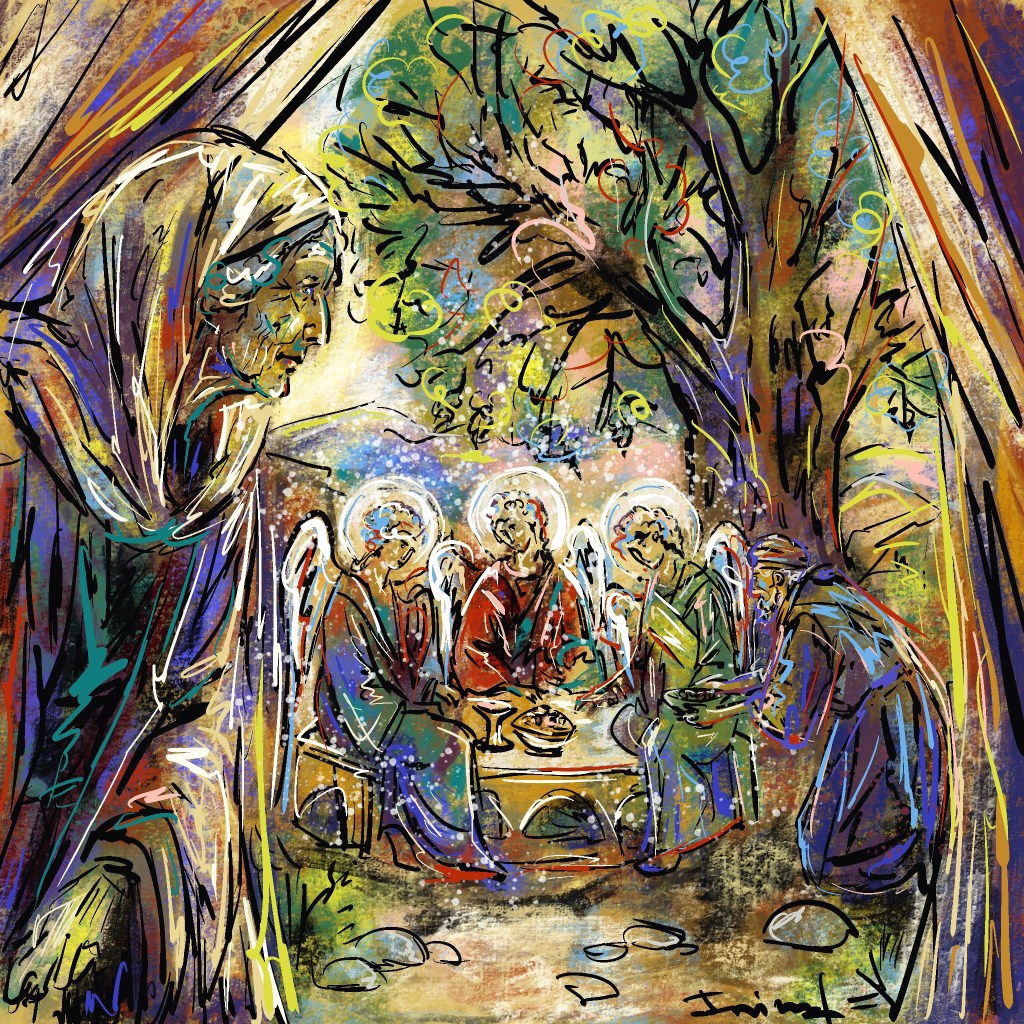
The visitors arrive unbidden and so they wait for an invitation, though Abraham is culturally bound to welcome them. The letter to the Hebrews will later say, “Do not neglect to show hospitality to strangers, for by doing that some have entertained angels without knowing it.” (13:2) The scene became central in iconography as an image of the Trinity represented by three angels. Abraham addresses them at times as three and at times as one. He bows before them, offers water for their feet, rest under the tree, and a feast that includes a whole calf and bread baked from twenty-four litres of flour. Yes, Abraham is a generous host, but it is Sarah who bakes all that bread! God’s presence here arrives through the doorway of human hospitality.
Sarah is listening from the entrance of the tent, standing on the threshold of a future she cannot yet see. Finally, the promise becomes much more concrete: not someday, but within a year she will have a son. She is almost ninety years old. She has made peace with her life, perhaps bitterly and perhaps peacefully by turns. And she laughs. “After I have grown old, and my husband is old, shall I have pleasure?”
While the word “pleasure” suggests delight and enjoyment, it may express either wonder or sarcasm. Perhaps when Abraham hears, “You will have a son,” Sarah hears, “You will carry a pregnancy to term, go through childbirth, nurse a baby every two hours night and day, worry about illnesses, chase a toddler, and deal with a teenager, all beginning at ninety years of age.” At half her age, I would not want to do any of it now. When I think of my grandmother and many parishioners in their nineties, and of the effort required simply to get through a day of standing, walking, eating, dressing, remembering medication, and managing pain and fatigue, the proposition sounds ridiculous.
Perhaps Sarah’s laughter is not disbelief but an honest recognition of what new life would cost. Abraham was delighted, but he would not be the one doing most of that work, just as he was not the one who baked twenty-four litres of flour into bread. Sarah is afraid, and God rebukes her, yet allows her to preserve the memory of that moment in the child’s very name. Imagine calling out every day: “Laughter, come here.” “Laughter, time to eat.” “Laughter, go to bed.” That is why Sarah says, “God has brought laughter for me; everyone who hears will laugh with me.”
Sarah’s story belongs to everyone who has ever thought, “This is all there will be,” and laughed, not because something was funny, but because hope seemed impossible. As such, the story should not be reduced to a fertility miracle. In real life, not everyone who longs for a child receives one. Some have children and still experience loneliness. Others outlive their children. One of the deepest griefs many older people describe is not physical decline but no longer having around them those who knew them longest. Children do not exist merely to solve loneliness, help us in old age, increase social status, or make life worth living. So Isaac is not the miracle itself, but a sign of it.
Just as the rainbow is the sign of God’s covenant with Noah and the stone tablets are the sign of the covenant with Moses, Isaac is the sign that God’s future is larger than what we can see from inside the tent. Standing at the entrance of her tent, Sarah cannot see Isaac, Moses, David, Mary, Jesus, Paul, or the Church. Yet God already sees the whole story. As the letter to the Hebrews says, Abraham and Sarah “died in faith, not having received the promises, but having seen them and greeted them from afar.” They never saw descendants as numerous as the stars, nor did they possess the land beyond the burial place Abraham purchased for Sarah. Even their family life remained marked by conflict and misunderstanding, as when Hagar and Ishmael were sent away and Abraham nearly murdered Isaac, believing that it was what God wanted.
The same is true for us. We often misunderstand God’s purposes and mistake our own plans for his. Yet God continues to correct our course while guiding us toward a fulfilment that extends beyond this life. Meanwhile, as John’s Gospel reminds us, the Word became flesh and “dwelt” among us—or, more literally, “pitched his tent” among us—even as our bodies age, relationships change, familiar worlds recede, and eternity draws nearer. So perhaps the invitation today is simple. Standing at the entrance of our own tent, let us give thanks for what we have, name what seems too late, too unlikely, too difficult, or too strange, and acknowledge that we cannot see the entire road ahead. Then let us remember the promise we proclaim at Christmas: Emmanuel, God is with us.
The miracle in this story begins not with the birth of Isaac but with the opening of a tent. Abraham and Sarah made room for strangers, and grace entered with them. The Church, too, lives in a tent. We cannot see very far ahead, yet God continues to arrive at the entrance in the form of strangers, neighbours, and unexpected guests. In the Gospels, God appears among people to eat and drink, sometimes providing abundance himself and at other times receiving hospitality from others. Every time we welcome another person, we make room for God. At the Eucharist, we do the same. We bring bread and wine, set a table, and receive the sign of the new covenant in which all God’s promises are gathered together. As we gather for our parish picnic this afternoon, may we continue that same holy practice of making room for one another, trusting that God often arrives through the ordinary gifts of food, conversation, and community. And may our own laughter, even when it begins in weariness or disbelief, be transformed into the laughter of those who discover that God was present all along.
 Irina's Art
Leave a Reply