
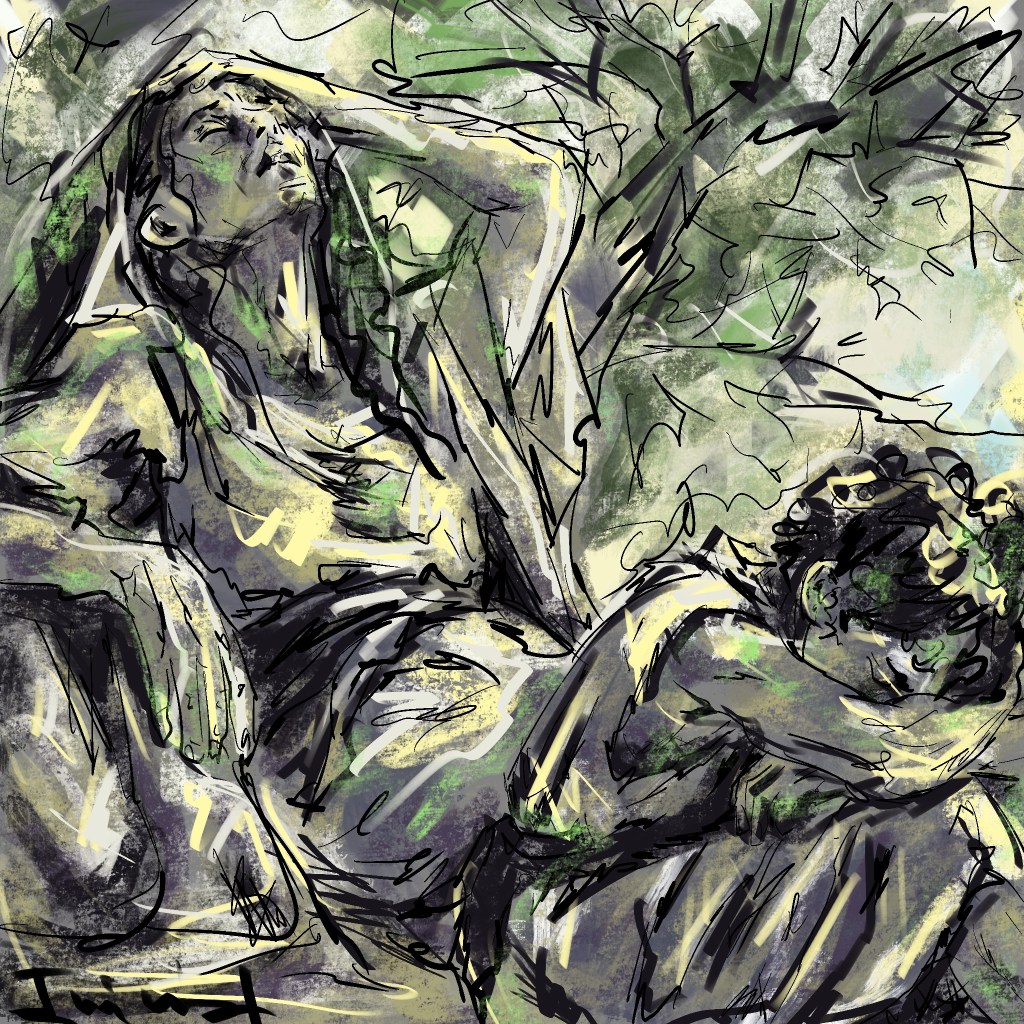
This week’s reading from Genesis 21:8–21 tells the heartbreaking story of Hagar and Ishmael, cast out into the desert with little hope of survival (click here to read the text). This is certainly one of the texts that I began to hear very differently with age and parenthood. Previously, I noticed the theological themes of promise, deliverance, and divine intervention. I learned about the historical origins of Israel in Isaac and the Arab peoples in Ishmael. But when I re-read the story this week, I found myself focusing on what I had largely overlooked before: the terrible finality of the moment when Abraham places a skin of water on Hagar’s shoulder and sends her away with no indication that he ever expects to see her or the boy again, and a mother watching her son collapse from thirst in the wilderness. This time, I found the story unbearable.
Perhaps that is because, as we age, we become increasingly aware not only of suffering itself but of all the suffering that never needed to happen, both in this story and in the world around us. There was always enough love for both boys, enough dignity for both women, enough room in God’s covenant for more than one race and one nation. Yet people acted from fear rather than trust, scarcity rather than abundance, then and now. Whether we are talking about treaties broken, nations oppressing nations, churches behaving primarily as institutions rather than as mystical bodies, propaganda, scapegoating, political movements, or personal relationships, much human cruelty begins with the conviction that there is not enough: not enough resources, money, land, recognition, value, power, influence, or future. And it results in the recurring temptation to make inconvenient people disappear. These are the connections worth considering as we observe the National Indigenous Day of Prayer.
Yet before we arrive there, the story of Hagar raises another important point: it is not always easy to identify a villain. Abraham is remembered as an exemplar of faith, yet he repeatedly accepts arrangements from which he benefits, while allowing the women around him to bear the consequences. Twice he saves himself by placing Sarah in situations that expose her to terrible danger. He raises no objection to using Hagar’s body both to secure an heir and to serve as his concubine. It is Abraham who hands Hagar and Ishmael the skin of water and ushers them out the door, even though it is Sarah who demands that they be sent away. Yet Sarah’s own life has been shaped by grief, infertility, disappointment, and insecurity. The women become rivals not because they were destined to be so, but because patriarchal systems frequently place them in competition with one another, and prevent them from seeing one another as allies. Sarah is constrained by that system, yet she possesses power over Hagar. Hagar, meanwhile, bears the greatest burden as a woman who is also enslaved and foreign.
We sometimes ask why the Old Testament is so brutal. However, I wonder whether Scripture is less concerned with presenting God’s unknowable essence than with revealing human nature, whose shortcomings we know all too well. Abraham and Sarah deceive and oppress others. Their grandson Jacob deceives his brother in order to gain an inheritance. Jacob’s sons sell Joseph into slavery and lie about it. Moses commits murder. David commits both adultery and murder, and later fails to seek justice for his daughter’s abuse. The disciples abandon Jesus, and Peter denies him.
In my opinion, the authors who preserved these stories often attempt to explain human actions and historical events by attributing them to God’s will. Ancient Israelites explained military victories, defeats, and even genocide through divine favour and judgment. Early Christians interpreted the crucifixion through the language of sacrifice and salvation presumed to be required by God. Paul instructs slaves to obey their masters, the author of Timothy instructs women to be silent in church, and Leviticus condemns sexual relations between men – all to counteract the perceived threats to what was understood to be the God-ordained social order. Even Genesis 21 frames Abraham’s decision to send Hagar away as an act of faith in God’s promise to make a nation out of Ishmael. I think that the Scripture is a record of human beings attempting to understand their world, institutions, and suffering, as well as to understand God.
Humans encounter mystery, pain, joy, guilt, beauty, and transcendence, and then try to describe what those experiences mean. Scripture is therefore less a divine instruction manual and more a record of humanity wrestling with enduring questions: Who is God? Why do we suffer? What do we owe one another? Where can hope be found? These ancient stories continue to resonate because humans still compete for security, status, belonging, and recognition. Women are often encouraged to judge other women rather than challenge the systems that diminish them. Communities define themselves by excluding those who complicate their vision of the future. Families protect themselves at the expense of their most vulnerable members. We tend to define ourselves against others and blame those who harm us without examining the conditions that produced the conflict in the first place.
This theme feels especially relevant this month as we observe both the National Indigenous Day of Prayer and Pride Month. Throughout history, societies have repeatedly attempted to solve their problems by pushing certain people to the margins. Indigenous peoples were displaced in various parts of the world, but countless European peoples were also repeatedly conquered under new empires occupying the same lands. Jewish people were seen as a threat. Unwed mothers were hidden away so their children could be adopted for profit. The British poor were exploited in workhouses and child labourers were sent to Canada. Queer people were criminalized and pressured into conversion therapy. People with disabilities were confined to institutions. The refugees and the elderly, the children with behavioral challenges, and many others are seen as unproductive members of society. Different eras choose different people. The mechanism is often the same. A story is created that makes certain people less fully human and ignores the image of God within them. Society convinces itself that life would be simpler if those people simply disappeared. In Argentina, desaparecidos actually became the term for thousands who vanished during the military dictatorship in the 1970s. Earlier in the century, under Stalin’s regime, the number reached into the millions, including members of my own family. Even this week I heard the same language applied to people reported missing in Iran. But what strikes me about Hagar’s story is that the narrative refuses to let her disappear.
Abraham and Sarah send her into the wilderness. The household forgets her. God does not. God does not remain exclusively in the tent of the powerful and follows Hagar into the desert. Indeed, Hagar is the first person in Scripture to give God a name: El-Roi, “the God who sees me.” In Islam, Hagar and Ishmael occupy an even more prominent place than they do in the Bible. Hagar is brought with Ishmael to the region of Mecca, where her search for water becomes associated with the sacred well of Zamzam and eventually with the origins of pilgrimage. Interestingly, the Quran also places Ishmael rather than Isaac at the centre of Abraham’s near-sacrifice.
Although the details differ, both traditions transform the place of abandonment into a place of encounter and revelation. And at the centre of that revelation stands a remarkable detail. God does not create a well but leads Hagar to discover the water that was already there. In fact, most biblical miracles are not the creation of a new reality but the revelation of a reality that already exists. The disciples discover there is enough bread. The travellers to Emmaus suddenly recognize the stranger who has been walking beside them all day. What changes is not the world but our perception.
That insight connects with some Indigenous spiritual perspectives, which emphasize that all creation is alive with the presence of the Creator. In Christian theology, the doctrine of creation out of nothing eventually became dominant, but Genesis itself begins not with absolute nothingness but with the tohu va-bohu—the formless void—and the tehom, the deep waters over which God’s Spirit hovers, possibly made out of God’s own being. Some theologians have therefore suggested that creation is not something entirely separate from God but something continually formed of and sustained within God’s life. Eastern Christian traditions distinguish between God’s unknowable essence and God’s energies, in which all creation is able to participate. Sacramental traditions, including Catholic Jesuit and Anglican theology, emphasize that ordinary material reality can reveal divine presence. Every atom, every creature, every person exists because it participates in God’s life. This leads to a different understanding of salvation as well.
Salvation is not primarily God changing God’s mind, deciding not to punish humanity, or devising a backup plan after human failure. Rather, salvation is the unfolding of God’s original desire for creation, present from the beginning: that none should perish and that all should come to life, that chaos should turn into order. Hagar’s deliverance does not occur because God suddenly becomes compassionate in the desert and makes a well for her. God was compassionate all along, and the well existed before she arrived there. Perhaps that is what salvation is. Not a new reality descending from heaven, but our hearts awakening to the reality that has always been present: the God who sees us, the people who love us, and the sacredness woven throughout creation.
The same may be said of our view of other people. The image of God within every person is already there. The stranger does not become Christ when we treat them kindly. He already is Christ. The marginalized person does not suddenly become worthy of love. They always were. What is often missing is our ability to perceive it. When we mistreat others, perhaps it is because we fail to recognize the divine image within them. Sin, then, is not merely the breaking of rules but a failure of perception.
Sin is mistaking scarcity for abundance, rivalry for kinship, possession for stewardship, appearances for reality. Sarah sees Hagar as a threat. Her household sees a future in which there is not enough status, inheritance, or security to go around. Abraham sees a problem to be solved. The disciples on the road to Emmaus see only a stranger. The religious and political authorities see only a criminal hanging on a cross. We spend so much of our lives acting from fear, convinced that there is not enough, and that those whom we consider “others” are less worthy of our care and lack the dignity that should be rooted in the Image of our Creator, present in all. Yet the gospel continually invites us to look again. To open our hearts to a reality larger than our immediate perceptions. To question our assumptions about what is enough.
Five loaves become enough to feed a multitude. Water becomes wine. A father has enough love for both sons. The kingdom has room for unexpected guests. Even a desert contains a well. None of these gifts are newly created. They are finally recognized, received, and embraced. There is love enough for all. There is God, closer than we imagined, waiting to be acknowledged. And perhaps the task of our faith and the ethics that we derive from it is learning to refuse to let anyone disappear beyond the boundaries of our concern, recognizing the humanity of those we have been taught to regard as rivals, and trusting that even in the most desolate places, there may yet be water beneath the sand.
 Irina's Art
Leave a Reply